This review page is supported in part by the sponsors whose ad banners are displayed below |
 |
 |
|
 |
Reviewer: Srajan Ebaen
Financial Interests: click here
Source: Esoteric UX-1, Yamamoto YDA-01, Ancient Audio Lektor Prime, Raysonic Audio CD228 [on review]
Preamp/Integrated: Esoteric C-03 (transistor), ModWright DM 36.5 (valves)
Amplifier: Octave MRE-130 monos with SBB, Metronome Technologie MT One [on review]
Speakers: ASI Tango R, Zu Essence
Headphones: Audio-Technica WHT-1000, Beyer Dynamic DT880, AKG K-1000, Sennheiser HD800
Headphone amplifier: Yamamoto HA-02, Woo Audio Model 5 with EAT 300Bs, KingRex HeadQuarters [on review]
Cables: Complete loom of ASI Liveline
Stands: ASI HeartSong [on review], Ikea Molger with butcher-block platforms
Powerline conditioning: 2 x Walker Audio Velocitor S
Sundry accessories: Furutech RD-2 CD demagnetizer; Nanotech Nespa Pro; extensive use of Acoustic System Resonators, noise filters and phase inverters, Advanced Acoustics Orbis Wall & Corner units
Room size: The sound platform is 3 x 4.5m with a 2-story slanted ceiling above; four steps below continue into an 8m long combined open kitchen, dining room and office, an area which widens to 5.2m with a 2.8m ceiling; the sound platform space is open to a 2nd story landing and, via spiral stair case, to a 3rd-floor studio; concrete floor, concrete and brick walls from a converted barn with no parallel walls nor perfect right angles; short-wall setup with speaker backs facing the 8-meter expanse and 2nd-story landing.
Review Component Retail:
€3,500/pr
within the EU, certain offsets to be expected due to different VAT rates
|
What happens when one marries Italian design flair and fine wood working with Chinese driver know-how?
One answer will have to be Pearl Evo's Ballerina range of open baffle speakers. With drive units by HiVi Research Swans*—ribbon tweeter, 50mm fabric dome midrange, Alu/Mag alloy woofer—plus Italian manufacture and R&D, it fits our profile to the 'T'.
|
|
|
 |
* • The HiVi iso dynamic RT1C-A tweeter combines a Kapton membrane with aluminum traces over ca. 90% of its 50 x 13mm surface suspended between two rows of Neodymium bar magnets. An aluminum mounting flange with flared wave guide controls the frequency response and directivity of the tweeter. The clamped membrane area is connected to the front metal plate. Combined with a special heat conductive compound, this provides effective cooling of the aluminum conductors. The tweeter is magnetically shielded and only 18 mm deep including the mounting flange. Its sensitivity is 94dB, its recommended high-pass >4500Hz.
• The HiVi DMN-A runs a 50mm/2" hand-treated fabric dome with two big Neodymium rings in a vented design with a large non-resonant acoustic chamber inside an open plastic frame for effective cooling and a detachable back cap for critical flat-mount applications. The DMN-A is 91dB efficient and rated for power handling of 108dB peaks. Its resonant frequency is 800Hz, its recommended bandwidth >800Hz to <9000Hz.
• The HiVi M8A uses a gold-anodized Magnesium Aluminum alloy cone with Conex spider, Kapton voice coil former and underhung voice coil in a long-throw design mounted in a die-cast aluminum basket. Recommended crossover frequency for a 2-way speaker is 1-2kHz. Fs is 33Hz, sensitivity 88dB.
I first encountered the PearlEvo brand at the Milan Top Audio Show 2009 where the entire Ballerina range was on display. It stretches across four models. They are differentiated by the use of one dome (as shown) or two then in a d'Appolito array mated to either an 8-inch or 12-inch woofer. This nets two three- and two four-driver 3-ways with smaller and bigger woofers and scales up what is otherwise very similar performance to rooms of progressively larger size.
|
|
 |
Unlike the kind of cosmetically challenged open baffles whose guts of driver backs, magnets and wiring hang out to dry and in plain view, PearlEvo designer Silvano Cremonesi bestowed on his Ballerina 301 and its larger siblings a sufficiently thick, shapely minimum two-tone baffle to completely conceal the shallow tweeter. The dome only shows a cleanly encased bullet end. The woofer presents an enclosed canister ported out the front. This enhances bass performance from a small driver over typical open-baffle figure 8 cancellation at omni-radiated frequencies. All wiring runs invisible below the black baffle insert. For a box-less speaker concept, this is as clean as it gets.
|
 |
|
|
|
Related large planars and electrostats always suffer stability problem when their broad but very shallow plane meets some variation on an L bracket on the floor. PearlEvo neatly circumvents that with their heat-curved multi-laminate D frame. What's involved in its manufacture is chronicled succinctly in export manager Andrea Calabresi's photos to require little commentary.
|
 |
The first steps involve cutting, then bonding the 25 wooden sheets in cross-fiber orientation.
|
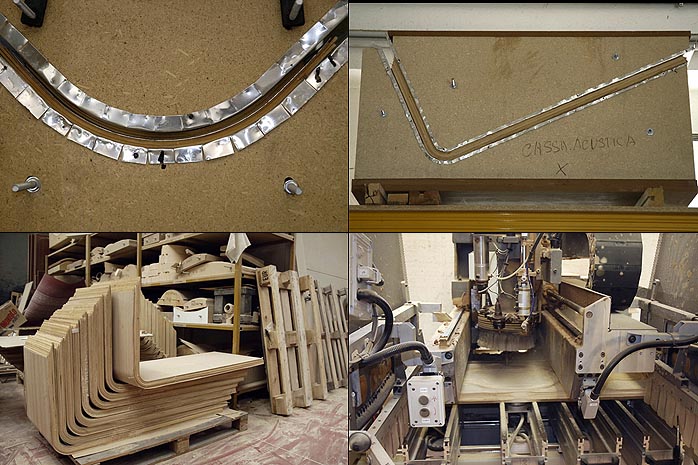 |
Specific sections that undergo heat treatment are subjected to a molding process in which custom jigs press the steam-softened wood into the desired shape.
|
|
|
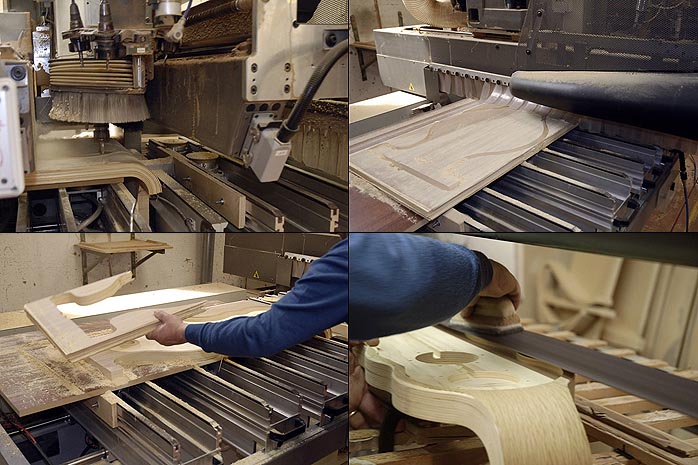 |
After heat bending, the L blanks need to be shaped by router, then receive the cut-outs, recesses and channels required for the drivers and their wiring.
|
|
|
After various hand finishing steps not shown—including the manufacture of the baffle inserts—the final product is rather more attractive and labor intensive than what most open baffles with dynamic drivers offer. Considering the work involved, the pricing begins on the low end with €3.500/pr for the 301-8" under review. The 401-8" sells for €4.200, the 301-12" for €4.700/pr and the top 401-12" for €5.700.
|
 |
 |
 |
|


