This review page is supported in part by the sponsors whose ad banners are displayed below |
 |
 |
|
 |
In my mind the quality of Ocellia's cables is a given and rare combination of resolution, tonal richness and accuracy with speed and dynamics. As my review developed over the months, a number of readers contacted me afterwards to share their experiences and satisfaction with purchasing one or more cables from Ocellia. Especially with cables that can be so system and component specific, I always find it reassuring to know of others who seem to hear the same enhancements I did.
That said, I felt the need to revisit this topic and tie up a few loose ends, one of those being the matter of static build-up on transducers and the benefit of draining those away through a ground connection.
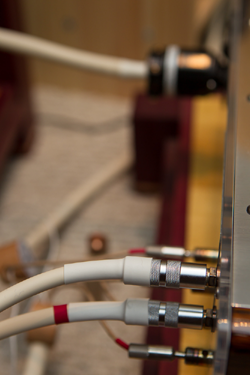
When I reviewed Ocellia's speaker cables I mentioned a third connector that allows linking the metallic woofer basket to ground. I was not able to test the effect of those connections since my Zu Essence do not easily allow me to reach inside their cabinets.
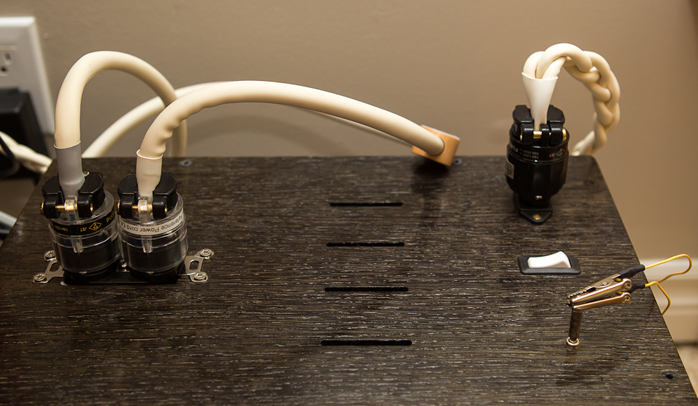
A few weeks later I was lucky enough to spend a day with Samuel Furon in his Montreal atelier. His system included both a power transformer designed with a ground connection pin as well as a pair of Calliope .21 wired to enable static charge drain to ground.
With this setup testing the MDI hypothesis that static charge on a transducer can be heard as a slight midrange harshness was a breeze. All we had to do was disconnect the static drains from ground for a minute while playing music to let the charge rebuild; then reconnect the drains to the transformer. |
|
While not huge, the effect was easily heard and similar each time. Let the membranes charge, reconnect the cables. The music seems slightly more free, some midrange congestion goes away, the tonal colors become slightly more intense and the upper midrange gets smoother. It’s not a wow type effect but I don't think anybody would doubt its existence if listened to carefully.
|
 |
|
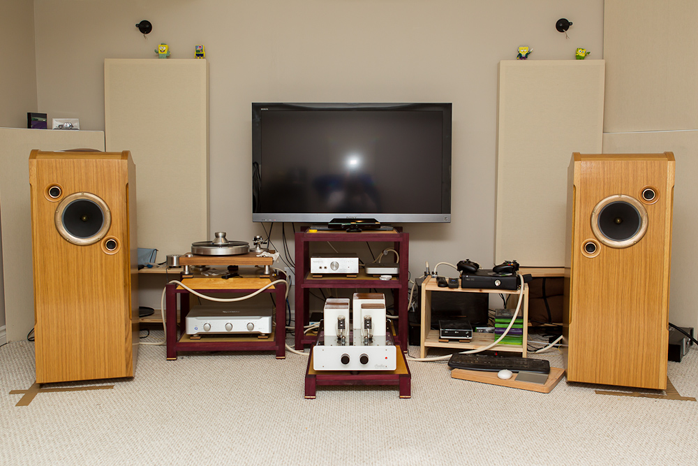
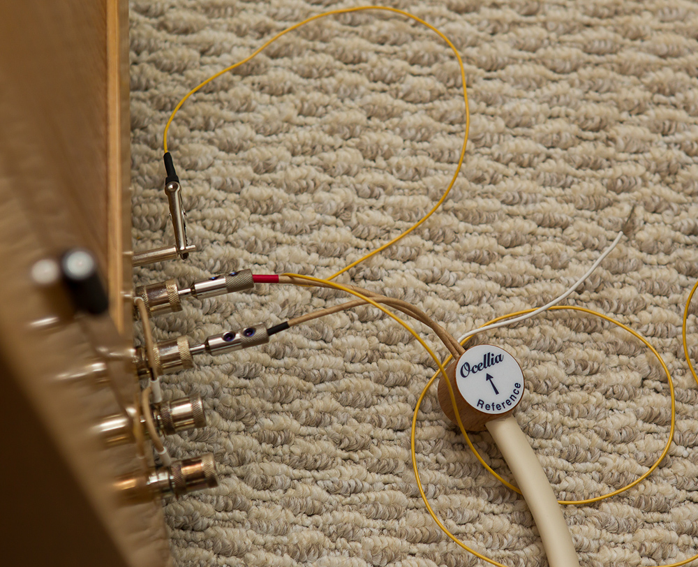
For the past three months though I have been even luckier in the sense that I listened to a full Ocellia system in my home set up and fine-tuned by Samuel Furon as he does it for any customer within driving distance from Montreal. The full system review is forthcoming. What matters here is that I was able to replay the same test at my place to obtain the exactly same effect each time. Charge up the membrane with music signal, connect the drain and suddenly the music opens and frees up subtly but in a very repeatable manner. It was not a trick played on me at his place or due to different listening conditions.
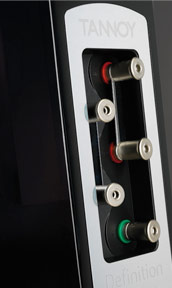
One may of course wonder whether the bronze basket and natural rubber surround of PHY drivers are unusually sensitive to this phenomenon. Perhaps so. I cannot really test the theory on other speakers so these two incidents shall suffice on the topic but if one owns Ocellia speakers, the effect is obvious and beneficial though not dramatic. Simply make sure the drain connects to system ground. It is pretty much a free upgrade and not unlike what people expect from upgrading a $1000 interconnect to a $5000 one. You can't beat the return on investment on this one! [Certain Tannoy speakers sport a 5th binding post for this very grounding purpose - see green one at right– Ed.]
|
|
|
|
|
|
A second topic to revisit was due to a few emails from puzzled readers about bass reproduction and the persistent reputation that Ocellia cables lack bass. When it comes to their interconnects the answer is a resolute “no way!” Whether I compared the Ocellias to Zu Varials, my primary ASI Liveline references or a few other cables I own, they offered the highest quality and quantity bass of any on hand. There is no excess but these interconnects provide depth, weight, tunefulness, resolution and speed that for me sets a new reference. I don't know if they would triumph over mega buck cables costing more than a small car and I don't really care. When it comes to their price range, they are simply the best I know of unless one needed a strongly colored cable to offset a specific system weakness.
|
 |
When it comes to their speaker cables the answer is a little more complex but in essence comes down to the same thing. If you aren’t looking to compensate for a weakness elsewhere, the Ocellias don’t lack in any way. I keep remembering the Zu/Ocellia demonstration of last year’s Toronto Audio Show. Replacing the Ocellia speaker cables with a very famous brand indeed delivered more bass but it was somewhat bloated and poorly defined - simply too much uncontrolled bass.
Similarly to what I wrote in my review of the ASI Livelines, the Ocellia speaker cables do not add anything (though compared to the ASI they do offer a little more meat on the bass bones with a richer more nuanced midrange) and that can be initially disturbing. All it takes then is to attend a few acoustic concerts to be reminded of what true bass sounds like. It’s neither hard and overpowering nor mushy and slow yet both extremes are what is often the case in systems that are either out of tune or poorly voiced.
|
|
|
Cables should never be used to balance a system and the Ocellias will let you know if your system is imbalanced. Despite their extreme sweetness and tone realism they hide nothing. There’s no sugar coating or chilly sauce in the oyster omelet as Gary Koh of Genesis likes to say. The pure and simple truth is that if your oysters are past their prime, the Ocellias will let you hear the ugly and all yet in a well-balanced system they provide a beautiful window on the recording with a realism that remains unmatched by anything I have heard to date including Audio Note.
|
 |
More on that in the full system review. For today listen to their cables for a first taste of the Ocellia house sound. Should you not get sufficient bass, start questioning which of your other elements are the limiting factor. It certainly won’t be the cables, no matter what the Internet rumor may say.
6moons rarely bestows cable awards because results are so often system or component specific. One of the exceptions were the ASI Livelines where many of us consistently heard similar results in vastly different systems to confirm that the qualities described transferred from system to system and weren’t due to unexpected isolated synergy.
Today we don't have the benefit of similar cross examinations although Srajan can vouch for the qualities of the first generation. Hopefully testimonies will build up over the coming months to confirm that these cables are very special indeed, inherently more musical and delivering transparency, dynamic and tone of the highest quality all at a price that is not completely unreasonable considering the pure silver conductors and entirely manual assembly. |
 |
 |
 |
|
Samuel Furon's Canadian atelier's website |
 |