This review page is supported in part by the sponsors whose ad banners are displayed below |
 |
 |
|
| Octave HP300SE | Nagra Jazz. This €5.500 German line stage (add €850 for phono) with single 12AU7 driver and 6922 follower combines 50Ω output impedance with 10Hz-200kHz response at -1.5dB, gain of 12/19/25dB and a S/N ratio of -108dB in low-gain mode. The XLR inputs see a differential summing opamp whilst the XLR outputs are transformer-coupled like the Jazz. Closer inspection reveals Octave's brilliant specs to rely on a chip-based output buffer and 22-35dB of NFB depending on gain. |
|
|
|
 |
Valve purists might scoff at the hybrid transistor outputs and the liberal use of negative feedback. They should recall that Octave's amplifiers are specifically designed to deal with low-impedance reactive speakers to be exclusively push-pull pentode and thus feedback by design. Octave demonstrates with big Dynaudio, Triangle Magellan and other burly boxes beyond the reach of most valve amps and which would be a virtual death knell to nearly all zero-NFB SETs. That makes for an altogether different design ethic and— one shouldn't be surprised to learn—also a different type of sound.
|
|
|
| But the core difference to the Nagra Jazz had less to do with audiophile sound items on the usual checklist and all with gestalt. Obviously speakers only deal in the acoustic transmission of electrical signals. They care nothing about abstract human concepts. Listener response is due to what's in that signal. It simply appears that some very important responses to hifi playback aren't confirmed yet by collaborative measurements. I'll thus talk of the audible effect, then briefly theorize what caused it. The Jazz was fluid, elastic, outgoing, effervescent and aerated. It had swing. Breath. It was generous and vibrant. Gushing. The HP300SE embodied a Victorian woman. In her fishbone corset she moves with very conscious poise whilst taking very shallow breaths. Musically things were rigid, stiff, drawn inward and dry. There was very clear and audible exertion of control. Its byproduct was simply a squelching of the Nagra's elasticity. |
|
|
Yet nothing was wrong or objectionable about the sound per se! In fact listeners majoring on high-output wall-of-sound type power music would probably not at all relate to my description. But take for example Miguel Poveda's last track from Coplas del Querer. Here the singer is backed by massive string orchestra and solo violin. That oceanic soaring of expertly recorded strings had a very different singing quality which I imagine even lovers of amplified music would key into. And that bel canto gestalt was the vital differentiator.
|
|
|
What caused Nagra's buoyancy and freedom of expression? Valve outputs without a transistor buffer? Much lower feedback? Here designers who have strategically isolated effects of specific circuit choices must chime in. Asked what audible attributes created or contributed to the effect, I'd point at more elongated decays and their connective tissue and as such perhaps results of lesser damping. When I experimented with foam-filled acoustic corner traps and first-reflection sidewall absorbers, the effect was quite similar. Reduction of HF reflections killed off vital energies. Textures dried up. The sense of free breathing restricted. Once I removed these treatments, musical freedom returned and suffocation lifted. I understood that at least in my setup these treatments did something very different than damp unwanted bass energies. Hence my theorizing that this change of musical gestalt was directly related to an electronic facsimile of my long since abandoned acoustic damping attempts. The Nagra sounded like a reverberant room, the Octave like an overdamped one. Or think resonant tonewood soundkaos speaker versus an inert aluminum Magico. The latter's popularity reminds us. None of this is absolute. It merely reflects different design approaches and their associated sonic ideals.
|
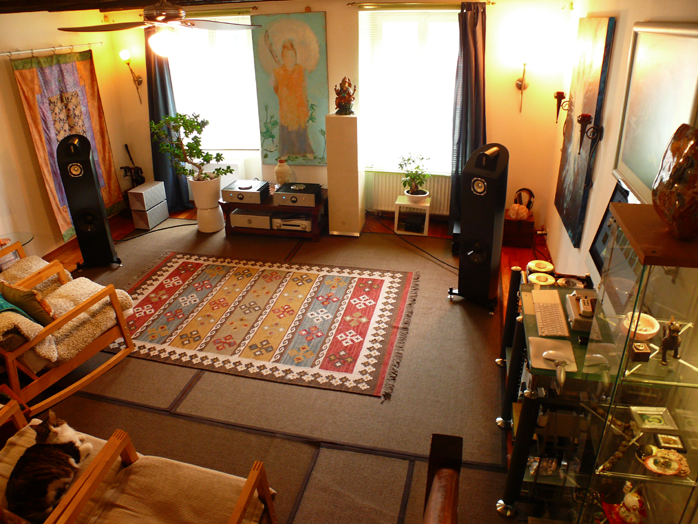 |
with Aries Cerat Stentor speakers
|
To reconfirm that the Jazz bears little semblance to the firm's previous house sound, Frederic Beudot on staff wrote in after being emailed how the Jazz surprised me given expectations from its PL-L predecessor. "I agree. Their new stuff is head and shoulders better than the previous generation. Like you I found their gear too warm and plush except for the small solid-state phono preamp I reviewed a few years back. It had enough dynamics to be interesting whilst keeping a lot of Nagra's richness of tone. I heard the Jazz a few weeks ago. I really liked what I heard. It replaced an older Nagra at a friend's and lit up his whole system without losing the charm. I was impressed!" Back on usage items, Octave's feedback-generated gain changes took about 10 seconds of output muting to manifest. The Jazz could be switched from 0dB to 12dB and back on the fly. This was one more demonstrator of its featurization practicality.
|
|
|
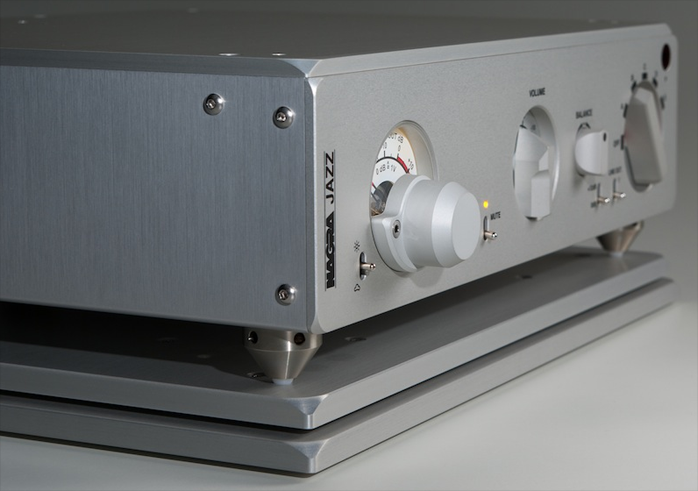
Conclusion. New wine in old skins. That's what Nagra's Jazz is all about. It's the same long-loved looks with a new modernized sound. Of eight preamps on hand—ModWright, TruLife Audio, Thrax, Octave, Esoteric, Wyred4Sound, Bent Audio passive—the Jazz competed at the very top of the resolution game played on bandwidth, low noise and drive. It then added a finely measured dose of tube aroma which didn't infringe one iota on its resolution but added the type of nuanced texturization which our hifi vocabulary points to with words like suppleness, fluidity and succulence. Finished flawlessly, it is enhanced by an ultra-responsive remote that offers very fine volume gradations whilst adding balance and input switching. And the machine is fitted with just the right connectivity features. Audio Technology Switzerland's Nagra Jazz thus bodes exceptionally well for the company's restructured future under its new ownership.
|
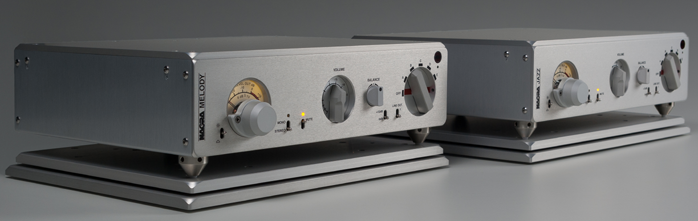 |
the next of the new crop - Nagra's solid-state Melody
|
By eye traditional, by ear pointing in a bold new direction, Nagra's Jazz is a bridge product. It should appeal to the established clientele and a new audience who perhaps never before considered the brand because like yours truly and Frederic Beudot, they assumed its sonics were too plush and tuned for comfort rather than thrills. I never expected it but with my SET-like transistor amps, the Nagra Jazz truly thrilled me. Hence consider this writer—and perhaps Nagra too?—an old dawg who just learned a terrific new trick. Live and learn? You bet. Let's never get too old for that...!
|
 |
 |
Quality of packing: Top shelf.
Reusability of packing: Many times.
Ease of unpacking/repacking: A cinch.
Condition of component received: Flawless.
Completeness of delivery: Perfect.
Human interactions: Good but slow as is typical for the Swiss.
Pricing: Costly as you'd expect from a luxury brand but highly competitive on sonics.
Website comments: Present state not commensurate with either product or brand.
Final comments & suggestions: If technically feasible—it's probably not or it would be there—I'd love to see both RCA and XLR outputs usable simultaneously to accommodate purely balanced amps like NCore monos with a subwoofer. I'd also like to see a center detent for the continuously variable balance control. Finally I'd like to have the power supply's umbilical to the Jazz exit on its rear next to the IEC power inlet so that the front merely shows the red LED; and add a power mains switch to the PSU so its power LED doesn't remain on indefinitely unless unplugged from the wall.
|
 |
Audio Technology Switzerland website |
 |
 |