This review page is supported in part by the sponsors whose ad banners are displayed below |
 |
 |
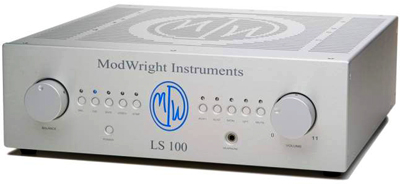
ModWright LS100 | Nagra Jazz. Nagra's metal work is an obvious cut above the excellent LS100 by which ModWright at least to these eyes had established somewhat of a price reference already. But the rather costlier Jazz brought to the table more than just a pretty face and finer bone structure. In the most real-world of terms, its all-there ability at low levels was superior. Hearing literally more with less signaled higher resolution. Men shopping for cars routinely engage in test-drive behavior that's alien to their usual driving style. They go faster, accelerate harder and—if testing a 4x4—hit off-road terrain they'd never dream of if the vehicle was their own. Likewise for hifi auditions. At unrealistic levels men hit taiko drum spectacles, cannon-shot overtures and other Rubicon Trail excesses which put a shop system under duress in ways which home living with others abutted by neighbors would never create.
|
 |
The Jazz can do all that with ease. But compared to remaining fully present, palpable, intelligible and involving at the subdued and subtle end of the scale, loud and bombastic is very primitive beginner's stuff. As the ModWright demonstrated, going quiet equates to smaller, clumped together, clouded over and trading tonal and textural variety for progressively more and more homogenized sameness. That's a perfectly normal result of throttling back dynamic range. The very fine very quiet parts fall below the event horizon. |
|
The Nagra obviously followed the same inescapable trend of turning down the volume. But not only did it delay its onset, it didn't suffer the same extent of shrinkage and obscuration. By starting out with a higher S/N ratio, the Jazz retained more of it when the loudest-to-quietest scope was strategically squeezed like tooth paste. The LS100 got flat and empty sooner.
This greater magnification power and separation of the Jazz expressed itself also in the tone density domain. The LS100's slightly fuzzier and thicker meatier expression was less teased out and articulated. This reflected directly as a subjectively smaller sense of venue scale and dimmer stage lighting. With its fatter tone the LS100 gave up some definition and illumination. Simultaneously it played somewhat looser. The one area in which the ModWright undeniably exhibited 'more' was bass power or weight. Here it has routinely outdone previous challengers. This comparison was no different. I'd not call the Jazz under-endowed by any stretch. I'd call the LS100 hung a bit like a horse.
|
From this comparison my takeaway was, never mind vaunted Swiss manufacturing finesse and advanced finishing chops. Those arguably aren't primary sound contributors. They'll be of little importance to budget-conscious shoppers. Very compellingly Nagra's Jazz also demonstrated the same finessed sophistication sonically. Where I'd found the earlier PL-L somewhat of an older man's toy—think echoes of the aural pipe'n'slippers aesthetic—the Jazz felt decidely younger and fresher. It was in fact more vigorous than the ModWright. Whilst making it look traditional as always, the designers of the Jazz really did overhaul and modernize the PL-L platform. As first evidence of the brand's renaissance presently underway, to me the new team at Romanel-sur-Lausanne surely seemed exactly on the right track!
|
|
|
|
|
|
TruLife Audio Athena | Nagra Jazz. After my review of the Grecian preamp I'd asked designer Velissarios whether he'd ever listened to it with a transistor amp. He hadn't. This didn't surprise me. Whether as suspected it was his choice of 6H30 or not, on transient focus, cutting power and textural dryness the Athena was decidely more transistory than my solid-state Esoteric C-03. Though I could well envision truly copasetic synergy with a somewhat fatter less incisive bandwidth-restricted valve amp where the Athena would become welcome degreaser and accelerator, with superior transistor amps of FirstWatt SIT-1 caliber the same qualities became somewhat excessive. Within my resident stable of loudspeakers, Athena's sword did wonders however with Sven Boenicke's mostly omni B10. Their horizontally opposed sidefiring 10-inch woofers/midranges deliberately enhance a room's reverberant field. This makes for a naturally redolent dense farfield-mixed sound. For my long-wall upstairs system anchored by these compact speakers then the 6H30 linestage became my top choice mated to a SIT-2 stereo amp. Like with fine wines whose connoisseurs recommend specific foods to best complements them, proper matching of electronics and speakers is key for artful results.
|
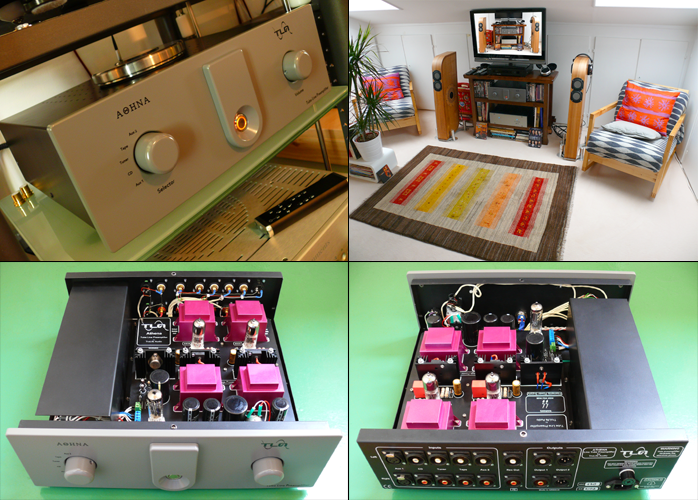 |
Back downstairs against the Nagra and same SIT-1, Athena's encounter proved short-lived for the same reasons as before. Whilst the 12AX7 and 12AT7 which the Jazz champions aren't necessarily known for textures—here the 'big-tone' 6SN7 has the reputation—they trounced the 6H30s in the Grecian implementation. The latter were comparatively strident, glassy and dry. At least with transistor amps not deliberately voiced to emulate tubes like an ARS Emitter, Nagra's very fluid highly resolved Jazz was the far better match. Triangulating against the LS100, I could now clearly verbalize their positions relative to my bigger system. Where the TruLife Audio was overly transistory to push the presentation too deep into the cool and edgy, the ModWright very gently erred on the other side. The Jazz nailed the golden middle and added the most responsive remote volume control to also walk off the winner on the interface smarts. The latter would repeat itself for the next comparison.
|
|
|
|
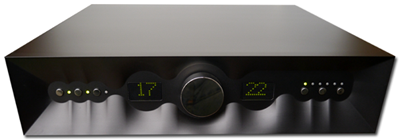
| Thrax Audio Dionysos | Nagra Jazz. At €15.000, this single-stage 6N6P preamp with 6C4P-EV rectifier runs a transformer volume control with only 23 steps below unity gain. Add a high-output 4V balanced source and amps of 1V or higher input sensitivity and this gets too loud far too quickly. Thrax's own discrete R2R DAC thus outputs only 1Vrms and their amplifiers offer strategic 2/4V input sensitivity adjustments. |
 |
|
|
 |
This obviously broadens their pre's useful range to be just right. Conventional high-gain systems simply are unceremoniously left out in the hot as it were. Given price I'd call that a serious flaw. Not only is Nagra's volume taper far more gradual, the 0dB gain option offers further 'grey-zone' expansion to increase the breadth of attainable intermediate values. In the real world that's not only practical whilst opening the doors to modern hi-gain sources and amplifiers plus high-efficiency speakers. It's a must! Not being able to reach the exact desired volume is like an automobile jumping from 0 to 10 to 20km/h. Good luck parking it.
On other tech the Dionysos is fully transformer-coupled on all i/o ports which include two each XLR. Like the Jazz, its mixed outputs unfortunately cannot be run simultaneously. |
|
Positioned within €2.800 when one fits the more affordable Jazz with its optional input transformers, Thrax and Nagra competed as sonic equals with one discernable core difference. The Thrax was the more lit up and piquant on transients. The catch-all term for this truly broadband behavior was crystalline. At least in popular perception it equated to a greater transistor flavor. Though applied subtly, Nagra's mild texturization expressed classic valve virtues. If textures are what has folks gravitate to a tube preamp in the first place—an entirely sensible rational—the Dionysos strips them away. It quite literally acted like a superior impedance-compensated passive. Yet my autoformer volume passive Bent Audio Tap-X in its admittedly very drab enclosure beat the Thrax functionally with 61 discrete attenuation steps at one fifth the price*.
_____________________________________________________________________________________________
* For another experiment I connected my Metrum Hex converter via XLR and RCA to both preamps to learn how its offset in output voltage (XLR is twice as high) would shift/expand their volume control ranges. Imagine my surprise when switching inputs on the Jazz caused zero signal interruption. With a very small time delay the music simply got slightly louder (XLR) or quieter (RCA). I don't know who'd ever appreciate that in practice but I saw it as another example for how Nagra's engineers really do sweat even the smallest of details.
|
| A smaller difference between Dionysos and Jazz was the latter's greater weight in the bass. If this were the Wild West, the Thrax might be called the quicker draw for its highly crystallized slightly stark behavior. That also made it leaner. Nagra's contours were drawn with a slightly softer-tipped pencil. This expressed itself as fluffier or gentler whilst the Thrax was hyper focused and sharp. On raw detail capture where audiophile perception would grant the costly Bulgarian volume control the theoretical advantage over Nagra's far simpler motorized resistive pot, I discerned no appreciable performance delta. On guitar tremolo close to the bridge, the Platinum content of the Thrax treble was higher to create the usual illusion of more detail but listening closely only saw a different handling of the transient edge. |
|
|
In this comparison the prior spend-more-get-more ascent had hit a wall. Between €10.700 and €15.000 things no longer moved up. Now they went sideways into two equally valid flavor choices with very similar basic hardware functionality. Whilst I loved the split numerical display of the Dionysos, I much preferred how the Jazz actually handled its volume. In the final analysis the Nagra sonics also suited my transistor power amps better.
|
 |
  |
 |