This review page is supported in part by the sponsors whose ad banners are displayed below |
 |
 |
|
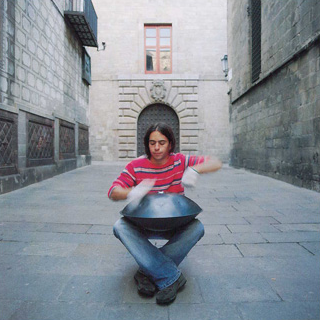
Next up was Llama by Ravid Goldschmidt and Silvia Perez Cruz. This recording takes us to Barcelona and more specifically its Barri quarter. Ravid plays a novel instrument called hang as the only accompaniment for Silvia’s voice. It was this instrument which first triggered Todd whilst roaming the streets of old Barcelona; and then of course its performer. Israel-born Ravid ended up in Barcelona after a pilgrimage. In this magical Catalonian city he met Silvia during a concert. When Todd ran into Ravid and discussed recording him, Ravid insisted that Silvia participate.
Though reluctant at first, Todd was convinced after hearing the beautiful voice of singer/saxophonist Silvia Perez Cruz. As an instrument the hang is like an inverted steel pan with a bottom where a sound hole turns it into a Helmholtz resonator. With the hang the Swiss inventors of this instrument created a rare new acoustic instrument. One plays the hang with the hand and/or fingers and not mallets like a steel drum.
|
|
|
Recording one is no easy task. The sound is rich in overtones and spiky in intensity. Overloading a microphone is simple when it's too closely placed. Just as powerful as the hang is Silvia’s voice. On the CD of Llama overload approach occurs here and there. On the DVD this is absent. The higher bit rate copes with these sonic explosions far better and also softens the sound to make it more organic. Recorded at a chapel in Barcelona, the venue just adds a little space around the already reverberant hang while it softens the voice of Perez Cruz. While one would imagine that an all-hang recording would be a bit tiring, Ravid Goldschmidt brings to bear a variety of playing techniques that keep all tracks appealing.
|
|
|
Completely different in style and recording is the Swedish jazz trio around Mathias Landæus. With Opening the trio follows in the steps of other Nordic jazz musicians like Norway’s Tord Gustavson. They all play very lyrical pieces not unlike the best parts of Keith Jarrett improvisations. Todd recorded the trio of Mathias on piano, Palle Danielson on bass and Jon Fält on drums in a real recording studio for a change, one of the Swedish Radio. Also different from his other recordings is that this one was done using 5.6MHz as the sampling rate. It is incredible what a $2.000 Korg recorder like the MR-2000 can do in the hands of a well-seasoned producer! On the DVD the trio not only plays some Landæus compositions but also standards. What makes this recording outstanding are its dynamics. When played at live levels, the Steinway really sings and Fält’s drum kit is not of the card-box kettle variety but has real skins and brass cymbals and the bass is big and woody. While the choice of music may be a bit broad in style for a single recording, as a live event it has style and class. We don’t own the ‘low res’ version of this recording but there is no doubt that it won’t have the quality of this 24/176.4 rendering. For now this recording is our new jazz trio reference.
|
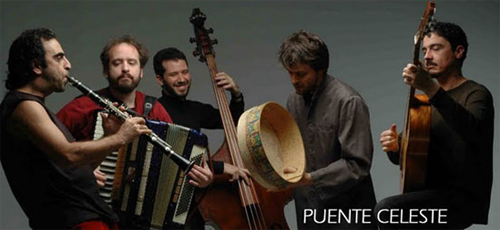 |
Another superb hi-res recording in 5.6MHz DSD is Nama by Puente Celeste. After the Será una Noche adventure percussionist Santiago Vazquez put together this group to play world, jazz and even pop music all flavored in an Argentinean style. Todd recorded the group in a large hall of the Goethe Institute in Buenos Aires which is why the sound of the group lacks his signature acoustic reverb. |
|
Without it the sound is even more intense if also more straight forward. This begs for higher playback levels and when attained the live feeling is complete. For the DVD the 5.6MHz master is downsampled to a respectable 176.4KHz with a word length of 24 bits. Only the visual cues betray the fact that the band is not really in the room. Dynamics are great and the five musicians are nicely placed between the loudspeakers. For now this album is our new world music reference.
|
|
|
|
 |
All these hi-res recordings outscore their low-res siblings by a significant margin. Tranquility, ease of reproduction, superior dynamics and airiness define the differences. There's no doubt which sampling frequency wins hands down: 176.4kHz. 24 bits are more than sufficient, the theoretically superior 32 bits unnecessary. Todd Garfinkle’s choice of DVD ROM carrier gets our highest recommendation over downloading. The fastest Internet speed in Holland at the moment is 80Mb/sec. Mind you that's mega bit not byte and only reached when all partners in the uplink—server to home plus everything between—maintain that speed. In theory it takes 10 minutes to download a 4GB album at 6.4MBytes (8 bits to the byte). In practice it takes longer. Until we get a faster Internet, the physical DVD carrier seems best. Given this we ask Todd and all other well-meaning music producers to henceforth make their original recordings available in 24/176.4 DVD files whenever possible.
|
|
|
|
 |
 |
|
 |