This review page is supported in part by the sponsors whose ad banners are displayed below |
 |
 |
|
The only practical way is to experience a lower concert pitch of an existing recording. This can be done by slowing down your playback. If you slow down the record by 1.818% the result is an 8Hz lower overall pitch. However the tempo of the performance has been slowed down too. A better solution is to use software to lower the recording's concert pitch. Once again only the pitch is lowered. The rest is still the 12-tone musical interval system and equal temperament of today. What we are basically looking for then is a studio harmonizer. A harmonizer can correct a singer or musician playing out of tune to put 'em back on track. Unfortunately the use of harmonizers in modern music has become standard practice rather than just a stop gap for one or two notes that went south.
|
|
Various software players like Foobar offer plug-ins that can lower pitch but they're a bit of a hassle. A fare more user-friendly option comes from Belgium's Klinktbeter. Their name literally translates as Soundsbetter (klingt besser in German). Proprietor Frédéric Vanden Poel happens to be a fervent 432Hz evangelist. He thus offers streaming hardware that's already equipped with 432Hz transforming options. Most of today’s streamers are basically computers. Many of them run some form of Linux OS. With Linux being a standard, it's possible to add applications or plug-ins which by themselves can be used in combination with various hardware platforms.
|
|
|
|
Frédéric adds that "we tried the tempo/pitch adjustment of the Foobar Soundtouch plug-in some three years ago. Using this led us to the conclusion that micro detail and spatial cues clearly degraded. Some music sounded out of tune; acoustical instruments like on the first Vayo Con Dios album got outright bad whilst on electronic music the effect was not that obvious. Using the pitch method was not an 'audiophile-grade' option so we adopted the current method of lowering pitch as well as tempo in conjunction.”
|
|
Klinktbeter currently offers two ready-to-go 432Hz capable streamers, the SOtM sMS-1000 and the in-house developed Klinktbeter 432evo. Both run the same operating system, Fedora Linux with the same 432Hz conversion plug-in. For our review we received a SOtM sMS-1000U streamer with the 432 plug-in and the matching SOtM DAC. The link between the two SOtM devices was by USB. The Klinktbeter 432Hz plug-in makes it possible to switch on the fly from standard to lower-pitch playback. SOtM is one of the few manufacturers who endorse open source support to the max. Hence no proprietary sneaky secrets. All is open for adjustment, thus the happy plug-in option. Part of the sMS-1000's software is the VortexBox Media server software. That's what the plug-in hooks into. Another big plus for the SOtM is the possibility to process just about any format you can think of: up to 24/384 PCM and DSD128 in AIFF, WAV and FLAC for lossless and ALAC and MP3 for compressed.
|
|
|
Easy control over the functions is via tablet or smart phone. The heart of the streamer is the MPD music player daemon, hence any MPD compatible client will do the job. We downloaded Auremo to our iPad which worked within seconds after the SOtM got hardwired to our home network. To asses the SOtM sMS-1000's capabilities we first compared the standard player to our other two streamers. One is based on the Devialet AIR, the other is built around the La Rosita Beta. Both use a wireless connection to an iMac and offer a proprietary plug-in for iTunes. The difference with the SOtM is that the music source loaded on the internal hard drive to eliminate extra connections, be those wired or wireless. The SOtM however can also use a NAS as music library and the connection then is via cabled Ethernet.
|
|
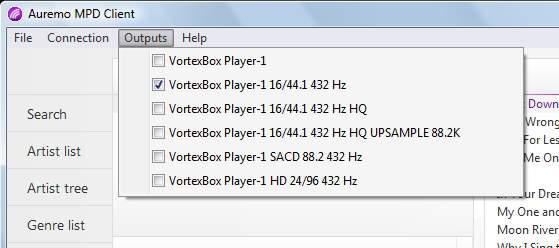
From our relatively short comparison between our three options which involved serious system reconfigurations, we found that the SOtM outperformed the Devialet AIR on detail and tone decays to far more resemble the La Rosita Beta. With an idea of what the streamer did relative to our more familiar machines, it was time to engage the 432Hz option. The Auremo MPD client gave us access to the various setting of the 432 plug-in via the tab Outputs. Here you can select the standard player as we did before plus the five Klinktbeter options. Standard Redbook 16/44.1 fare can be retuned to 432Hz as can Redbook HQ source material. You can upsample to 88.2kHz. SACD is handled at 88.2kHz and 24/96kHz files may be used as well. We however did not find a DSD64 or 128 option. Frédéric: “The SOtM sMS-1000 can, when the MPD software is updated to do so, handle DSD 64 and 128 via either DSD over PCM (DoP) or internally decode it to PCM. Unfortunately decoding of DSD in combination with our 432 plug-in overloads the Atom CPU of the SOtM so we refrained from offering this option. However our own 432evo streamer with its more powerful processor can fully handle DSD.”
|
 |
  |
 |