 |
|||||||||||||
| The layering equation clearly demanded classical music again, hence another xrcd recording to the rescue: Sir George Solti's inspired reading of Stravinsky's Rite of Spring, remastered by Alan Yoshida at Hollywood's Ocean Way JVC facility, from the 1974 Decca session in Chicago's Medinah hall [JVCXR-0225-2]. The work's original title was actually Vyesna Svyashchennaya, Sacred Spring or The Coronation of Spring. However, Bask's French translation of Sacre du Printemps stuck and the first riotous performance, on May 29, 1913, at the Théâtre des Champs-Elysées under Pierre Monteux and Nijinsky's choreography, has, like Merlin, become the stuff of legend. A further tie-in? The Russian/Slavic heritage shared between Igor Stravinsky, painter Nicolas Roerich who helped the composer with an action summary of the various movements, Diaghilev who commissioned the ballet, Nikolia Tolstoy's 1985 book The Quest for Merlin, and the Russian skomorokh and volkhvy druid and bards. | |||||||||||||
 |
|||||||||||||
While the degree of row-counting ability was remarkable, the Bel Canto PRe6's more Apollonian mien actually kept the individual threads of the two major theme cords, spaced apart by just a semi-tone and with a minor seventh added to the second, more distinctly individuated. It thus offered a higher degree of separation resolution, something that suggested lower intrinsic noisefloor which was verifiable by comparing both preamps under no signal while opening their attenuators. What, again, proved a far more powerful differentiator was the enlarged dynamic scale of the Merlin and its superior grunt during the famous tympani beats. They plainly moved more air and, like the mortar rounds during the French attack on the British-held fort in Michael Mann's Last Mohican, displaced more dust upon impact. Stravinsky's hugely exploded orchestral head count and heavy reliance on woodwinds and brass over strings made it child's play to investigate timbral accuracy, from bass to regular B-flat and miniature E-flat clarinet; oboe d'amore and standard oboe; traverse flute and piccolo etc. While the textural element already observed was still in evidence, it did not audibly alter harmonic content and thus timbre, or the overtone signature of each instrument. What measurable parameter was responsible for this texture I don't know - but it was different from what's traditionally thought of as wet versus dry since the PRe6 clearly isn't dry but rather, very airy. The well-oxygenated glow of skin after a workout is the closest image that comes to mind. It doesn't suggest coloration although, as tends to be the limitation with most similes, skin will turn more pink with increased blood flow. Rather, think a sense of a slight swelling or puffing accompanied by a perception of larger size, not physically but in the radiated aura and hence presence of such a person - or here, the sonic equivalent. |
|||||||||||||
| Neil Andersson's recent solo album Ç'est si bon on Pearl Django's Modern Hot Records label [MHR007] was a great test for Merlin's swing factor, that delicate rhythmic domain which different components recreate to different degrees of head-boppin', foot-tappin' inspiration. In a subtle fashion, the transistor unit's crisper leading edges and lither overall character emphasized the beat element we call 'hard' when something swings - well, hard, tight, propulsively on edge. Here the Merlin was a mite more relaxed, jamming not quite as furiously. The bard didn't sound slow, mind you, just not quite as energetic. On balance and true for all music played, I enjoyed both presentations, appreciating their differences, not responding to them with any sense of lack but rather, experiencing them as different strengths that didn't telegraph parallel weaknesses. | |||||||||||||
 |
|||||||||||||
In hindsight, that's exactly as it should have been, in any comparison of well-balanced statement components that don't take interpretative liberties but, like the best of conductors, manage to show you new aspects of familiar works, sans wholesale reinvention but by revealing different perspectives, underlying strata of moods, conceptual connections of minor themes and rhythmic elements. The question now became at what material cost - $3,800 for the BCD unit versus $6,000 for the distributor-direct Merlin without phono [add $500 for phono]. The preamp from Minneapolis is packaged with truly sophisticated remote functionality for which a smaller firm like Klimo tends to lack the software coding and micro-processor expertise. I had just shipped back my Bel Canto eVo 200.4 for a board upgrade to latest Gen4 Tripath incarnation and can't directly report on the otherwise de rigeur tube pre/transistor power match. However, it's easy to predict that many owners of slightly lean, fast while dynamically a bit restrained systems would go ape over the finely tailored additive qualities of the Merlin. |
|||||||||||||
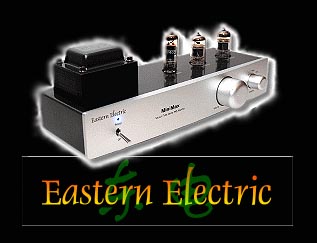
How much more would $4,800 buy you over the overachieving $1,195 Eastern Electric MiniMax - besides the additional input, tape loop and punishment of diminishing returns? This question turned out harder to answer since the little contender from Hong Kong is exceptionally responsive to tube rolling - as is US partner/ importer Bill O'Connell about suggesting appropriate valves and personally providing them. Discounting the various tonal flavors thus achievable, the MiniMax in de-romanticized guise came uncomfortably close to the German in most areas except two where Merlin enjoyed clear and uncontested advantages: Dynamics and bass control. In general, MiniMax is voiced more overtly lush but can be leaned out to abscond with any overt thermionic glow and voluptuousness. Due to the Klimo's massive power supply, it owned large-scale voltage swings as well as the current required to control large bass transients. |
|||||||||||||
 |
|||||||||||||
| Another area of smaller distinction occurred in the treble where the exploded bandwidth of Dusan's circuit gave away nothing to sand-based designs except for not speaking the language of glare, brittleness and hardness. Again variable with the choice of valves, the small extent of upper treble softening in the MiniMax can be minimized but, likely as a function of inherent circuit limitation, will never approach Merlin's ultra-sonic reach. Depending on the remainder of the system, particularly the HF behavior of source and speakers, this treble subject can turn either way. Because of system synergy concerns and general contribution to listening enjoyment, I deem this particular difference small in magnitude and, depending on the listener's bandwidth which could be restricted to 8kHz, possibly entirely insignificant. Which now trims Merlin's chief advantage to dynamic scale and the associated weight that comes with it, as well as superior ability to maintain tautness and damping factor with challenging, high-mass low-frequency content. Someone not hip to High-End audio's inverse logarithmic scale of dollars-for-progress would react in disbelief at this assessment. He'd conclude that only someone completely hair-brained, thick-skinned or fat of wallet would even consider braving the $4,800 step necessary to get into the no-compromise end game. Admittedly, this particular fiscal gulf vis-à-vis the actual sonic advances does appear more drastic than usual. It's primarily because the Merlin -- dare I repeat it -- lacks hi-tech remote functionality which, considering how good MiniMax is, would have to also include input switching, mute and balance to spread the difference around. |
|||||||||||||
 |
But there's another angle which will turn the tides for the right kind of listener. Do you fancy the heightened emotional musical involvement which invariably is directly proportionate to a system's ability to render realistic dynamic range, imbued with the necessary rise times to instantaneously jump from 30 to 95dB? This demand -- combined with the requirement to own speakers that actually know how to respond in linear uncompressed fashion to dynamic shifts -- this demand then transforms a smaller quantitative difference between preamps into a far larger qualitative one where musical impact and thrills are concerned. And while it's perhaps trite to say, a component that's as emotionally trigger-happy as a Hollywood gunslinger caricature is somewhat priceless. |
||||||||||||
| This is not some facile attempt to justify costs in High-End audio. It's merely a reflection on how components significantly dearer than Merlin can leave one emotionally completely cold. And unlike a good Frigidaire, frigid HiFi's not a good thing. It's also a reflection on how the emotional element of music reproduction is the most elusive of the bunch, the one we all hanker after but often do without. Perhaps the word 'priceless' in that context makes more sense? What remains to be seen is how the Klimo Merlin with outboard power supply would fare against one of Conrad-Johnson's lesser ART units or BAT's latest VK-50SE. Perhaps some other reviewer will cover that ground. For now, I'll leave you with this: Dusan Klimo's Merlin Plus is a sonically very modern valve preamp that focuses its harvest of tube-typical expectations on the capacity for fast and massive voltage swings; textural warmth which is different from harmonic warmth; and welcome weight and displacement that turns the rendition more Dionysian. Especially in low-level circuits, valves are susceptible to raising the noisefloor. While my Bel Canto balanced transistor preamp is likely one of the measurably quietest units on the market, Merlin's designer clearly knows his craft and has made his preamp remarkably silent for a tube piece. During its stay, the Klimo piece suffered zero practical complications except to note that engaging stand-by should be done after engaging mute or you'll be exposed to a considerable speaker transient. Fit'n'finish was truly first-rate, the cool elegance of the piano gloss lacquer without any frontal mars of logo or silk-screening very attractive, the green cat eye barely visible at day light. Those who automatically relegate valved components into the colored camp would need to heavily rethink their assumptions here. While its fashionable to consider tubes first and foremost in THD terms of harmonic distortion, their real strengths in fact lie exactly in the areas this review described. This makes the Klimo Merlin Plus into a front-row example of its breed. |
|||||||||||||
Incidentally, like the BMW motorcycle boxer engine, it's also an example that finds itself at the evolutionary end of numerous iterations that have refined the basic Klimo topology over the last two decades. I shall miss this magician whose only lacking trick in his stacked book of charms and spells was the wireless wand. Returning to my opening question about more finely aged aural wines, I wasn't too far off. However, the underlying implication of superiority was unwarranted. Returning to the PRe6 didn't at all feel like a cheaper glass of wine but rather, the difference that room temperature makes. A chilled wine is more refreshing, drier yet sparklier; a slightly warmed wine seems a bit thicker, heavier and fruitier - texture. Neither is inherently superior but appropriate for different occasions and different accompanying food. And that imagery seems as accurate as I can concoct in conclusion, hinting in fact at two different wines rather than dissimilarly aged versions of the same. Cheers! Flip to the next page for Dusan's informative reply. |
|||||||||||||
 |
|||||||||||||
 |
 |
||||||||||||
 |
|||||||||||||