This review page is supported in part by the sponsors whose ad banners are displayed below |
 |
 |
 |
The Amphion and Dayens monitors soundstaged just as grand. So will pretty much any competently designed monitor set up properly. The Amphion went slightly lower in the bass. Here statement monitors from JMlab to Magico will all exceed the Kiso farther still. Where the HB-1 jumped tracks into mostly uncharted territory—the Micropure Kotaro would be one very notable exception I've heard—was that within the expectedly exploded soundstage individual sounds grew bigger. That wasn't because they were unnaturally pumped up or scaled out of proportion for 10-foot guitars. It's because they exuded more vibrancy. This finally gets us to the very heart of the matter. To present itself did require more than background levels however. This signature quality kicked in fully only at room levels and higher. It became less and less evident as SPL reduced. In the desk-top nearfield where I do my work and thus only use music for atmosphere lest it become intrusive, this effect didn't emerge at all. Hence here the HB-1 held no real advantage over the standard 3-inch two-way Tizo I customarily use.
One could speculate that the Kiso design relies on a certain intensity of cabinet action to telegraph as intended. Perhaps. I'll leave speculation to others. I simply observed how once it came alive—and that's really the operative term—the clearly drier more contained mechanical atmosphere of the prior probably more linear Amphion was suddenly replaced by this freely breathing gushing organic radiant quality.
|
|
|
|
|
|
It's this radiance which made the HB-1 sound so bodacious juicy and humongous, not the staging typical for all monitors. Because this full-scale effect included the bass, its clearly limited extension was very cleverly concealed. Even if one knew what was missing, it tended to get forgotten easily. Radiance became senior or dominant. To clarify, this effect invoked the difference between an anechoic chamber and a reverberant acoustic. One is dry, the other resonant. On a feeling level, the former is constricted and small. The latter is free and big. I'm referring only to principle of course, not excess or actuality. Obviously the Kiso didn't really inject artificial reverb into the recordings. And yet this radiance of tone did bear a semblance to how reverb action so subliminal in magnitude as to become apparent only in its removal does clearly enrich the sound.
That then is the direct consequence of and rationale for the hyper-finicky laboriously particular construction of the HB-1. It's here where and how the Kiso sounds bigger than the competition. To repeat, this form of bigger does not mean wider or deeper soundstaging. It does not produce 8-foot singers. Bigger refers to more energy. It's not about the energy of dynamics or loudness. It's about how sounds feather out and blossom.
|
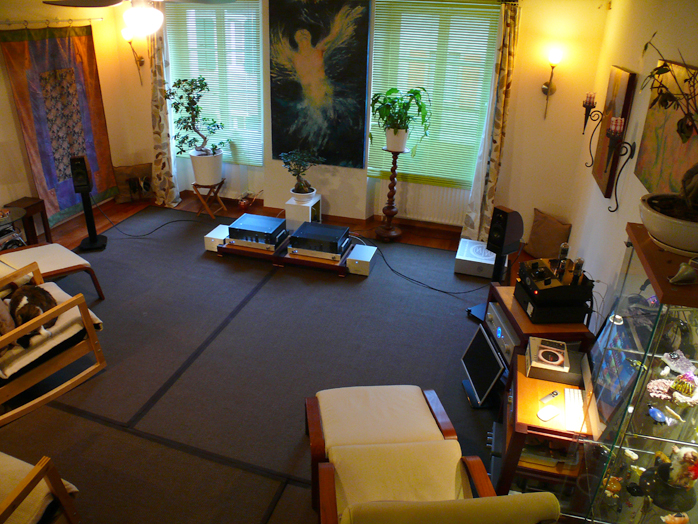 |
With Octave MRE130 valve monos and optional outboard SBB capacitor banks |
What exactly makes playback 'lifelike' is subject of endless discussions. Horn fiends champion ultimate dynamics. That's not the Kiso's special providence. Others cite infrasonic presence. That counts the Kiso out altogether. Another faction focuses on tone and timbre to often include valves. Here our attempt at defining exactly where the HB-1 excels gets warmer. If for you the Zu/WLM aesthetic equates to superior tone, the Kiso is still different. It neither carries their innate warmth and density nor their boisterous kicky dynamics. Far closer would be a PHY-HP-based thin-walled Ocellia though it's still not the same. But it's probably as close as I can come from my speaker acquaintances.
The practical upshot is that where physically small visually unobtrusive immaculately finished speakers are meant to produce big sound in large spaces, the little Kiso is a surprisingly effective and very valid proposition. It's simply not at its best at background levels. To get radiant and effulgent requires more sound pressure; nothing remotely uncivilized but slightly above where focused conversations remain meaningful. Beefy amps are a must too. To introduce maximum gravitas and mass at the expense of some treble illumination and litheness, moving from the $4.000 ModWright KWA100SE to the big 130-watt Octave tube monos with Super Black Box augmentation was the ticket. Of course this added another €15.000 to the bill but that's a given in the world which the Kiso and its most likely customers inhabit.
|
 |
I'd still not believe that any halfway astute listener could possibly mistake the HB-1 for the Emerald Physics if both were set up and I played from the vast majority of my software library. As team REL has demonstrated effectively many times, a properly integrated infrasonic foundation is relevant and audible as space and recorded ambiance even on material which apparently lacks bass to favor the Kiso. Just as true, most people have never experienced true full-range sound at home without suffering major room boom. That issue could well be mute. What's more, the Kiso doesn't create the problems infrasonic bass brings in the first place which then need fixing. If we figure that the target HB-1 customer probably has a stunningly decorated home but no audiophile compulsion or patience for complex solutions, that's really perfect.
If the HB-1 was priced more closely to the Micropure Kotaro—which most commentators found expensive already—I could well imagine how an effective marketing campaign in conjunction with plenty of live demonstrations at shows and dealers could make big Kiso waves. As is the only waves I see will ride on indignation, ridicule or disbelief over the sticker. This extends to the promoted stands.
|
|
|
Though it will, none of that ought to distract from the very real accomplishment at hand here. For sounds to blossom with the type of flourish they exhibit out of, with or through these very small but active LiveVibe enclosures is remarkable. It's truly something to behold and cherish. It's an example of taking a proven concept—here the Onkyo precedent—and pushing it to the max whilst removing any practical restrictions on cost. As 'one-up' proof of concept, it succeeds massively. As a viable sales object, it's just as massively limited. That part was clear when I accepted the assignment. Once I'd separated marketing spin and proud daddy perspective from reality however, the real surprise was seeing it actually deliver. This deliverance came not by way of beat-Physics puffed-up Superman antics but from a very trick and uncompromising exploitation of proven instrument-builder techniques.
Put differently so there can't be any misunderstanding, were I to quit professional reviewing tomorrow and settle down as Joe Private music lover, I could just as easily live with the Kiso HB-1 as I presently do with my ASI Tango R. That's not because the Kiso can do everything the Tango can. Not. It's because the emotional persuasiveness at the playback levels I actually use and with the music I favor plays out just as convincingly. For me especially large-scale classical is a sort of past life I visit rarely and opera doesn't factor one iota. I'm not into Rock or Rap and tend to prefer music that's scaled such that its performers could actually (or nearly) fit into my space were they physically present.
At the proper level and with the right amp and music, that emotional persuasiveness was what I did not expect. Here the li'l Kiso really did play as a far bigger (and very good) speaker. In summary, the HB-1 is different. It goes about making sound contrary to how 99% of box speakers pursue it. Those aim to kill the box and rear wave with mass, heroic bracing and composite hi-tech materials. The remaining one percent abandons the box and goes open baffle. Not as just a theoretical notion or a pretty but unachievable ideal, the Kiso instead embraces the box to make it sing. |
|
|
PS: Once the Spanish stands arrive, I'll pen a few additional paragraphs on how they impacted performance over Kiso's own Podium stand.
|
 |
 |
|
 |
|