This review page is supported in part by the sponsors whose ad banners are displayed below |
 |
 |
Monitor basics: For context, just a bit more ground remains to be covered. When introduced to a properly placed quality monitor system that can play the room, those used to only big speakers are routinely shocked. As a function of freedom from apparent sound sources, imaging is often superior. Soundstaging can be grander, holography spookier. Box talk reduces. Room-induced bass issues minimize. How less bass turns into less problems to improve midband resolution and lucidity combines with the psychological disconnect of having small speakers make positively huge sound. Transparency in the vocal and treble bands goes up. We seem to hear more to overlook reduced bass. And where human psychology tells us that two objects can't possibly occupy the same physical space, not seeing big speakers which to the eye obscure part of the soundstage where the ears place performers also becomes one less sensory conflict. Don't underestimate psychology here.
|
 |
All of the above
can become a reality check which prompts valid questions. Are big speakers really required? Are they even advantageous? As audio shows so painfully demonstrate, too much speaker for the room is a fatal but common mistake that even folks who ought to know better commit like clockwork. How big is big enough? What's too much?
|
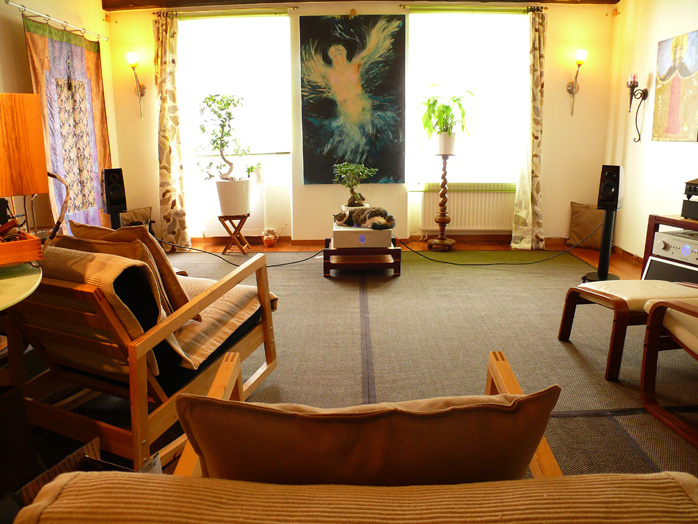 |
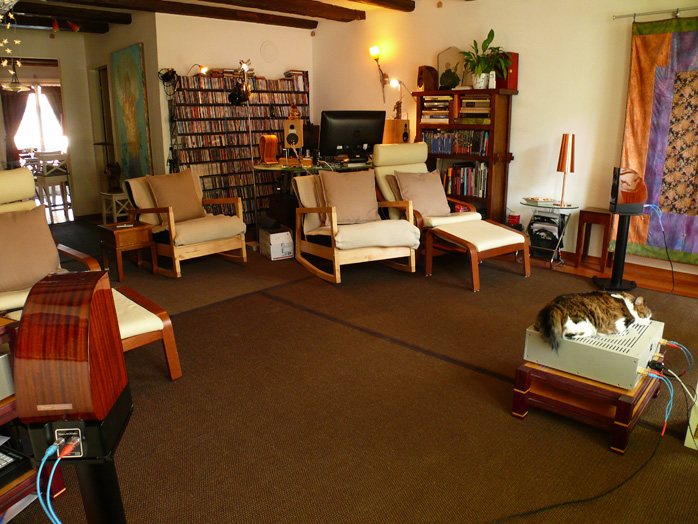
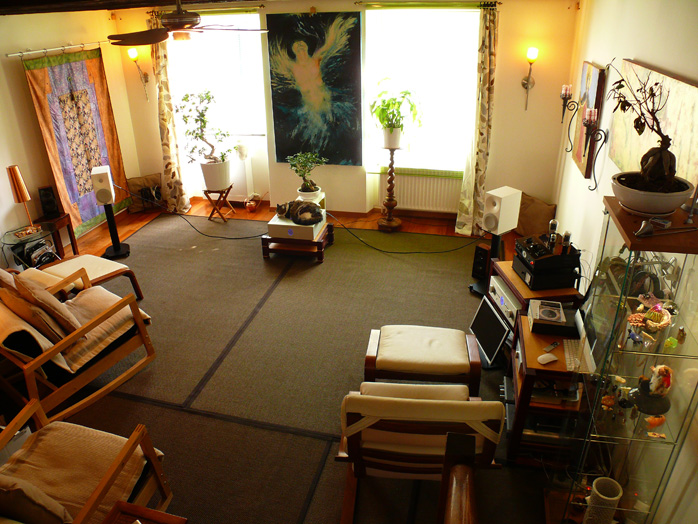
iMac, Burson HA160D/Weiss DAC2, ModWright LS100/Eddie Current Balancing Act, ModWright KWA100SE |
The flip side is that someone hip to a superior monitor system often unlearns how 50Hz from a 5-inch mid/woofer is really very different from that of a 10" or 15" dedicated woofer. Such folks also forget—or perhaps never experienced—what bass flat to 20Hz does for gut-level realism, soundstage depth and emotional scale. Admittedly linear extension to the lower limits of human hearing without messy room interference mandates sophisticated digital equalization. But here the revolutionary $3.000 Spatial software package with expert remote-access measurement and calibration takes care of that on the digital files directly (which means good-bye antiquated CD player and getting on with the future that's here to stay).
|
|
|
The point is, once you've experienced properly integrated 20Hz bass you never again dare suggest that bass quality (aspects like tone and articulation) are separable from quantity (extension, mass and dynamics). Bass quality and quantity are really two sides of one coin. Particularly at €13.800/pr a flatly missing octave cannot be justified as quality. For that investment customers and manufacturers ought to agree that you deserve to hear everything that's encoded in your pits, bits or grooves. Lastly, if one wishes to play loud, big speakers have superior dynamics. They also displace more air. This scores higher on visceral impact. Complex music with significant bass content tends to come off better with dedicated bass drivers than twin-duty mid/woofers. Those are endemic of course to the two-way designs that litter the monitor scene of which the HB-1 is a prime example.
|
 |
At the end of the day compelling cases can be made for big and small speakers alike. Much depends on room size, listening levels, what you want to listen to, your budget and your tastes. When keeping it real involves very small hyper-expensive monitors however, it's mandatory to admit that far cheaper bookshelf speakers will do all the typical show-off monitor soundstaging stuff too. That's the second reality check of these monitor basics. It doesn't take all that money to secure those qualities. For today the question becomes what's left purely in the audible realm (so we can eliminate cosmetics and intangibles like pride of ownership and luxury finishes) which differentiates or even outright distinguishes the extremist Kiso from a very affordable but well-engineered monitor like the €900/pr Amphion Helium 510 from Finland or the €880/pr (delivered globally) Dayens Tizo+ from Serbia? Those were two arbitrary options I had on hand. How would the Kiso prove demonstrably superior whilst bearing in mind that those models are far from their respective firms' best efforts?
|
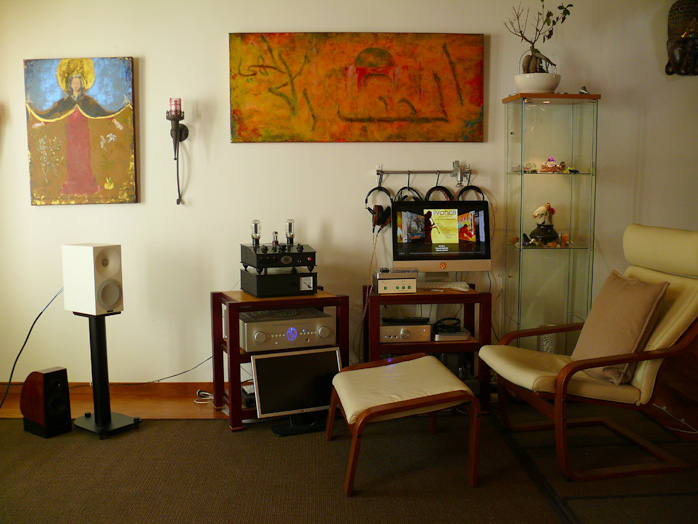 |
Amphion Helium 510 |
With due respect to Stig & friends I must now deliver what a particular type of customer will consider the fatal blow to the entire Kiso proposition. For their €13.800 the Spatial/Emerald Physics package I reviewed just prior to the Kiso buys one a complete front-to-back system with all the necessary cabling, preloaded MacMini, 1TB hard-drive, monitor screen, Blutooth mouse and keyboard, backup hard-drive, 4-channel preamp/processor, two quality stereo amplifiers of ModWright and Wyred4Sound caliber, dual box-less 15-inch woofers per side and—here comes the magic bullet—very comprehensive stereo near- and far-field measurements with surgically administered software corrections (speaker and room) accomplished by remote access to your music computer. This even includes follow-up software upgrades, reconfigurations and 10 hours of maintenance labor (additional hours charge $100/per).
|
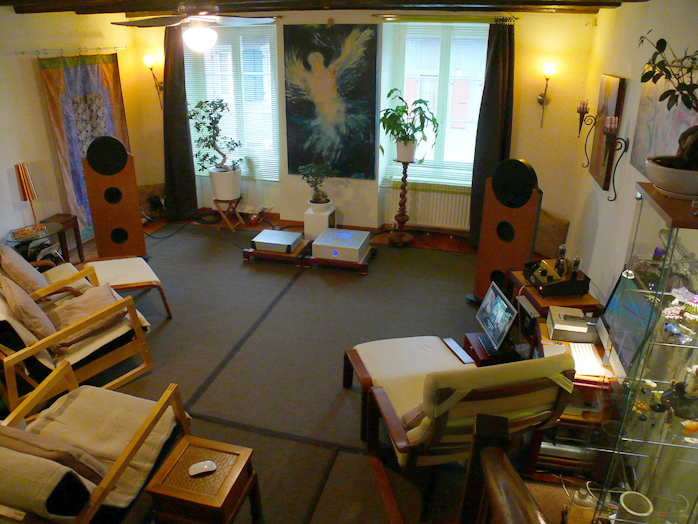 |
Emerald Physics CS2.3 system |
This groundbreaking protocol guarantees high-output 20Hz to 20kHz in-room response at the ear. This response will be far more linear than any uncorrected $100.000 speaker could possibly produce in any untreated room no matter its golden-eared reviewer endorsements, earnest manufacturer claims or prettily smoothed anechoic graphs. Below is the actual response measured in my listening seat post digital equalization of the above speakers.
|
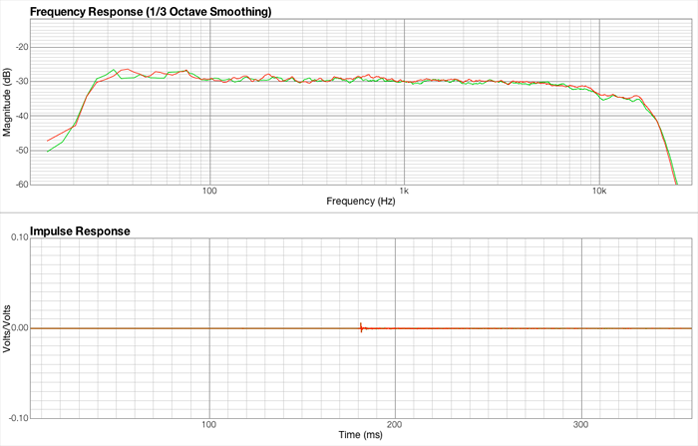 |
Compared to this result of the very forward-thinking spatialized Emerald Physic system that avails itself fully of present-day smart technology, the identically priced Kiso monitor belongs to a different era and value system. And it doesn't even include a stand yet, never mind anything else needed to make sound save speaker cables. To suggest that the HB-1's 4-inch bass quality if not quantity occurs on the same plateau as the perfectly linearized fully extended actively biamped dual 15-inch CS2.3 would be one massive deception. Ditto dynamics. Ditto 3-way separation during complex passages. Ditto impact, scale and much more. With that stated for the record—and before we start fretting over which stand to get for the Kiso or what flavor of even costlier enclosure wood to pursue—let's move on to what it can actually do.
|
|
|
It can play a room my size (5.5m x 12m) to levels higher than town-house living would tolerate. It can do bass sufficient on amplitude and frequency to—on properly chosen music—be completely satisfying if one didn't have a full-range reference to know the difference. Given its price, it's not a complete speaker though. For much music it's a head unit in search of a properly matched subwoofer or two.
Ported monitors with forced alignments that attempt max bass extension often sound unnaturally bloated and ringy. As a species monitors with very small-diameter ports or none at all make drier leaner more accurate bass. Here the Kiso's thin-walled 'active' enclosure and slot port introduce a middle flavor. Cleaner, springier and more on time than maximally ported alignments with inherent 'turbo drag', the Kiso's bass also doesn't belong to the school of dry farts. In that scheme natural buoyancy and vibrancy are replaced by something far more damped and corseted that turns into an explosive charged jack-hammer aesthetic instead of resonating freely.
Here the Kiso's bass lets the notes go more naturally. It doesn't fire them at you. This is particularly attractive with acoustic upright bass. While that 10cm mid/woofer doesn't have the raw shove to capture the full snarl of a heartily plucked long string meant to pop, it pushes a bit farther into that liberated direction than size would suggest.
Perhaps because the enclosure doesn't resist but plays with the driver, dynamic bass compression on acoustic music didn't telegraph as loudly as expected. While raw displacement and air motion was clearly limited and with it the complete recreation of a double bass' physical scale, the sounds themselves betrayed little lack even though attenuation clearly set in whilst moving down a scale. Here even a single subwoofer dialled in rather gingerly for just a tad of added weightiness and assist on the lowest notes would complete the picture.
On thunderous piano antics descending very far left, a subwoofer becomes essential if you expect not just tones—and then mere hints of them—but the full appearance of a large resonant body shedding energy in all directions. On ambient electronica the Kiso leaves too much sub bass under the table to be complete. Let's favor it with suitable music then and focus on any special qualities that might set it apart from other small monitors.
|
 |
  |
|
| |