This review page is supported in part by the sponsors whose ad banners are displayed below |
 |
 |
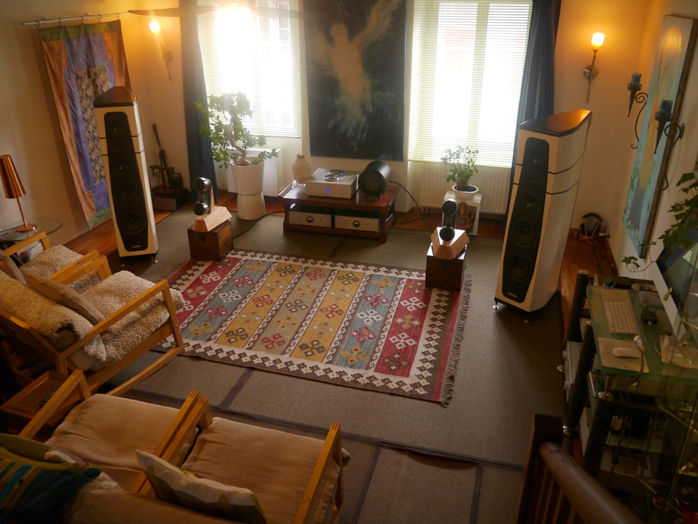
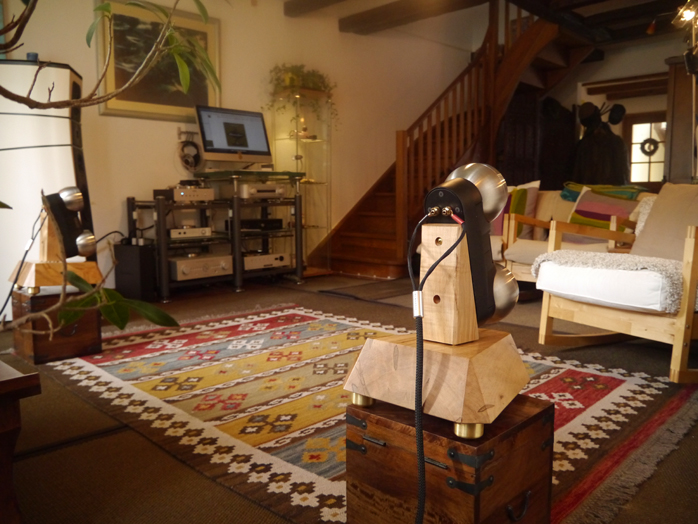
Squatting in the farfield. Using my two wooden crates filled with spare cables which usually hunker in the corners behind the speakers, I perched the Strada 2 off the floor. Ditto for the matching TR-3D which hopped atop the same Rajasthani hardwood rack which already held my main ModWright KWA-100SE amp. To keep things real after such rampant enthusiasm on the desktop, I left my white AudioSolutions Rhapsody 200 speakers up for quick A/Bs, simply shorting out whichever pair wasn't playing.
As common sense anticipated, in this setup and in this comparison the Strada was disadvantaged on the counts of reduced cone surface particularly in the power region for less air displacement and impact; by reduced cubic loading of the rear wave for lower general dynamics; and by some vertical spatial compression for lower staging. On the bonus side were distinct advantages and differences.
|
 |
|
 |
"Soul Driven" from the ambient Miles_Gurtu collaboration between techno maestro Robert Miles & Indian percussion wizard Trilok Gurtu highlighted most of them. There were drier textures and superior control across the three registers of low, mid and upper bass with decidedly less room involvement. This heightened infrasonic intelligibility and far-flung percussive incisiveness. The far larger Lithuanian speakers were more redolent, elastic and by comparison minorly resonant even with their twin bass ports plugged. They moved more air and staged taller. They were texturally warmer and softer. Dynamic behavior was a split. Above the upper midrange the Stradas won, below the Rhapsody 200 ruled. In terms of exactitude and inner tensegrity—the sense that the musical fabric pulsates across tightly stretched filaments—the Gallo sound had the clear edge and greater charge. |
|
|
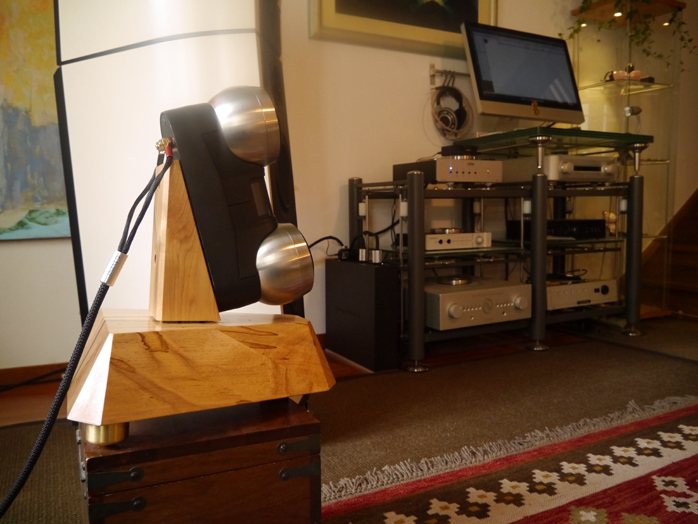 |
iMac with PureMusic 1.88a, Metrum Hex and AURALiC Taurus Pre
|
The Lithuanian sound was massier and more physical. It also was inherently more relaxed than the peppery illuminated lit-up airier monitors. The Strada seemingly built things up from the micro range. The Rhapsody 200 approached their work from the macro range down. On off-axis response and to the very useful extent of maintaining a laterally shifted panorama even from my work desk which sits diagonally in the room's closer rear corner, there was no comparison. With the floorstanders the sound reduced to mono. For all intents and purposes the right unit acted disconnected. With the Gallos I still had decent stereo, simply across a narrower spread than being seated more centrally.
|
|
|
The Strada 2/TR-3D combo has macro lens powers. Locked in at perfect focus—this takes some time—image sharpness is astonishing. Unlike a macro lens however there's simultaneous depth of field to make you think 'soundstage demons'. But it's also a highly tactile sound because leading-edge behavior is so quick and decisive. Surprisingly the nearfield experience translated to conventional distances far more than anticipated. If I settled down with such a setup, I'd probably go full hog and after two of the cheaper TR-1D subs. This would cover the critical 100Hz region in stereo to increase air displacement and raw shove. The biggest issue here isn't sound or expense. It's aesthetics. The Strada 2 loves space and thrives on breathing room. How to end up with a visually acceptable solution that crosses off proper height, proper alignment and proper anchoring all in free space appears critical and at present not completely handled.
|
 |
Anthony Gallo: "In the past we've sold very few Stradas as desktop speakers. Now I really want to promote desktop and outdoor applications on our
website which is in the process of being totally redone. The TR-1D subwoofer is identical to the TR-3D in every
way except for output capability. It uses the same processing/preamp board
which means
the same EQ parameters, rear controls and layout - everything. The sound
quality is remarkably close even though the retail is only
$599. For many 2-channel systems the TR-1D's 3dB lower output potential
will be a fine choice. It brings the MSRP of a Strada 2/TR-1D system down to the same
price point as the original Reference 3 was when first released. I'm sure the TR-1D has more
than enough output for a desktop system.
"The CDT is quite bulletproof. The max secondary
output voltage of the matching transformer is limited to about 2000VAC whereas
the CDT itself
has a 5200VAC max input before breakdown. Back when the Ref 3
was first introduced
we had some CDT/circuit failures mostly from defective systems but by the
time the latest-gen Ref 3.1 was out, CDT failure dropped to
almost non-existent even with abusive amps like the strapped pair of
Spectron Musician 3 we used one year at CES. Those are at 1800wpc into 4 ohms and were accidentally clipping during one of our demos. There are over
40.000 CDT-equipped speakers out there right now and
in the last 5 years the amount of defective CDTs we've seen can be counted
on two hands. It's an incredible figure."
|
|
|
Conclusion: What makes the Strada 2/TR system so extraordinary is perhaps most fully experienced in the nearfield. Psychoacoustic feedback on how we perceive sound revolves around a number of interrelated factors. I'm not certain of their true hierarchy or any conclusive cause/effect sequence. I'll simply cite highlights. There's deep space free from any apparent physical source constraints or directionality. There's phenomenal speed without tonal bleaching but sensational timing and imaging. There's amazing transient precision whereby the smallest buried cymbal tickle or shaker seed tick become crystallized and easefully obvious. Properly set up there's perfect subwoofer integration for full-range bandwidth with great linearity. And perhaps best of all, there's no need to play even remotely loud to hear everything in the densest of mixes. It's all mapped out in Teutonically sorted 3D, intelligibly teased out like a microscopically enlarged panorama yet arising simultaneously as an inseparable whole. Whilst extravagantly costly in the context of a desktop speaker system, performance operates at such an elevated plateau—exactly like superior headphones do routinely over ordinary speakers—that one could spend 10 times more on a farfield speaker system and not achieve the same.
|
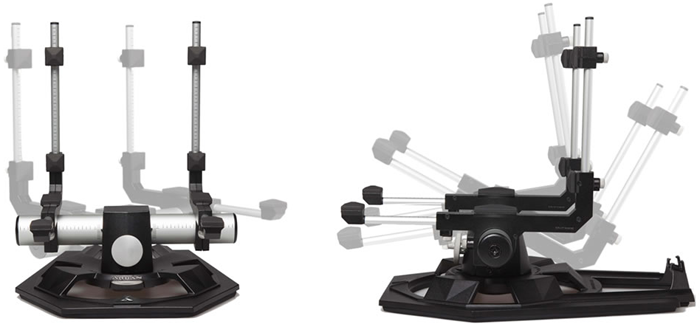 |
Having heard a number of quality monitors on the above truly excellent €488/pr Ardán Audio EVP-M1 stands in the exact same nearfield milieu, the Strada 2/TR-3D combo went a few extra miles. Yes here it made for a more intimate smaller experience than 2x4m HxW scenery cast by floorstanders 4 meters removed which peak at 90dB at the ear. But unless you've got a perfectly treated room with perfectly matched speakers—most likely a rather costly lengthy endeavor—you won't match the fidelity, immediacy, rise times, transient precision, linearity and purity of this $4.000 3-piece speaker (I included a grand for the Mapleshade stands to round things off). This won't require painfully upscale electronics either. I ran with a $995 Aura CDP/DAC, a $1.495 50wpc Aura integrated, a $349 Cambridge Audio dock and a 160GB AIFF-loaded iPod Classic of the sort hifi's pure bloods love to hate. Call it $7.500 for the lot including cables, essentially what my big white speakers cost. In the nearfield one eliminates most the room from the equation. That means transferable excellence. Nothing vital gets lost in translation from one system to the next. It simply requires fastidiousness of setup. But that costs nothing at all. To wrap up, I'd think of this as a headfi system of top pedigree which has been perfectly extricated from inside the head and projected at less than one meter in free space before you. It's audiophile-approved studio monitoring but with full aural sex appeal to condense the vital difference in a casual but explicit form. This really is hot stuff! |
 |
 |
 |
|
 |