This review page is supported in part by the sponsors whose ad banners are displayed below |
 |
 |
Anthony Gallo: "I don't know whether you will be as happy with the Mapleshade approach for the farfield unless you prop up the Stradas higher off the floor. But
if you have all his gear mounted to the Strada 2/TR-3D system
positioned on the floor and sit in the nearfield, it's quite the experience.
There are several variables
to contend with in such a setup and it's somewhat of a commitment to
optimizing each. I wish I had experience with his Strada upgrades
on a glass desk.
It will be interesting to see what he suggests. I wouldn't
expect he'd recommend his standard brass cones.
He may switch those
out for his rubber-cork-rubber isolation sandwich footers. I'm fairly certain his
TR mounting scheme will yield dramatic improvements and with less effort. However with their
improved rise time and leading-edge definition, the Strada/TR positioning
becomes even more obvious and critical."
|
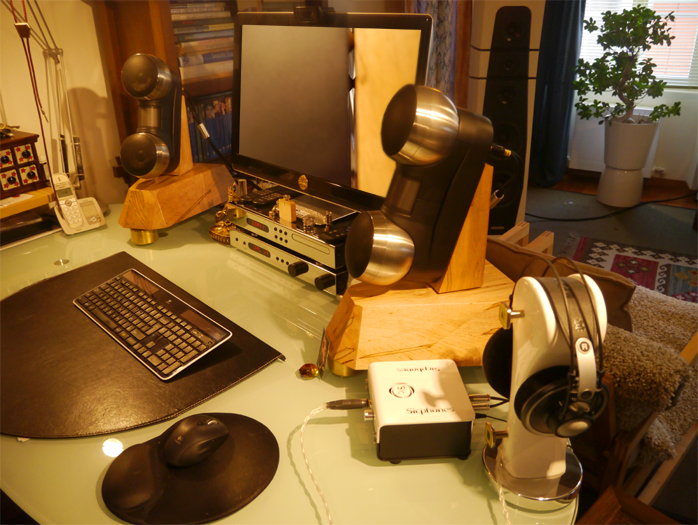 |
Shown on the monitor insert are the pointy brass inserts between Strada back and Mapleshade upright
|
Successful overkill equals dead doubt. At $925, the Mapleshade stands are a serious commitment. In my 4" version they are also seriously large and with the radiused smaller brass footers in the rear and a giant one with upward-facing triple points in the front seriously heavy to boot. In short, it's a gratuitous extravagance for any desktop. It has me hesitant to endorse any of it from a value or cosmetic perspective. But (cough)...
|
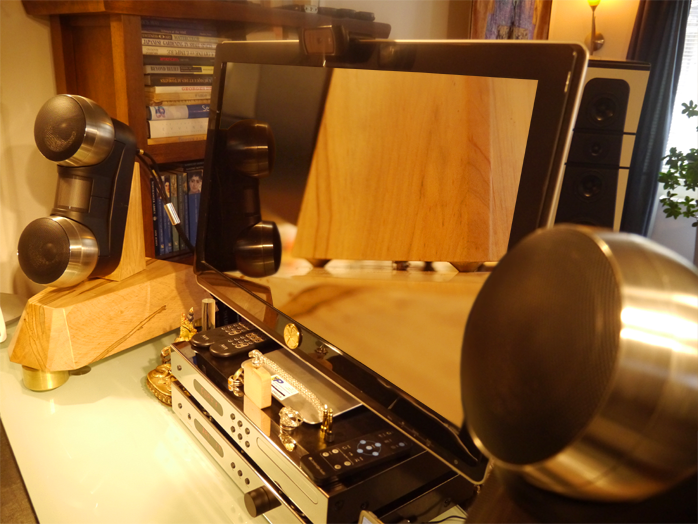 |
Shown on the monitor insert are the pointy brass inserts between Mapleshade upright and base
|
|
|
|
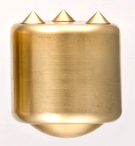 |
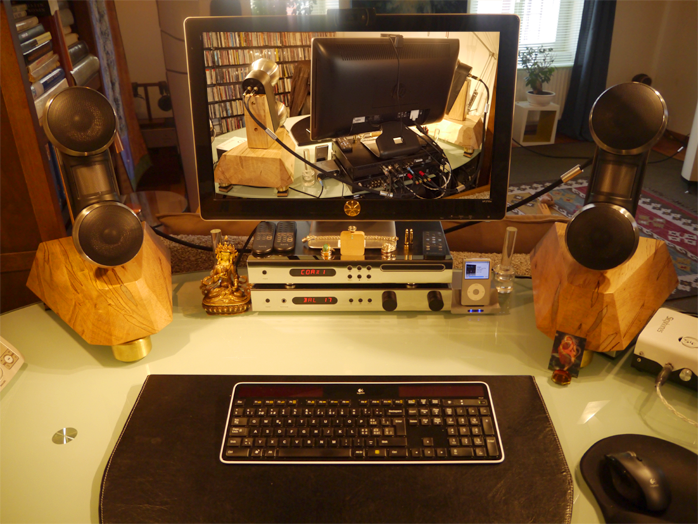
... those seriously heavy on performance will want to know about it. First a few words on the wooden contraptions. As the screen inserts showed in closeup above, there are two vibrational transfer barriers created by super-gluing a total of 16 very small pointy brass cones—four per contact patch—to the Stradas and bases of the stems. Once these connections are locked down and torqued up with long sturdy bolts, the micro cones embed permanently and under considerable tension inside the rock maple. Finally there's the massive front brass footer with its upfacing integral triple points meeting the plinth. Any nasty vibe trying to travel from the Strada into what it sits on or vice versa will be lost, exhausted and spent to never make it like a salmon fighting his way upstream only to be fished out by a bear.
|
|
|
 |
Shown on the monitor insert are the cork/rubber footers beneath the rear brass footers to reduce rake angle on the desktop
|
I used Anthony's original squishy pads beneath the front footers and Pierre's optional cork/rubber footers below the back units. This avoided any brass-on-glass contacts and created optimal height/alignment. The latter was dead obvious once hit upon. Perhaps because the center of gravity had now moved beneath the Strada and physical micro resonances captured by the wooden support structure and brass barriers, the sound exhibited a number of clear improvements. The upper-bass region firmed up; ambient recovery increased for even more shocking soundstage depth and image focus; transient exactitude and wiry string striations sat as though in a sniper's hyper-vision cross hairs; and detail magnification in general—lens quality in photo speak—went up (or some free-hand micro blur was cancelled out by a professional tripod).
|
 |
Weird but gratifying, after reducing sub output by a mini notch the blend with the TR-3D went from very good to perfect. I don't have a fully rational explanation especially for that. My inner bookkeeper's nagging about personal excessiveness simply shut up. This blind-date purchase showed proper teeth and legs. The Strada 2 now kept the curtain open into even lower playback levels. With fiery Flamenco footwork and hand claps like on "Soleá A Dos Paralelos" from Agustín Carbonell Bola's Rojo y Rosa, those machine-gun transients had that nearly instinctual but quite elusive rightness. After my review of the Irish Ardán Audio desktop/studio-console stands, this was my second encounter with a counter-intuitively large before/after delta achieved from proper alignment and anchoring of nearfield monitors on a work desk. On paper that's a tough sell. In person the experience is self-validating. It's ouch to the portemonnaie, my precious for Gollum's big ears. |
|
|
|
|
The takeaway for the Strada 2 particularly in this direct soundfield without boundary reflections is twofold: beat fidelity that's mega-pixel pin-point precision; and 3D layering that's nearly supernaturally specific. Besides actual coin, the currency you pay with is scale. Performers shrink to 50cm tall bodies dancing atop the table. In my case overall stage width contracted to the 90cm I had between the centers of each lower Strada sphere. 'twas the proverbial teapot tempest, albeit ultra pure, meaning zero room boom with all its concomitant resonance. It explained why Pierre Sprey found even the original Strada—on his stands, on the floor and in the nearfield—to best $20.000 ultra monitors.
|
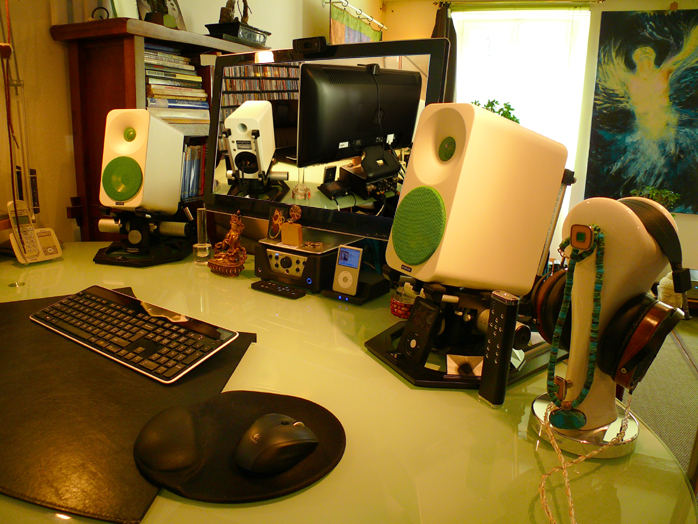 |
Amphion's Ion+ atop the hi-tech Ardán Audio stands
|
Part of the secret is the Strada's engineering brilliance. The other two parts are extreme proximity and fastidious setup. Call the sum total super stereo. No CES or Munich HighEnd über system approaches it. The farfield with its room intrusions simply disables it. What the farfield does reintroduce are life-size scale both vertical and horizontal plus skin-pressure dynamics. So pick your poison. Or—another excess alert!—do both. I guarantee that if you do, such a nearfield setup will change your expectations and standards for the big rig.
|
 |
  |
 |