This review page is supported in part by the sponsors whose ad banners are displayed below |
 |
 |
Conversions: From originator 47lab to Audio Note UK and Zanden, non-oversampling or so-called NOS converters (not the new/old stock abbreviation of tube lore but certainly related) have a rep for smoothness as well as treble softness. On his website, Vincent Brient of TotalDAC explains why: "Non-oversampling DACs are known for their musicality but they all suffer sinus(x)/x treble loss of more than 3dB at 20KHz. All DACs with oversampling compensate for this in their digital filter. I use a short FIR filter only for the high frequencies to compensate for sin(x)/x loss in my NOS implementation."
|
|
|
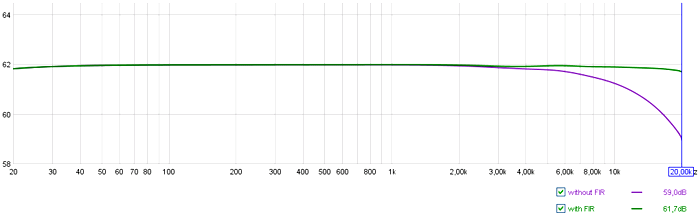 |
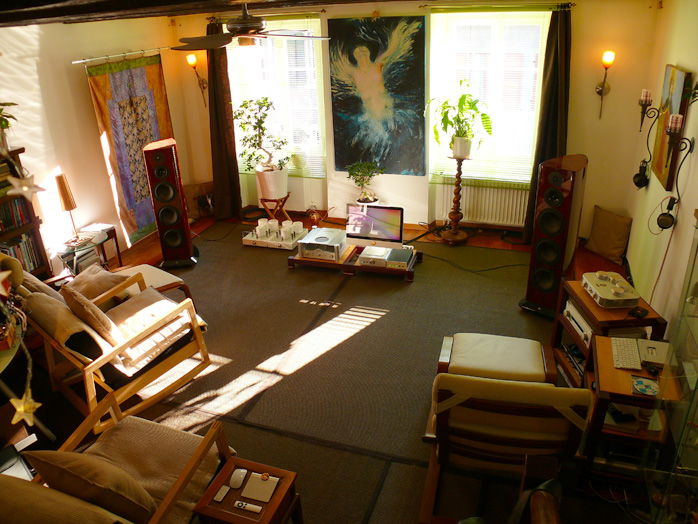
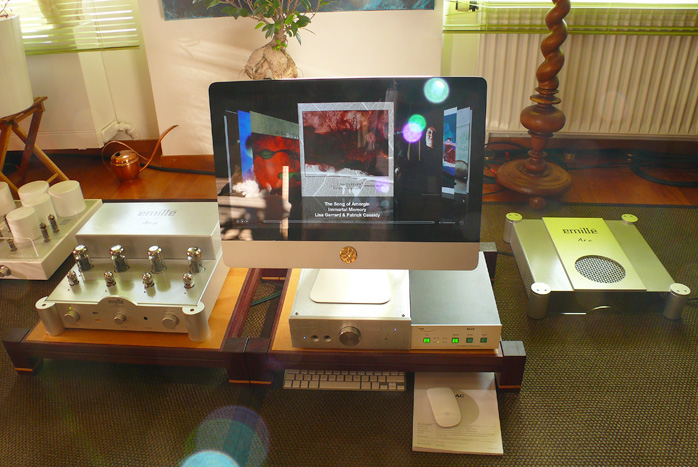
His graph [originally found here] shows the correction. "Response at 48KHz with and without FIR filter when a 10K potentiometer is used at the output of the DAC. With the FIR it is flat to 20KHz." For the AMR CD-77's vintage Philips chips, Abbingdon Music Research has authored their Master I filter to accomplish equivalent linearization. Without any such claims by Emillé, one would assume typical NOS voicing. To establish context, I reconfigured my system. I moved the iMac and 24/192 Firewire Weiss DAC2 and 24/96 async USB Burson HA160D converters next to the Ara between the speakers. It was the only way to have my Entreq USB, Firewire and Black Cat Veloce coax cables reach.
|
 |
Rob Robinson's PureMusic player version 1.73 ran in memory play mode with pre-allocated RAM. Accelerated source switching in Audio Setup sans iTunes relaunch took barely longer than turning Ara's hardwired source selector.
|
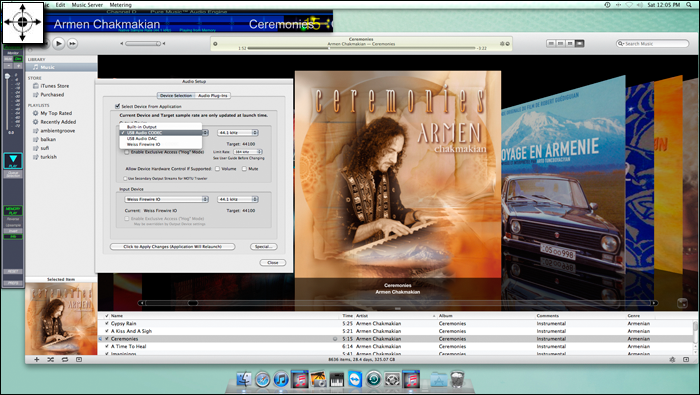 |
PureMusic recognized Ara's DAC as USB Audio Codec limited to 48kHz just as Emillé's specifications had predicted. Because of the lack of variable/fixed outputs which prevent disconnecting their converter from the high-level amplifier output stage to operate independently, my comparisons could not extricate Emillé's DAC to work as a standalone converter like the two others which connected through the analog line-level inputs with additional cabling. I also connected the Weiss as a Firewire-to-S/PDIF converter to the Ara's coaxial digital input.
|
|
|
My adventures down converter alley were far more streamlined than prior familiarity with my two resident DACs had expected. Thinking about why, I came up with a dominant gene theory. The Ara's tubed output circuitry seemed to exert strong seniority over any persnickety digital input differences. While the particular personalities of the Burson and Weiss DAC remained recognizable as I knew them, the degree of offset had significantly mellowed out.
|
 |
My first order of business was testing whether the shorter direct non-asynchronous USB connection of the Ara was inferior to letting the Weiss DAC2 become master clock via the more indirect plainly longer connection. Nick Bedworth's review of the Audiophilleo D/D converter contains much useful intel on audio-related jitter figures. How much jitter is audibly relevant and where pure specmanship takes over (never mind that the test gear required to accurately measure the tolerances some manufacturer claim is seriously expensive) remain valid questions. Many other factors pool into final results. The only way to isolate jitter-related audible specifics would be to deliberately alter just the jitter performance of a particular machine. In reviews this never happens but the Audiophilleo engineers actually add this educational facility. They include in their gear a second inferior clock that curious listeners can switch in to test themselves and learn how and where the effects are audible.
This by way of preamble to the—popularly assumed to be—inferior higher-jitter USB implementation Emillé chose. If there were differences to the Weiss as master clock, my hearing wasn't good enough to reliably latch on (and/or the Ara's level of resolution was insufficient). Either way I couldn't distinguish between USB and coaxial feeds.
|
 |
Comparing Weiss and Burson to the Ara's own converter concluded in the happy realization that doubling the Ara's asking price to include a well-regarded converter was most assuredly neither necessary nor recommended. Yes the Weiss did inject a little more white into the color palette, a bit more air into space and sharpness into transients—the Burson less so—but linking the iMac directly to the amp made for the chewier chunkier richer more dynamic slightly softer and not quite as focused but bigger outcome which in this context actually seemed preferable.
|
 |
Emillé's engineers clearly took pains to pair up their DAC with the main circuitry such that interlopers should find themselves essentially disarmed. This sound is not about the pin-prick tattoos of hail on a tin roof. It's not about cubits of air and we're-there transport into a different acoustic. It's about enhanced corporeality of they're-here performers. It's about weight, substance and exceptionally broad rather than deep staging when the recording allows. It's not about nearly cold cymbals emitting silvery tizz into the air like so many champagne bubbles. It's not about performer halos creating individual bubbles of space. Everything is darker, richer and centered lower like premium Swiss 90%+ cacao-content chocolate. Not at all sweet like the cheaper less concentrated black stuff, that's simply intense and pungent. Saccharine doesn't factor. Emillé's sonic world of the Ara isn't sweet either. But it's most assuredly earthy and opulent.
|
|
|
The Ara is about matter rather than space, guts rather than ultimate finesse. Seasoning with contrary voicing accomplished only very minor shifts. In the end those seemed to take away more than they added. I soon decided that buying into the intended sound hook line and sinker was the best way forward; and that like the Aussie analog gang of Burson had before, the tube heads at Emillé had in their converter authored far more than just a fashionable convenience item.
|
 |
  |
 |