This review page is supported in part by the sponsors whose ad banners are displayed below |
 |
 |
About Emillé's choice of digital silicon, chief designer Young Kim had this to share: "Philips created the TDA1543 chip about 20 years ago. Their converter family of TDA1540, TDA1541 and TDA1543 all have excellent harmonic suppression across the entire audio band. We had strong views on this matter and it's why we ultimately rejected the most modern chips so popular elsewhere. This incidentally is not about the type of harmonic distortion usually measured as THD. We felt that lower broadband harmonic occurrence was far better for the sound quality and using four TDA1543 in parallel merely enhances this suppression. In the end we very much doubted the effects which high sampling rates have on the sound. Because we're known as a valve amp manufacturer, we wanted to express digital audio data as good analog sound.
Our chosen signal path thus became the BurrBrown PCM2906 USB transceiver into the CS8416 S/PDIF receiver (the coaxial input encounters this directly) whose I²S output couples to the quad-paralleled TDA1543."
|
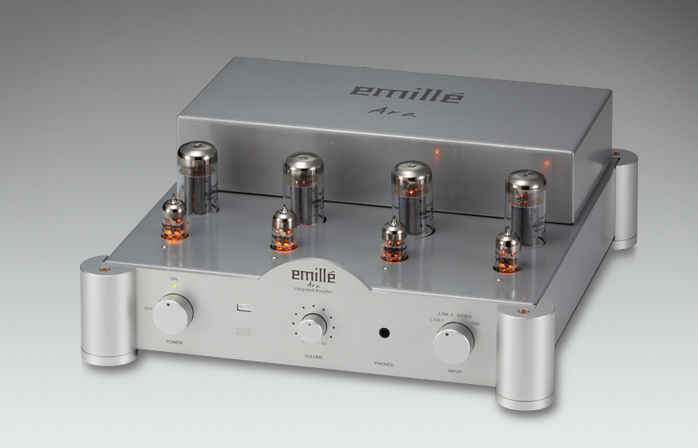 |
For PC audio users with exclusively ripped CDs, this poses no limitations. The Ara streams Redbook files until the cows come home. Those with 24/96 or higher music files simply can't hear them at native but only downsampled resolution (iTunes users will leave the standard 16/44.1 audio midi setting untouched). That's because unlike its 192kHz S/PDIF receiver, Ara's actual converter chips date back to a time when high-rez streaming audio wasn't yet commercial reality. For a year 2010 product release with USB, this decision does counter prevailing marketing wisdom. It assumes that the Ara's target audience—mid-power tube lovers—don't bother with high-resolution files. Does this counter actuality or really conforms with it? My 4000-some CDs versus less than a handful of hi-rez files on the hard drive have their own opinion. Hardcore hobbyists might applaud a maker who brazenly bucks commercialism to instead deliver what he believes are superior sonics. Wherever you stand on the topic, there it is. Next.
|
|
|
Walking the unexpectedly heavy shipping box back from our 1km-removed post office where the shipper had left it during our Istanbul New Year's vacation had me feel like a knuckle dragger. Damn was this "smallest" of Emillé's amps a humdinger. This was merely the first indication that €3.000 go farther here than usual.
|
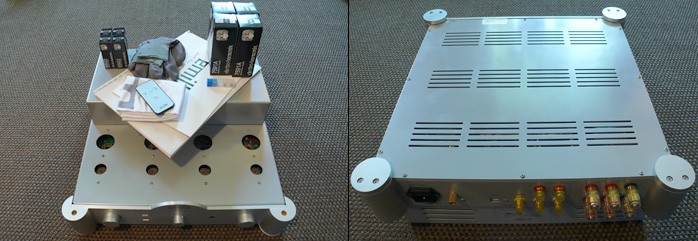 |
Heaving the beast out of its stout cardboard carton extracted the—quite bigger than anticipated—amp proper, the separate and substantial cover, numerically labeled tubes, a credit-card remote with separately packed watch-type battery, a spare mains fuse in its own container, gloves, a large branded cleaning cloth, a very extensive owner's manual with checked-off test values and a full-line company brochure.
|
 |
The lab test results for my loaner read 87.1/93dB cross talk for left/right channels respectively, 0.29/0.39mV noise with volume control fully opened, 0.48/0.37mV with the volume at minimum, 13V RMS output level with a 1kHz 0.32V 8-ohm input on both channels, 94.8/94.2dB S/N noise respectively and 0.09% THD+N on both channels.
|
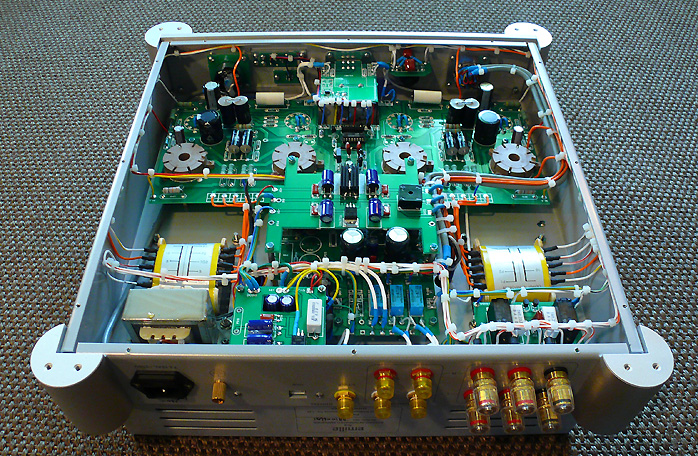 |
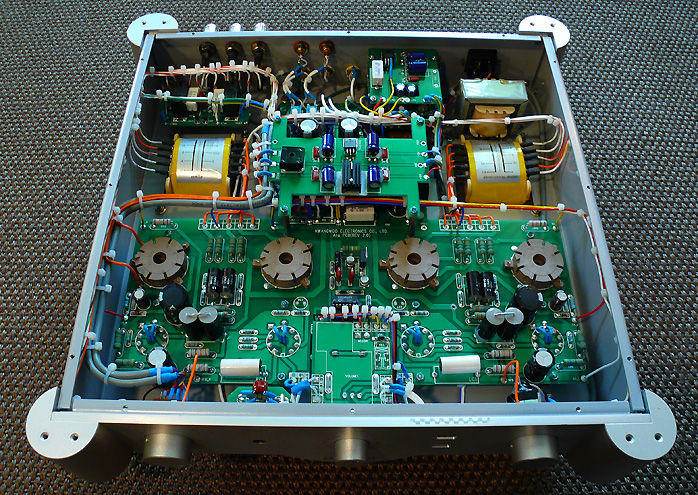
Once the bottom cover and footer discs beneath the corner stanchions had been removed, the internal architecture showed a front-to-back mother board with output transformer cutouts and various second-level boards for motorized volume, D/A conversion and such. There was also a small separate board for the output terminals and an exposed filter choke.
|
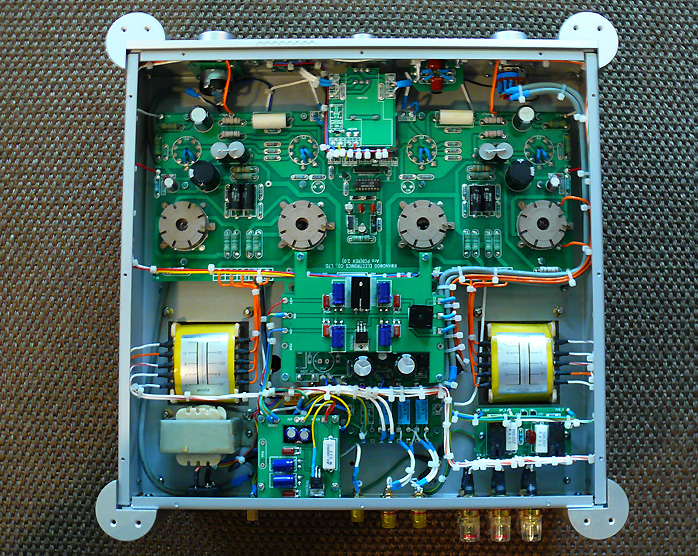 |
The power tube sockets weren't of the ubiquitous ceramic but made from a phenolic-type composite I'd not seen in this application before. As with prior Emillé loaners, construction and fit'n'finish including the honey-comb perf details and thick Acrylic tube window were meticulous.
|
|
|
Here are a few closeups of the Ara's inner workings...
|
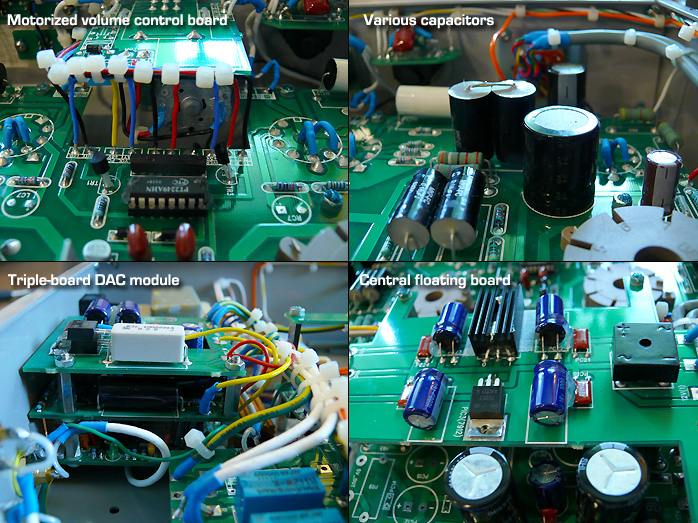 |
...and a few more.
|
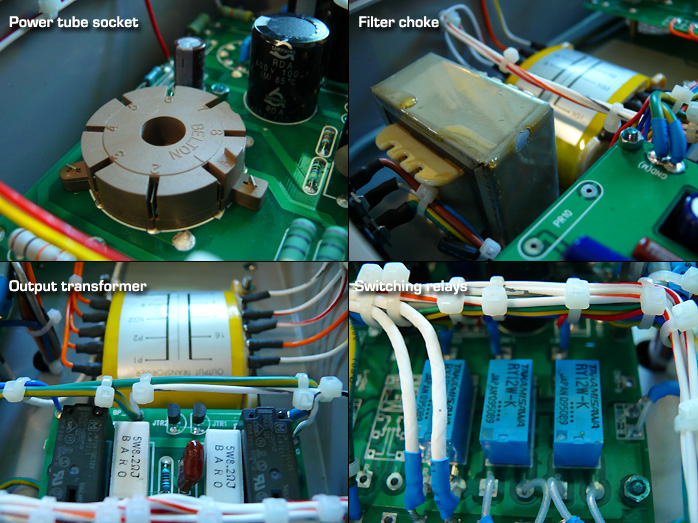
|
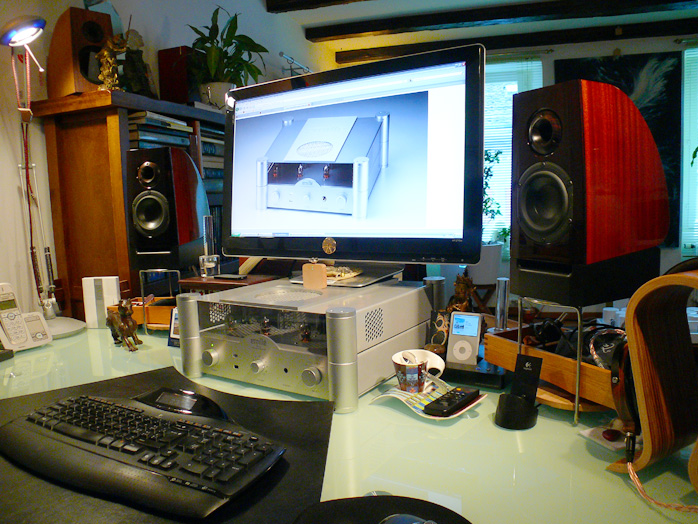
For break-in the Ara displaced my customary April Music Aura Premier on the desktop. It was fed from a fully AIFF/ALAC loaded 160GB iPod Classic via Onkyo's ND-S1 digital-direct dock into Emillé's S/PDIF input. The top cover's stout aluminum bridge proved to be exactly the same width as my HP2710m screen's footer. Coincidence? If so very fortuitous. Speakers were the usual Dayens Tizo minis and for a brief fling the Kiso Acoustics HB-1; headphones the ALO-recabled Audez'e LCD-2.
|
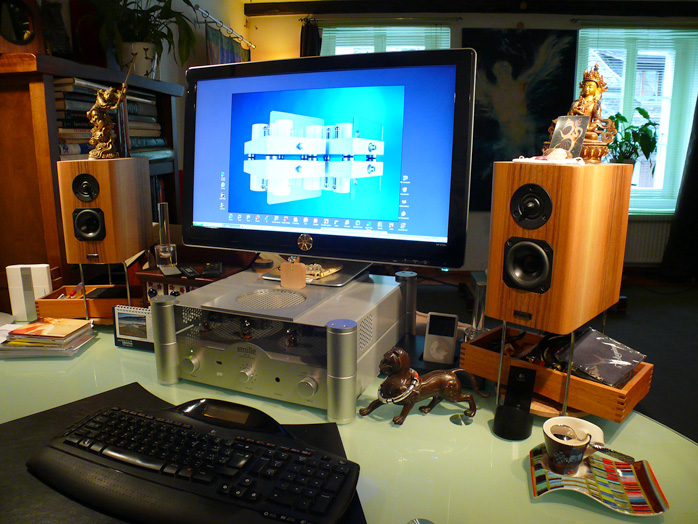
|
Either transducer produced desired SPL below 9:00 on the dial. Orthodynamics here have unreasonable headroom for the bangiest of headers. Mild onset of self noise with the Audez'e didn't occur until 2:00, i.e. well beyond levels anyone could ever listen to. This I thought was damn impressive for a headphone output whose gain apparently wasn't choked back versus the main speaker outputs but run wide open.
|
 |
|
 |
  |
 |