This review page is supported in part by the sponsors whose ad banners are displayed below |
 |
 |
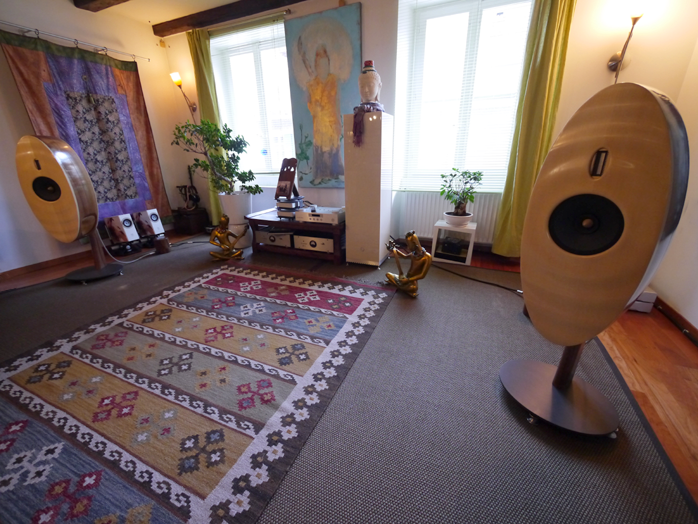
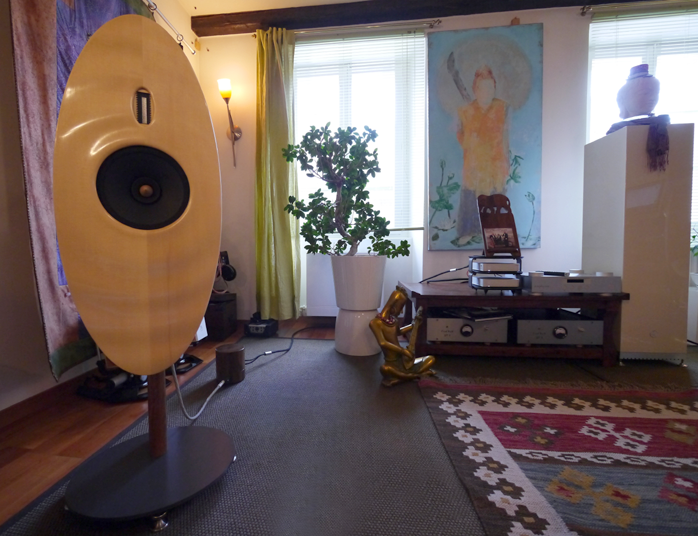
Boenicke's laterally opposed dual 10" mid/woofers per side with a 1st-order low-pass to reach quite high radiate into full space deliberately. This activates your room's ambient field with far more reflections than half-space direct radiators would before their low frequencies turn omni. Here the CFA's additive bass weight function which had so stunned on the Albedo backfired. The sound became too dark and heavy though the low registers remained very well controlled. Unlike the 200 where dual front-firing midranges counterbalance twin woofers also firing forward to become more directional with rising frequencies, the Swiss speakers favored the slightly drier Job 225 and its very linear but not as potent bass. With a long-wall layout to increase reflective delay times, this observation would likely reverse. Our upstairs 2-channel movie system lives in a smaller room alas along the long wall. Here the B10 strut their stuff without upsetting tonal balance at the ear. Downstairs they are trickier. The small Goldmund amp gets them still right. The Crayon's beaucoup bass power seemed to want more room width and thus even less boundary reinforcement.
|
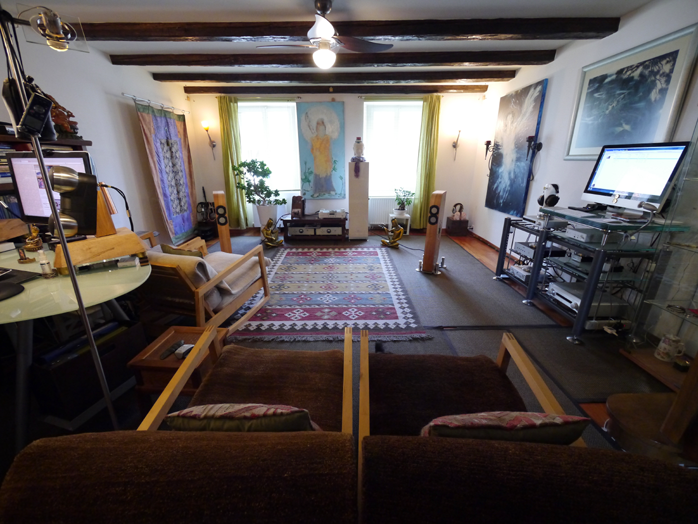 |
Though I usually don't, with this amp I liked the AudioSolutions better than the Boenicke. For the wrap and Bakoon duel I planned on reverting to the Albedo loaners as my most copasetic and quite frankly spectacular combo on hand*. This is why professional reviewers (should) maintain inventories of multiple options across different component categories. Whilst it can't ever completely eliminate the potential for mismatches, it minimizes them and with it the risk of wildly wrong calls. Here we're safely settled already on the Crayon behaving as its wide-bandwidth brief would predict (though such things are never iron-clad as the 2MHz Norma IPA-140 amp proved which didn't sound accordingly): lit up, very direct and quick.
|
 |
the most recent crop of new albums ripped or downloaded
|
* Though it is a feature review on the Austrian amp, this particular speaker match was so exceptionally happy as to suggest the perfect system report to give shoppers a guaranteed recommendation whose only very minor variable remains the source component. Albedo's clever down-firing and narrowing transmission-line loading is super unfussy about placement to work anywhere. The CFA-1.2's uncanny 'turbo' boost of the small 6-inch Accuton woofer decommissions subwoofer need even in a 5.5 x 12m room. Together they make for a very stylish compact reference hifi that won't turn your living room into a shrine to electronica or a hardware cemetery. Sonically cut from the same cloth, this becomes an ultra-resolved stunningly spacious completely light-filled sound of phenomenal articulation as modern as the aesthetics.
|
 |
With optional Bent Audio metal wand (the stocker is the same plastic job we've already seen with Nagra and Soulution)
|
Back on the CFA, its predominant though low-magnitude 2nd-order harmonic distortion signature adds a very fine never overt or saccharine sweetness. Its low output impedance manifests as high woofer control. Wide bandwidth and very low noise guarantee extreme magnification of minute ambient detail for enormous audible space if recorded. This very low self noise points at a proper SMPS. It's what Linn have done for decades with their Brilliant/Dynamik power supply—or Nagra, Jeff Rowland, Soulution and Chord—to avoid transformer hum, power line noise and its harmonics. The extra bonus which the specs couldn't predict is exceptional bass weight coupled to grippy articulation. Particularly on Albedo's unique TL-loaded small woofer this built out extension to a very noticeable degree. Despite its unimpressive power rating to not be a bona fide muscle amp, the CFA-1.2 behaved as one on speakers within its purview. It might be pretty and 'small' but packs a mean punch.
|
|
|
|
Bakoon vs. Crayon. With its 15wpc rating my freshly upgraded Bakoon AMP-12R would have seemed badly handicapped. Hence I moved in my just arrived soundkaos Wave 40 widebanders with Raal ribbon. Those both soar and rumble on my 10wpc FirstWatt SIT1 monos. This game wouldn't be about wattage. It'd be about sound quality. Because both integrateds really are amps with passive pots, they sound better even with an active linestage of obviously premium quality. I used my Nagra Jazz with the amps' own attenuators fully open to start with a best-case scenario.
Off the bat the Korean and Austrian amps had clearly graduated from the very same sonic aesthetic design class and year just as their background tech and specs predicted: very low noise, high dynamic range, expanded bandwidth, superior lucidity. Polished cut crystal without the sharp edges. Smooth but fully elucidated. Supremely informative. Evenly lit staging front to back to hear everything. No shadows. |
|
|
.
|
 |
For the purposes of this review it shall indeed suffice that Crayon's sonics overlaid Bakoon's to near perfection. Whilst one can always split hairs, such persnicketism rarely if ever translates outside a given system. I'll thus only mention the one aspect I'd think would migrate regardless. Texturally the 12R was somewhat drier. It took some digging to determine what caused this impression. I ended up in the treble where the Raal ribbon is exceptionally telling. Here the CFA-1.2 felt a bit more elastic. More fluidic. This influenced my general perception. On magnitude this wasn't a make-it/break-it type difference to determine any purchase.
|
 |
Given the astonishing similarity of sonics, what should strongly influence a decision are features, power and price. Unless you were a headfi fanatic—I am and the Bakoon thus lives on my nightstand feeding Audez'e LCD-2—the Crayon surely dominates over the Korean with far more useful power and full linestage functionality including phono, pre-out and remote.
|
|
|
Adding it up. Since my review four years ago, the CFA's v1 to v1.2 conversion now clocks in with a 42% price hike. This likely reflects at least in part the addition of global distributors and their need for operational margin. Since my review of Bakoon's award-winning then $4.995 AMP-11R one year ago, conversion to the AMP-12R commands its own 20% raise. At the time of writing this equalized stickers between the two within €250 based on a very twitchy €/$ exchange. Yet Crayon offers quadruple the power, remote control, an apparently sterling phono stage and far more i/o connectivity. On features it's the better buy. On sonics these decks compete as fiercely as they do on price. Thus the overall value advantage goes to Crayon as well. Despite a €3.000 to €4.250 upswing this justifies that we grandfather the original 2009 Blue Moon award for the most current iteration.
|
 |
In the intervening four years the brand's global recognition wouldn't seem to have increased by much. It's still underground. But a new US presence through Fred Crane at StereoDesk/AudioPrana suggests this could change. If a high-profile American reviewer like Stereophile's Art Dudley got behind it—this would be right up his alley—Crayon Audio could become more than just an oddly named Austrian hifi house familiar only to the very few. And its Roland Krammer might finally get recognition for being as clever a circuit designer as Bakoon's Akira Nagai. Here's a toast of zum Wohl that lady fortune will make it so. This is an amp a lot more people should hear! |
 |
Quality of packing: Good.
Reusability of packing: Many times.
Ease of unpacking/repacking: A cinch.
Completeness of delivery: Includes generic power cord, remote control and owner's manual. The full-metal Bent Audio wand is optional.
Human interactions: Good.
Value: Fair to high. This depends on your use (or not) of the built-in phono stage which the US importer says is the best they've ever seen as a non-standalone unit.
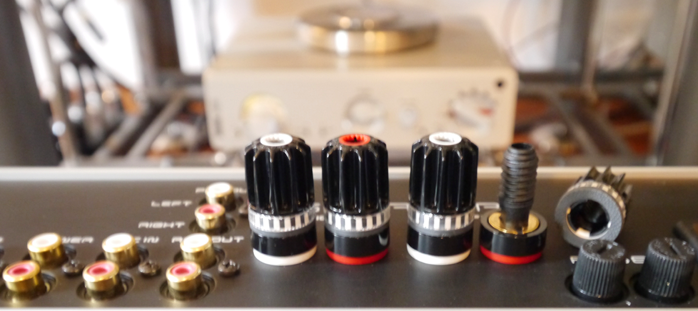
Final comments & suggestions: None. This is a mature hi-tech product with a well-considered feature set though the display remains too small to be legible across a 5m distance if you must know the numerical volume value. The new variable pre-out is perfect for a subwoofer and the NextGen WBT 5-way binding posts accommodate those who couldn't deal with the prior banana-only sockets. The amp also doesn't run hot to accommodate tighter installations. The CFA-1.2 works very well with a valve preamp of suitable pedigree for those who wish to inject greater temporal elasticity. In such a setup and with legacy Sonus faber-type speakers, low-power SET fanciers could have a religious conversion experience for the things this will do better whilst remaining within a related aural aesthetic. Who needs fussy power triodes then?
|
 |
 |
|
 |