This review page is supported in part by the sponsors whose ad banners are displayed below |
 |
 |
Sound. The CFA-1.2 doesn't sound like any valve amp I've heard. Its leading edge sharpness, noise floor, bandwidth and bass control are too different (higher, lower, wider and better/deeper respectively). Where it borrows from the best single-ended triodes albeit furtively is on trailing-edge behavior. Here valve lovers commonly complain. Transistors overdamp the decays they say. Everything focuses on attacks to freeze elasticity and fluency. For their liking things get too choppy and mechanical. They clack away ultra articulated and dry like an old-fashioned typewriter's keys at 100 words a minute. Here I feel no smarter than the first time around how Crayon manages to inject a mild dose of triode-type fades into this picture.
|
 |
|
 |
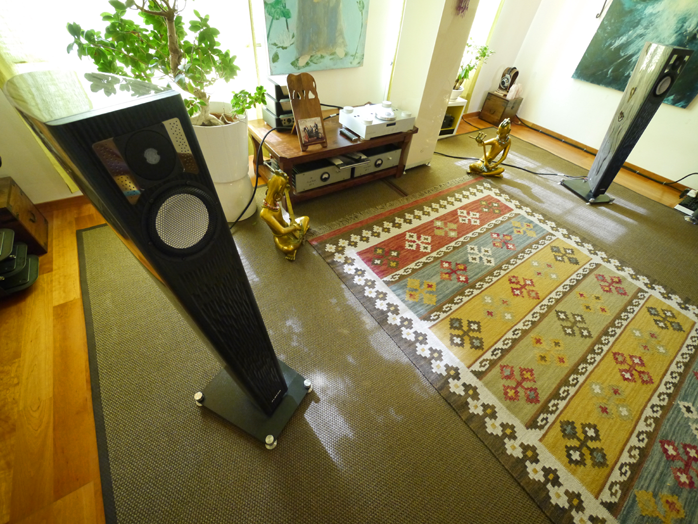
Yet it did, even over a speaker as dialled for speed, rise times and self damping as Albedo's mindblowing Aptica. On Jamshied Sharifi's African-flavored quasi soundtrack One* (think Mercan Dede meets Hans Zimmer) it also shocked with bass extension I hadn't thought this compact 6" 2-way with tapered transmission-line capable. Over a few clicks I'd kept turning down my Zu Submission sub because bass was too potent. Then I powered down the Crayon whilst music played on over the sub. Alas it no longer contributed. By overcompensating for the amp's addition of about ten cycles of reach, I'd attenuated the sub too much. In the end it had all been Aptica. This mirrored Fred Crane's show comment about Albedo's 5" 2-way cousin with the Crayon [below]. "Everyone looked for a sub."
|
|
|
 |
* Like Sharifi's Prayer for the Soul of Layla, this album belongs in any music library whose owner appreciates ethnic vocals, lush arrangements, complex rhythms, tribal drums and cinematic scope recorded very well. Highly evocative and challenging demo-quality stuff!
|
 |
|
 |
Two recent Qobuz downloads were Yıldıran Güz's Med Cezir and Renkler Ve Sesler albums. Here the Crayon/Albedo combo showcased phenomenal speed and dynamic impact on glittering oud strings. Such explosive wiriness tends not to be part of the tube lexicon. Here the wide bandwidth CFA eclipsed even the Goldmund/Job 225 which already is a very agile lit-up direct performer. Another thing the Crayon injected into the mix was minor sweetness. Here one could conjecture on its 2nd-order signature. Except with a twist. |
|
|
|
 |
Such octave-doubling—the 4th does it again one octave higher—tends to thicken the stew which has dense complex fare congeal. Think Ming-Da's massive €29.500/pr MD-212WE monos. A Dominique Mafrand review in Haute Fidélité lists for it a colossal <8% THD. That's 80 x higher than the CFA. The Crayon is a high noon not twilight amp. It completely sidesteps this issue. Yet there remains a fine though pervasive sweetness which sublimates the effects of transient speed just a tad. When the music gets busy it's thus a very vigorous distinctly articulated deep-space presentation without the overbearing dryness which often accompanies very keen separation and transients. The low output impedance clearly damps the sound for a gestalt quite different from valves of the no-feedback persuasion. The only common if diluted element is this sweetness associated with more generous decays than usual for such a taut very sculpted sound. |
|
|
|
|
It would seem that 'times ten' bandwidth of 2Hz - 200kHz can eliminate phase shift in the frequency extremes and with it the aural equivalent of motion blur. In the bass that sounds like the difference between sealed and ported, in the treble how a Raal ribbon overtakes an ordinary silk dome. To this sealed/ribbon quality the Crayon adds electrostatic speed and ceramic-driver transparency with the sort of dynamic punch one gets from hard-hung woofers properly damped like a Zu-spec Eminence. It's a very quick lucid vast and finely sorted sound into which I deliberately injected a bigger whiff of triode suppleness with my Nagra Jazz preamp (it also drove the Zu sub which is how I could power down the Crayon but still hear low bass unless the Submission's attenuator was set too low). For the Accuton-fitted Albedo the Jazz and a switch from Metrum Hex/PureMusic to AURALiC Vega/Audirvana made for an idealized example of ultra-spacious advanced transistor sound. On sonic core flavor it stayed squarely in the €1.495 Goldmund/Job 225 vein but compensated for its lower power—which here didn't factor one iota—with greater mellifluousness and pliancy.
|
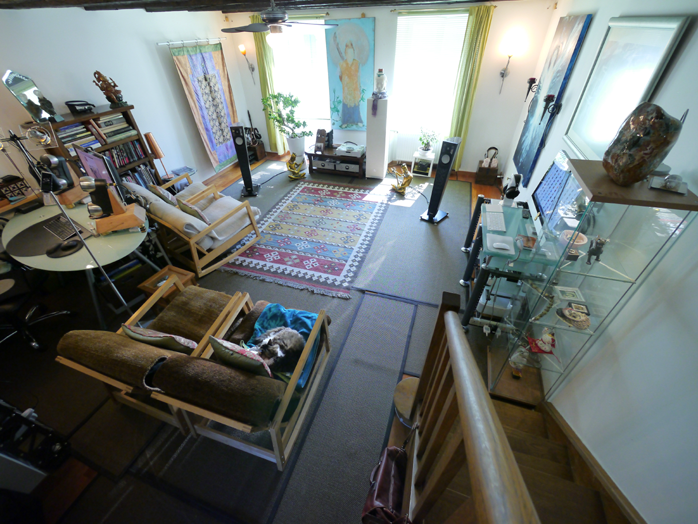 |
To check on ultimate woofer control our household keeps the large 3-way 4-driver AudioSolutions Rhapsody 200. Their twin-woofer twin-port alignment is deliberately underdamped. It requires port plugs unless an amp can control what in my short-wall setup turns to bloat and boom otherwise. Prior champs of complete control had been Acoustic Imagery's Ncore 1200 monos. Those are followed at a small distance by the DC-coupled Job 225 whose brief includes perfected woofer damping by design (though the Swiss are tight-lipped on exactly how). As warmer paper-driver transducers voiced in a legacy Sonus faber mold with US-style bass, the Lithuanians welcome cooler transistor drive if one means to 'stay in the middle' (I in fact doubt any valve amp could control them totally).
|
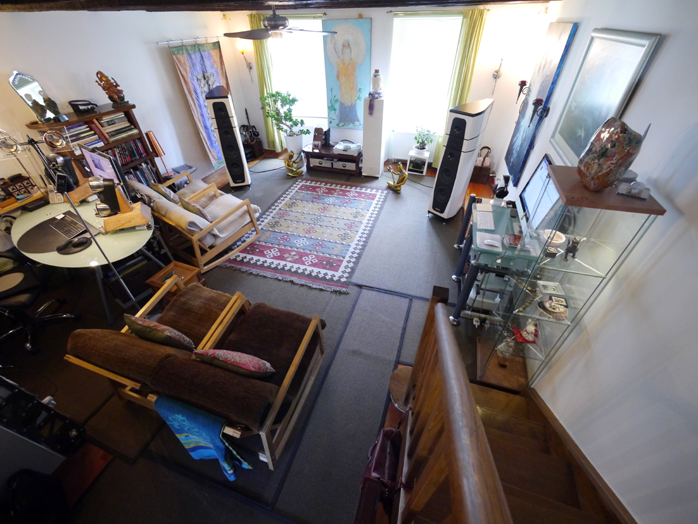 |
This became a physically bigger heavier darker and softer reading which was less tweaked for time-domain accuracy and more for tone color saturation. The Crayon controlled the woofers wonderfully to warrant no port plugs. Even so it couldn't fully ameliorate the typically vented/ringing bass textures the Ncore 1200 monos had so completely done away with. Here the CFA-1.2 joined the Job 225 on my personal second tier of death-grip speaker kungfu. That parked it well above the FirstWatt SIT-1s—those play their golden trump cards into the Swiss soundkaos Wave 40 on order—but still ceded victory to Bruno Putzeys' class D magic. It's very likely that the CFA-2 changes are aimed squarely at challenging bass systems to open up Crayon into those tougher transducer ranks. On a purely personal aside, once you've heard properly done sealed bass like my German Physiks HRS-120 or Boenicke B-10, something seems fundamentally flawed with the entire bass-reflex concept no matter how assiduously disguised by raw amplifier acrobatics it might be.
|
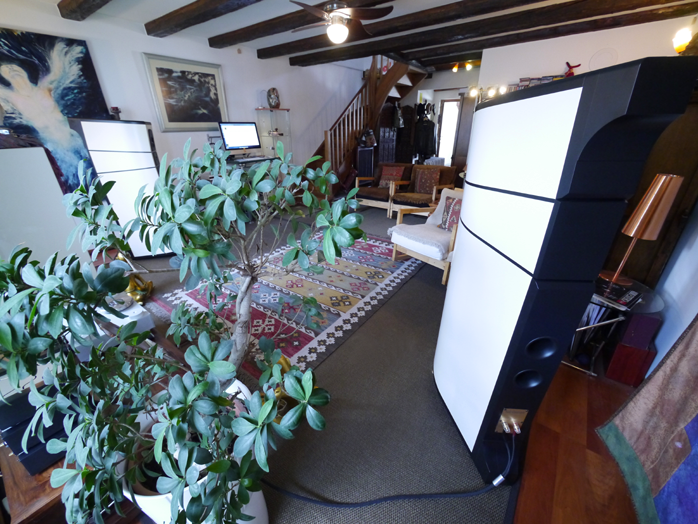 |
Where the team of Crayon and Albedo had matched each other's temperament and bias—speed, precision, damping—to create a presentation optimized for those aspects, the combo of Crayon and AudioSolutions fused Nordic and Latino opposites if we get anthropomorphic. Rather than personal favorite, I primarily keep the Rhapsody 200 around to stand in for conventional ported multi-way speakers of steeper filter slopes. Even so I had not heard the big Lithuanians quite like this before. Unlike the prior setup which tube lovers would oppose as too different, this one was meaty, supple, slightly lush and tonally generous to hit many valve-sound triggers without getting sloppy when faced by complexity. This really was a very winning combination. It'd also appeal to power rockers which you probably guessed isn't me.
|
|
|
The takeaway is that SET fanciers with complementary speakers—which here doesn't mean highly efficient or benign impedance but counterbalancing Crayon's own voicing as explained—can consider the CFA-1.2 if they also want better woofer control, lower noise and more frequency-extreme extension whilst in turn sacrificing some flow and gush. In short there are now middle-ground amplifiers of the transistorized persuasion that appeal also to open-minded valve fanciers if ancillary context is well judged. That the main output devices here are Mosfets and not bipolars to mirror FirstWatt and Bakoon and Goldmund is likely no coincidence.
|
 |
  |
 |