This review page is supported in part by the sponsors whose ad banners are displayed below |
 |
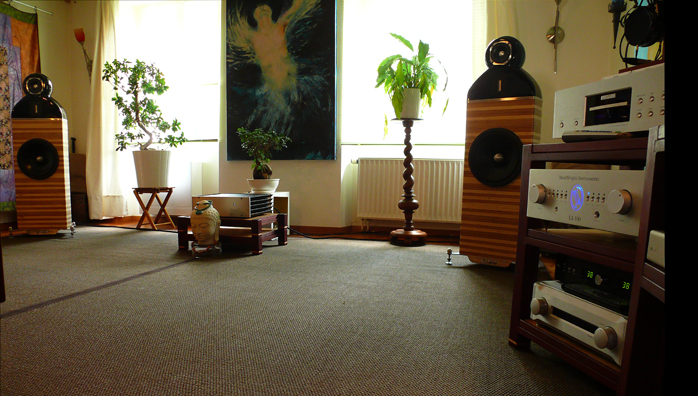
Endowed with patently top-echelon parts from its filter network to the modified transducers, the friendly load behavior of the Gladius lent itself to perfect triangulation throughout my full stable of ancillaries. Mixing and matching all resident amplifiers, preamps and sources at will, such 'backwards' investigations shed light on specific speaker qualities via my ultimate preference for particular electronics and what that said about the Gladius. My review journey progressed from the ModWright LS-100 tube to the Esoteric C03 transistor preamp to the Bent Audio passive Tap X autoformer volume control. The DAC changed from massively paralleled Delta-Sigma conversion and triodes in the APL Hifi NWO-M to less massively paralleled R/2R processing in the Metrum Acoustic NOS Mini DAC Octave. Finally amplification moved from 10wpc Colotube 300B to 30wpc Trafomatic Audio Kaivalya EL84 to 130wpc Octave MRE130 with SBB KT88 monos to ModWright's 100wpc Mosfets to Nelson Pass' 25wpc FirstWatt F5.
|
 |
Bent Audio Tap X, FirstWatt F5
|
Extrapolating from these quite linear and paralleled progressions, the winning preamp and power amp [shown above] both had the arguably simplest fastest purest circuitry of the bunch. The same held true for the winning converter. Eliminating the slightly fuzzier warmer tube colorations was progress. Eliminating active circuitry in the preamp was progress. Eliminating paralleled output devices in the amplifier was progress. Eliminating the subtle pre-ringing of Delta-Sigma conversion was progress.
|
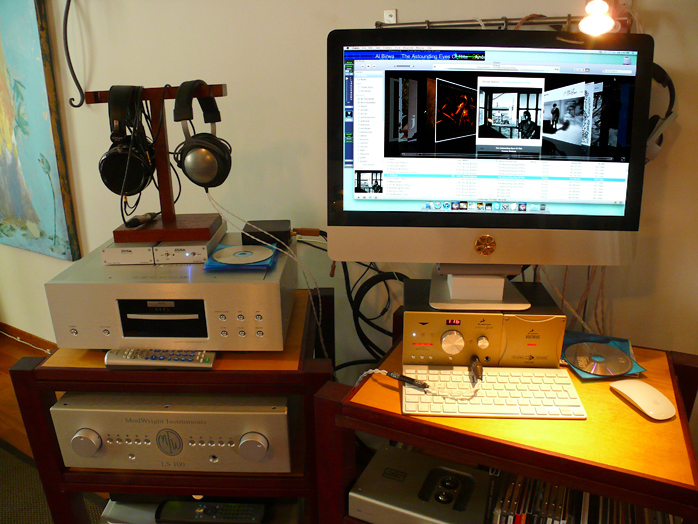 |
Zodiac Gold with latest firmware updates as USB HS 2.0 transceiver into Metrum Octave
|
To my mind this nicely illustrated two Gladius core virtues. One, this broad but shallow speaker had excellent innate tone. It did not require assistance from electronics—something I would not have said for the ceramic-driver carbon-fiber class D-powered speaker—and in fact sounded most liberated with minimal assist. Two, it had excellent innate timing by responding in obvious ways to subtle advances wider-bandwidth circuits with less phase shift and more speed introduced. Stavros' group-delay optimization schemes paid off. From my available choices, microdynamic reflexes, soundstage precision and timbre differentiation power were maximized by electronics with low self coloration and high speed from inherently simpler circuitry. These ancillary choices paid dividends also with the curtain call. The speaker came alive at demonstrably lower volumes. Bass punch and feistiness (surprise!) as well as tintinnabulation were highest with the low-power F5 too. My affection for this $3.000 amplifier added a few signatures on its voting sheet.
|
|
|
None of that is any predictive reflection on what a prospective Gladius owner should or would use. It simply means that for all its timing accuracy and speed, this speaker doesn't lack tone or body to require a thermionic injection. I achieved the greatest dynamic responsiveness, articulation and life charge without any valves in the signal path in fact. This reiterates my above claim that the Raal, Fostex and Acoustic Elegance transducers here are truly top spread and endowed with built-in tonefulness.
|
 |
The very good low-SPL showing with an amp of F5-type reflexes also pointed at low box talk. The more one pushes playback levels downward towards background, the more micro details tend to fall through the cracks of self noise and fuzziness from timing imprecision. Any system that excels at maintaining listener interest, involvement and small-print intelligibility at midnight-with-neighbors levels has to have low self noise and high timing accuracy.
|
 |
What most surprised me about the Tap-X/F5 combo was the flamenco dancer with stiletto heels quality in the bass. Articulation and snap in the low registers had been final hold-outs of minor reservations I nursed about the Gladius. Once I arrived at my final selection of electronics, this completely blew over. Cueing up Buddha Bar's Travel Impressions for some intelligent lounge fare with complex rhythm grooves that live or die on bass pertness and reflexes, I was unprepared for the extent of transformation the 12-incher's performance underwent. Now I had real snappiness on even tertiary bass impulses that are buried deeper in a mix while master beats had grown extra mass. Again, this wasn't a function of power. Both the Octave monos and ModWright stereo amp put out a lot more than the F5. I am frankly unsure why the F5 excelled. I'm simply glad I had it to hear how it did that. |
|
|
 |
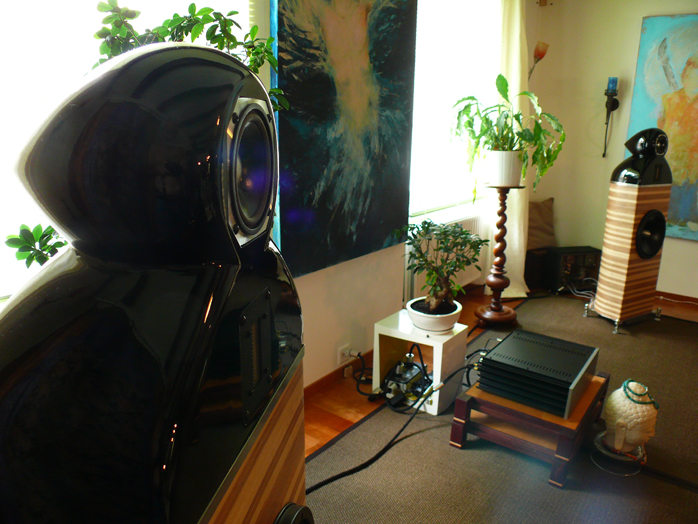
Conclusion: The Gladius from Cyprus newcomer Aries Cerat is a very serious attempt at a state-of-the-art floorstander of still friendly dimensions. For €22.000/pr the buyer gets very worked-out external crossovers, inert cabinetry with 'wind-tunnel' head units and three carefully selected and modified drivers per side which must be amongst the top available options in their respective bandwidth windows. Anyone sufficiently familiar with the industry can quickly calculate that the tall sticker buys rather more in materials and execution than is the current norm. It's why despite the new-car price this is actually quite a value proposition for the wealthy.
|
|
|
While diamond and beryllium tweeters are all the rage today, designers at Boenicke, Crystal Cable, Kaiser Acoustics, N.N. Acoustics, Selah Audio, Siltech, Sonics and Vapor Sound prefer the Serbian Raal ribbon for their best efforts. Unlike lesser ribbons with their metallic colorations and somewhat washed-out whitish tone, the Raal has the tone of premium silk domes with the speed and extension of super tweeters and dynamics which approach air-motion transformers. While the Gladius was designed by tube maniacs, this tweeter at least from my choices didn't completely hit the stratosphere until I leashed up a wide-bandwidth ultra quiet transistor amp. The cellulose/Mica midrange and treated paper woofer continue the theme of properly developed tone. That isn't due to valve-induced harmonics but au naturel. It makes the Gladius a top destination for transistor amps of FirstWatt caliber. Even so its deliberately benign load behavior and efficiency welcomes quality 10-watt SET amplifiers with open arms.
|
|
|
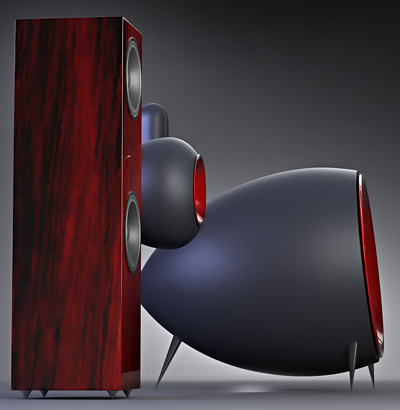 |
Concept rendering of new flagship hornspeaker |
|
The sealed bass loading sacrifices some extension in favor of non-ringy
top-to-bottom integration and like the Raal ribbon loves transistors, on this count presumably for their greater current delivery. Because the Gladius is dialled for speed and timing accuracy, precise setup (path length equality and listening-axis alignment with ear height) is mandatory to unpeel all the onion layers for the juiciest spiciest freshest core. In the end, the Gladius is a monster effort. Its launch from Cyprus would shock those who know the island. After 2.5 years of living there, I can very much appreciate how overall work conditions—mired as they are in widespread corruption and blatant ineptitude—should essentially prevent any such very ambitious efforts. The Gladius shows enormous design talent and personal resources. It also exceeded my in-house references, putting its stout sticker more than in line with performance. The only reservation I really have has nothing to do with the speaker. I'm worried merely about Aries Cerat's long-term viability of operating their upscale hifi manufacturing out of Cyprus. But they clearly have the ambition and plans for the future. |
|
Out of the gate, the Gladius is a fully formed mature speaker. It's far from the mainstream but carries with it easily quantifiable design and performance excellence. That puts it up there where the air is thin, the vistas grand and dreams of better faint memories. What a debut for a 'conventional' speaker! |
|
|
Postscript January 4, 2012: Due to unreliable supply of Acoustic Elegance woofers, we've been informed that Aries Cerat has discontinued their collaboration with this supplier. The drop-in replacement woofers are now Fostex FW305 8-ohm units which purportedly offer identical performance save for the unexpected bonus of an added 5 cycles of extension. - Ed
Postscipt October 20, 2015: Acoustic Elegance have been in business under this name since 2005, and under the name of Stryke Audio since 2001 before then. We purchased their remaining inventory from Lambda Acoustics in 2005 and began producing the TD woofers here. Throughout that time we have improved upon the fit and finish of the woofers. We have now been reliably delivering these great drivers for over 10 years. Our business model is a little different than most. We are not doing high-quantity mass production but handcrafting a very unique high-end product. We are a small company with few employees. At times our demand is very high, especially if large-quantity OEM orders are placed. While we hope to maintain lead times of 2-3 weeks, large orders can increase that substantially. We try to be very up front about lead times when orders are placed and ask our OEM customers to plan accordingly. Most will purchase a small quantity of woofers to keep on hand at their facility and replenish stock as needed. Unfortunately Aries Cerat wished to order woofers at a time when our lead time was already too high to meet their delivery needs. - John, Acoustic Elegance LLC
|
Quality of packing: Massive wooden crates with built-in palletising spacers. Very good.
Reusability of packing: Indefinitely.
Ease of unpacking/repacking: Preferably with two people. Transportation up any stairs definitely requires two. Thereafter a dolly and two phone books to take up slack between spikes and bottom plinth will do the job.
Condition of component received: One crossover got damaged in transit. That was easily fixed with a provided replacement part, some wire tie-downs and resoldering all broken connections.
Completeness of delivery: Perfect.
Human interactions: Very good.
Pricing: Expensive but excellent value at that and explained in the review.
Final comments & suggestions: Make the cap nuts and spikes from one piece and either weld the lock nut to the plinth or provide threading in the hole so height adjustments can be made from above. Revisit the fasteners of the heavy crossover parts so they're immune to transport abuse from higher drops of the shipping crates. Have the stainless steel dress banding overlap in the back. Consider painting the silver basket of the Fostex black for better cosmetic integration with the head unit. Exchange the see-through Acrylic crossover covers for solid leatherette-covered panels. Exchange the notch filter switch for a toggle with clear in/out markings so the customer knows at a glance whether both speakers are set the same and in what way. |
 |
|
 |