This review page is supported in part by the sponsors whose ad banners are displayed below |
 |
 |
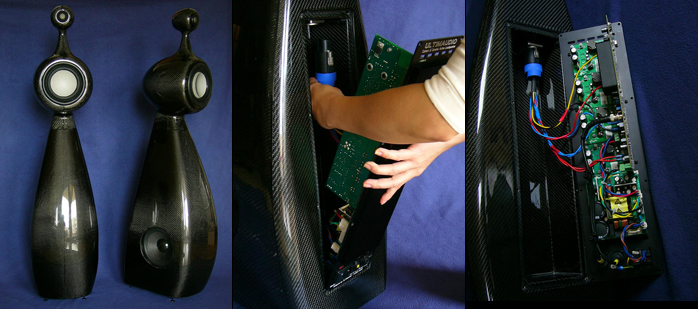
During the Gladius review I had opportunity to sample the below €35.000/pr three-way speaker pair in sophisticated carbon-fiber skins where active 4th-order networks with balanced Hypex class D power modules handle drive control. With quintessential monitor qualities recording engineers should want, their sound driven from the same front end as the Cypriots lacked tone color. Ultra crisp, things sounded too white, dry and frankly bland. Performer embodiment felt insufficiently developed and nubility or flow was replaced by a very damped cut-out quality. I thought of it as a high-level accurate hifi sound stimulating predominantly mental/visual observer triggers. This made for a useful contrast to the Gladius. The wood speaker sounded clearly gutsier, tonally deeper and timbrally far more individuated from recording to recording. Equally important, musical elasticity returned. This conveyed proper riding on breath rather than matching a metronome. As a result I felt involved and adrift in the music rather than at bay and on the shore.
|
 |
|
 |
It's pure artifice to break this sound—which my wife dubbed very well tempered—down into its constituents. But her other comment is the perfect foil. This related to the triangles on "Promenade" [Vassilis Tsabropolous, Melos, ECM] and the cymbal work on Jacques Loussier Plays Debussy [Telarc]. We'd never heard this degree of inner fire or coruscating iridescence from these metallic strikes with such deeply sourced bursts of upper harmonics. "Like diamonds" Ivette remarked very fittingly. Ditto for some of Trilok Gurtu's workouts on his collaborative effort with Robert Miles. |
|
|
|
|
|
|
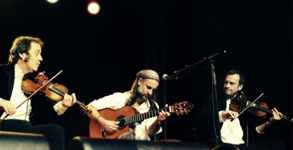 |
Then there was ace tsigane violinist Oleg Ponomarev ["Doïna", Shara] who performs hair-raising and high-power sliding flageolets close to the bridge with perfect intonation often octave-doubled to boot. The otherwise 'not there' Raal tweeter was very much in evidence as a real miracle worker when audiophile gymnastics in the ethers called on it. It's about not knowing what you don't know until something shows you. The Raal did. This went beyond my previous treble reference, the triple resonator-reinforced Dynaudio Esotar clone in my ASI Int. Tango R. |
|
|
| Switching to María del Mar Bonet's saucy Bellver with its romantic string orchestra and tremolo mandolin ["La Serenata] has one appreciate quickly how the same elegance and sophistication continues on with the deliberately bandwidth-limited Fostex widebander. The massed strings were sweet but not cloying, burnished but far from dulled. María's memorable voice so strangely cracked, vulnerable and melancholy was empowered to do its magic. For fierier sauce José Juan Mosalini [Bordoneo Y 900] and his Grande Orchestra de Tango demonstrated similar con-arco treasures but now with far bigger dynamic swells, here interspersed by the glittering bandoneon and jagged power chords of the pianist. |
|
|
|
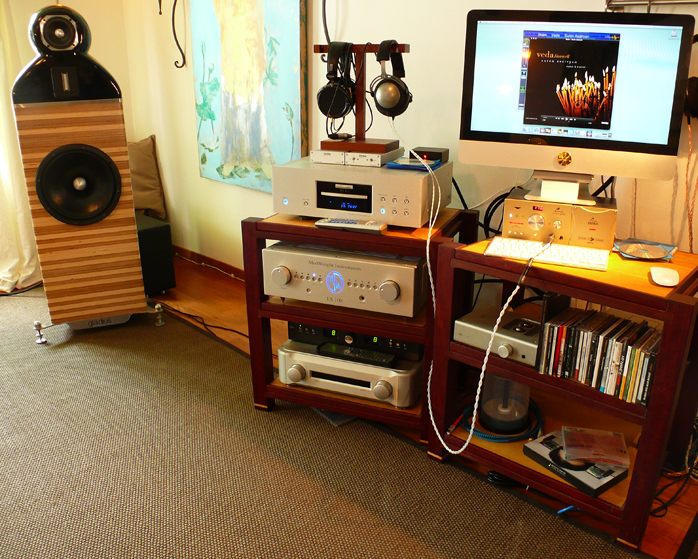 |
iMac with PureMusic 1.8, Antelope Audio Zodiac Gold/Voltikus with most current firmware update as USB 2.0HS receiver,
Esoteric UX1/ALP Hifi NWO-M as DAC, ModWright LS-100 with Synergy Hifi glass
|
 |
For a change of pace, Romane & Stochelo Rosenberg's shredder "Gypsy Groovin" from their 4th joint CD Tribulation blistered with twangy Maccaferri-style Selmer sound atop a very modern rhythm/bass groove. This showed how the sealed super woofer matched the reflexes of the smaller drivers above it to categorically underwrite Stavros' decision for bass quality over quantity. A 20Hz test tone produced mere doubling but 25Hz already became recognizable if attenuated. The Gladius in my space proved solid to 40Hz. |
|
|
|
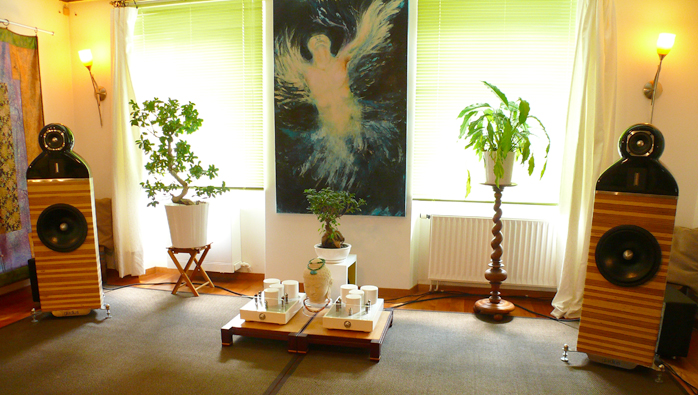 |
Trafomatic Audio 30wpc Kaivalya monos, all Zu Audio Event wiring
|
Both Mark+Daniel Fantasia-S and Acoustic System Int. Tango R extend lower with more gravitas, particularly the latter. That comes with the price of more inherent room loading, something the Gladius was blessedly free of despite sitting closer in the corners for some deliberate reinforcement. The ported alignment of the synthetic marble box from Shanghai also makes for a slightly pumped-up and clearly more resonant quality by comparison to the lither more singing and tempered bass of the Greek box. How would this quality respond to 100+ watts of two-stage transistor power?
|
|
|
Dan Wright's Mosfets added a bit of low-down growl. Given the power-hungry reputation of sealed bass however, this was less than expected. Ported bass is the default choice of today's vast speaker majority. That portly somewhat confused sound is what most people are used to. Gladius shoppers need to understand that the very real extra price to pay for this €22.000/pr speaker with tighter truer bass—which stops when it should and integrates properly with the upper bands—is less LF reach than woofer size and pedigree would seem to promise.
|
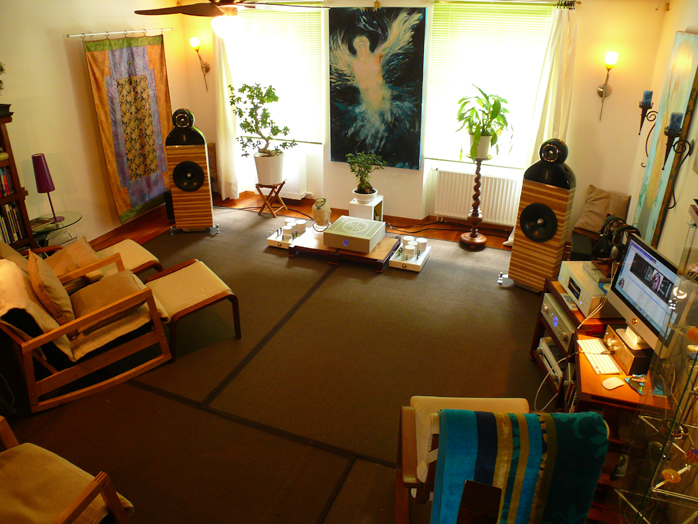 |
With ModWright KWA-100SE
|
The Gladius is the civilized choice of refinement. But it's clearly not the popular choice. Reggae heads with a need to put de boom boom in de riddim and their relatives in other styles will need to move on or add a very big sealed subwoofer. Key is that sealed bass—with a driver appropriate for such loading—shows up how some presumed room issues from ported bass systems are actually time-smear problems. Those 'magically' vanish when a sealed box of similar size hunkers down in the same spot which ought to cause identical room loading conditions but does not. That's not an asset to underestimate when one gets to the fundamental choice of whether the next speaker acquisition should look for sealed or ported bass. Cue up any Renaud Garcia-Fons solo bass number (I suggest "Bosphore" from Mediterraneés) to inspect the sonic coherence and textural integrity as he works out over the full bandwidth of his large 5-string upright. It'll be one good exercise in this decision-making process should you be sensitive to the distinction and have a pronounced preference.
|
 |
  |
 |