 |
|
|
Soundstage and imaging. The A-S2100 demonstrated performance levels in all parameters to merit serious big league comparisons. Image width could match my reference setup when utilizing the balanced input and came extremely close with the single-ended inputs. Depth information was extremely close to the reference and projection was phenomenally similar. This integrated amplifier could delineate individual images and positions on that soundstage with good precision and solid 3D mass. Space between instruments was handled with considerable openness and transparency and due to the low noise floor, instruments could erupt from a dark or silent background with luminous power. My regular reference combination could open up more space between instruments but the Yamaha countered by using its upper-mid luminosity to make the instruments more prominent. With the Arkana Physical Research interconnects, the presentation leaned more towards organic solidity. With the Audio Arts balanced IC, the emphasis shifted to massive amounts of hall information and air. The A-S2100 Yamaha managed to emulate the spatial character of good tubes in similar fashion to better D class, Fet and T-Fet efforts I have encountered. Combined with frequency response, that put the A-S2100 fiercely into better organic territory on solidity, placement and hall information.
|
 |
Comparisons and competition. Comparisons are always tricky but I thought that given the middle child situation of the A-S2100, it merited a Goldilocks' look at how it fared on performance/price. So here are three products that bear serious similarity at vastly different prices, one higher, one lower and one about the same. The first sonic competition that came to mind was, oddly enough, not another integrated but the H2O Audio separates of Fire preamp and Ice amplifier. The big ICEpower linear-PSU H2O had the most testicular use of that Danish D Class I came across. Its designer also subverted the natural tendency of the ICE to go somewhat dry on top by building a matching Fet preamp which introduced some lushness at those frequencies to create a uniform combined acoustic bubble. Some of you may argue that this is an unfair comparison but bear with me. The Yamaha lost on raw horsepower but had similar properties of maintaining a uniform acoustic bubble top to bottom, being only a touch leaner than the H2O combo on top and only slightly less dimensional in the same range. The A-S2100 was likewise luminous in the mid and upper midband to spectacular effect. Both were capable of floating believable instruments in space with startling realism and both demonstrated legitimate muscle-amp aspirations in their visceral handling of the lower octaves. In terms of convenience and features, the Yamaha was the far more ergonomically sophisticated. In absolutes of sound, the H2O separates sat at a slightly higher performance tier but in a very similar character vein for thrice the price.
At a lower $2'499, a competing integrated that sprang to mind immediately was the Wyred4Sound STI1000. It's the proverbial powerhouse, kicking out 500/1'000wpc into 8/4Ω of ICEpower gain with a very sophisticated preamp stage. Like the Yamaha, its designer opted for a resistor ladder volume control and likewise offers both balanced inputs and single-ended to balanced conversion. Both engineers approached their preamp portion with fastidious attention to detail and I can safely say that they are amongst the least obtrusive and most transparent active preamp stages I have encountered at any price. The place where the A-S2100 earned its roughly $400 higher sticker was with its Mosfet amplifier stage. While the Wyred remains a truly ridiculous bargain given its massive power rating, its ICEpower stage requires some extra TLC in my setup to come to full fruition. It took an Audio Art SE power cable to put more authority into the lower octaves of the Wyred and it necessitated some careful matching to compensate for the upper octave leanness. The Yamaha evinced equivalent tubular spatial characteristics of dimensionality and soundstage but extended them over a wider frequency range. It also had a baseline frequency demeanour weighted into warmth out of the box, with its stock power cable. Overall it could outperform the Wyred on an absolute basis and that was no small feat. If you can make do with less absolute power, the A-S2100 was more muscular in the lower octaves and a bit more focused and sonically sophisticated at the opposite extreme.
|
 |
A fair bit of the inspiration for the new Yamaha series originated in the European market whose audience has always regarded top-class integrateds with the level of seriousness which the best separates command in North America. It is therefore only fitting to bring up a stellar example of Europe's finest to act as a price-neutral challenger. At $3'700 when reviewed in 2010, the Densen Beat 130+ was sleek and sophisticated, sporting multiple power supplies and modular expansion slots. It was conservatively rated at 80/160wpc into 8/4Ω. It used a double-sided Teflon board for effective separation between ground plane and signal path and an ultra-short signal path. It boasted nitrogen-atmosphere soldering, zero feedback, an analog relay pot and full aluminium construction. It'd be my poster child for Yamaha's European high-end competition.
|
|
|
|
|
Like the Yamaha, the Densen was voiced more organic and managed a similar virtue of top-end detail without exaggeration. The most obvious points of divergence in the 130+ would be its handling of dynamics where the Densen exhibited more in common with the unbridled exuberance of the Yamaha A-S801; and maximum output where it fell somewhat short of both the A-S801 and A-S2100. While both the A-S2100 and 130+ lean to the organic side, the Yamaha went bigger, fuller and more dimensional, playing it more full-on ‘tubular' than the more solid-state Densen. Both mark legitimate high-end sound and both constitute ridiculously good overachievers. The Densen in stock form arrives minus the Yamaha's phono stage, headphone circuit and balanced capability but has modular upgradeability at a higher cost. On stock features and flexibility, Yamaha come out way on top. With real-world power to drive speakers, the Yamaha was the more robust with the proviso that the Densen can parade somewhat superior dynamic agility given ideal speaker matching. On construction quality, the Yamaha was superbly built whilst the Densen aspired to heirloom standards. The sonic divergence ultimately came down to a classic character battle between good tube style versus well executed solid state. This is where listening preferences will tip the scales.
|
 |
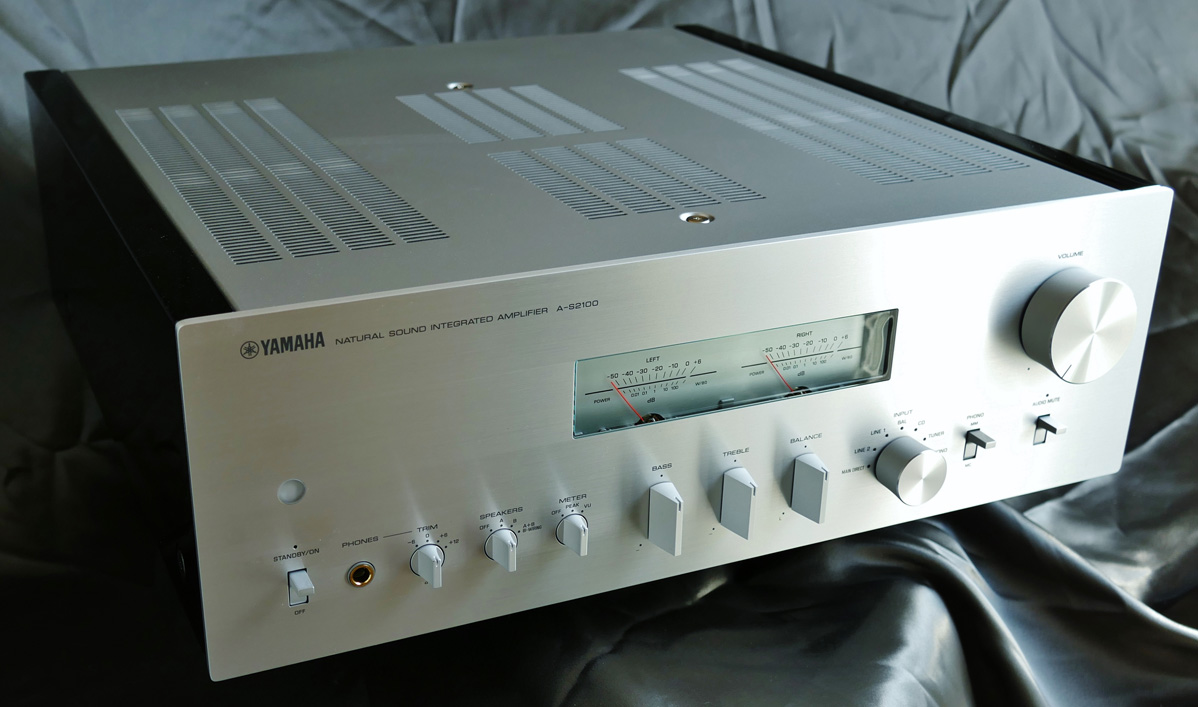
Where does all this leave Mr. Kumazawa's middle effort? It positions Yamaha on enviable territory. Performance at least matches if not exceeds competitive dark-horse overachievers at comparable prices and that means it can match or outperform most separates well beyond its cost. While Yamaha's no-holds-barred A-S3000 stands even higher, the far more attractively priced A-S2100 represents an accessible real world product that is far from being a weak sibling. Mr. Kumazawa has successfully lavished accumulated experience and an embarrassment of hand-me-down riches into the creation of his middle Mosfet child which therefore exemplifies the law of diminishing returns with a vengeance. For the majority of music lovers, that will make this second offering their first choice. If the faceplate wasn't iconic legacy, the A-S2100 would be applauded as a powerhouse overachiever, hitting miles above its asking price and setting standards for what can be expected. That's a tall achievement for our corporate giant. Congratulations to Mr. Kumazawa and team Yamaha. Who would have thought that Yamaha could emerge as the top dark horse candidate?
|
 |
So… who should open their wallet? Anyone who likes their character in top tubular fashion is going to be very happy. This amplifier has sufficient grunt to accomplish most speaker pairings with authority and enough grace to honour the music when it gets rough. It is mildly forgiving in that it makes good recordings sound exquisite but won't make lesser recording sound worse than they are. Who should walk away? If you fly the transparency banners of cool, crisp, clean and quick or if you're allergic to the word 'musical', this may not be your companion. Other than that, you can consider the A-S2100 a legitimate high-end bargain that won't shy away from ambitious scrutiny. Yamaha have squeezed a lot into this middle tier at a very aggressive price. That makes it an easy recommendation.
|
|
Quality of packing: The product came in a double thickness cardboard retail box with internal molded Styrofoam spacers for protection. The main component came foam wrapped. Remote and included batteries were in a clear plastic bag. A manual came individually bagged and protected with cardboard. A power cord was also individually bagged.
Reusability of packing: Should be suitable for shipping if required.
Condition of components received: Perfect.
Delivery: Picked up from distributor.
Website comments: Extensive and extremely useful.
Human interactions: Highly informative and responsive.
Warranty: 4 years (in Canada)
Final comments & suggestions: The Yamaha A-S2100 sings with all the sonic audiophile trappings but from a musical heart.
|
 |
|

|
|
|

|
|

