 |
|
|
If technology is the method, music is the goal. You can assume that all my standard Reference Recordings, Telarc, Dorian & Co. made it to the listening sessions but below I've chosen material to reflect that the game should also be one of fun and discovery. This Yamaha is built for that so I took guilty pleasure in the advantage. Here's a roundup of a few cuts. "Hands to Myself" from Revival by Selena Gomez [Interscope] is a bouncy little Pop number with some decent production values. It's big, it's wide and it has some dynamic swing in its stride, along with bass lines that go reasonably deep and meaty. "What Do You Mean?" from Justin Bieber's Purpose [Def Jam Recordings] is a surprisingly well engineered Pop album that allowed Bieber to move away from his boyhood image but remain accessible to his audience. This type of material relies on strong beat and incessant dynamic bounce which here are complemented by a reasonably weighty tonal balance and a good attempt at artificial ambience with dimensional solidity. I'm going to lump the next two recordings together because the juxtaposition is amazing fun. The first is a synth gamer's soundtrack, the second a television episode soundtrack. These are two different composers. At the 05:30 mark into the second composition, you will experience extreme déjà vu. These are "Suicide Mission" from Mass Effect 2 [Jack Wall] and "This Time There's Three of Us (the Majestic Tale)" from Doctor Who. I also did the "Earth to Echo Suite" from the eponymous soundtrack by Joseph Trapanese. The movie has been deemed ET for a younger generation so expect some tugging on the heartstrings. The composer brings his prior experience from Tron: Legacy and Oblivion to bear and shows superb control with a graceful orchestral swell that hits climax not with a massive peak but instead a haunting single note of longing. The recording is a combination of synths and full orchestra and while not top audiophile caliber, it has sufficient dynamic swing and soundstage complexity to keep it interesting.
|
 |
Now I'm going to double up again on some material from the current Late Night Jazz Tidal play list. This is a lovely way to discover new material as well as meet up with some old friends. The names below are familiar chestnuts and the recordings are clean, capable and commendable.
"In a Sentimental Mood" by Duke Ellington & John Coltrane (1962) and "Moonlight in Vermont" with Stan Getz & Astrud Gilberto (2002). And now onto the meat of the matter. Yamaha built versatility galore into this pint-sized package but what did it sound like?
Straight out of the box, tonal balance was a little light although midrange and upper frequencies were impressively smooth, expressive and remained so for the duration. The 5" woofers utilize stiff surrounds and take their sweet time to wear in. If there is penalty for short-term patience, long-term rewards have historically been durability, predictability and superior control (in a properly matched enclosure). The NX-N500 made impressive gains in bass excursion as the speakers wore in, evolving from controlled but somewhat polite to controlled and quite deep. Yamaha played conservative on their 54Hz spec. Even when stand-mounted for no boundary reinforcement, the NX-N500 still showed activity at 35 cycles. The response at this point was hardly ruler flat or massively authoritative but sufficient to build a bit of solidity into the bottom end. The NX-N500 may not achieve Mark & Daniel bass but managed a credible job. Experiments with more conventional bookshelf placements showed that greater bass weight was achievable. It simply required judicious positioning to avoid anomalies in the lower midrange. As with any speaker, placement alters response. The pursuit of holistic quality proved more rewarding than single-minded bass quantity.
|
|
|
|
|
Yamaha's polyester tweeter imparts a somewhat forgiving character to the upper octaves. Upon casual listening, most people will assume that the tweeter is voiced soft. The reality is a little more complex. Although anechoic measurements indicate roll-off above 13kHz, my in-room response was considerably flatter and listening showed that the design was highly responsive. The sweetness in the top was more a product of lack of resonance. My Apogee ribbons speak in similar fashion so there were no complaints from me. Yamaha managed a convergence of musicality and control in this modest tweeter that may not be immediately impressive but will certainly wear well over the long haul. That brings us to the midrange. Classic speaker design aims to get this spot on, then move outwards from there. It's tough to accomplish in multi-driver designs and requires a seamless marriage between woofer and tweeter. British monitors are famous for their success here and the LS35a is still a prime example of a mini monitor done right. Yamaha's engineers went down the same path with the NX-N500. The transition between drivers is near seamless. The woofer and tweeter behave tonally and dynamically in close unison. As a result, the speakers are very effective in the extreme nearfield where any disparities in character would distract. The woofer is guilty of some rise in the 500-1'000Hz range which cheats articulation of vocal material. Still, the conceit comes off as minor in general listening. Holistically, the NX-N500 achieves tonal balance that flows from the midrange. It's mildly warm in British monitor tradition and struts a good blend of organic solidity married to superior responsiveness. It may not quite achieve absolutes but does manage to be an effective people pleaser by drawing attention to the heart of the music.
|
 |
|
Dynamics, detail, and SPL were not left on the sidelines. The inherent character of the ESS DAC was effectively employed to translate through the chain. The amplifier stages and drivers did a worthy job of keeping up with the DAC's signature agility, tracking nuance and major swings with good control up to the speaker's limits. Bi-amplification and drivers were well matched sets which didn't overreach to maintain consistent tonal balance. The drivers reach their maximum limits pretty much at the same time to compress in similar fashion over most of the band at that point, so much so that I was suspicious of soft clipping or other electronic intervention in the circuitry. Yamaha assured me that this was not the case. This points to very careful choices from inception to production to match performance parameters. The speaker of course does have real world dynamic limitations governed by size but those limits are quite cleverly disguised.
|
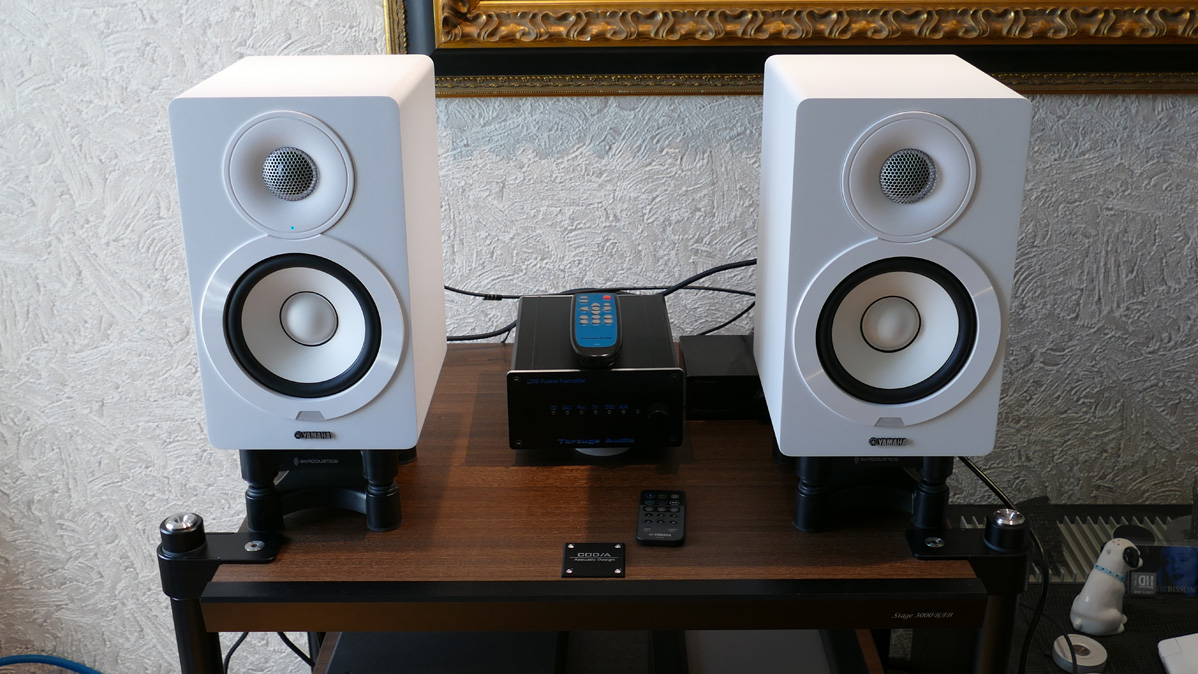 |
Despite the fact that the NX-N500 loses bass power past a certain level, the system maintains sufficient broadband reserves to give the illusion of considerably more weight and agility than the size would dictate. As with any small loudspeaker, there are absolute limits. When approached, the sound will progressively congeal, compressing dynamics and image depth until signs of audible distortion become evident. At the opposite end of the scale, the NX-N500 is one of those speakers that stays lively and interesting down to near zero, kicking effectively at real acoustic levels and benefiting those late-night listeners who choose to be considerate of their neighbours. With its low noise floor, it has a good combination of resolution, nuance and scale. Broken in, the NX-N500 can play to surprisingly satisfying levels with real musical life. While it will not play at party levels, it can fill a reasonable sized room with believable music.
|
 |
|

|

|
|
