|
|
|
|
X rated? Rating Tech X would require no break-in whilst the 15cm proximity figure promised easy on/off changes without leaving the room. As to where X Bulk would be most effective,
"you can try to connect to loudspeakers but a component chassis tap via an enclosure screw or ground post is better. Here the use of X Bulk is like the Tripoint and Entreq devices." I told Paweł that the shown spade would be far too large for most chassis screws though just right for loudspeakers. What I didn't say but think? Their naming conventions were some of the most unimaginative imaginable. And compared to the Dutch Akiko sticks which sell from €99 - €296 depending on model, the Polish pricing seemed high. Unless their stuff was from five to ten times more powerful (possible but for someone else to determine). And before anyone asks, yes, that's an €1'100 pair of Prada wedge shoes priced exactly like X Bulk Gold to keep Miss Hooey in the loop. Clearly, fashionable is in the beholder's eye. These would go swell with Highland Tartan cloth. Macho men, out with yer kilts; shaved legs optional. Back to Verictum. Here are some questions I had for my auditions. Given the phrasing that X Block "operates in a spectrum not reached by X Bulk", was it safe to surmise a higher frequency band? If so, how would sonic effects differ, then add up in combination? Would the twice-priced model be sonically more potent? Would there be an effectiveness sequence depending on whether X Bulk hung off a DAC, preamp or amp enclosure? How about speaker terminals? Would there come a point beyond which X Tech no longer registered? Or was it really the more the merrier within the finite number of my loaners? Relative to finite numbers, ask any amp designer about bandwidth and power figures. Refusing to reveal those would seem churlish and sales preventive. Yet asking an RF/EMI filter designer exactly the same questions where power becomes attenuation/suppression strength could become less than straightforward. |
|
|
|
|
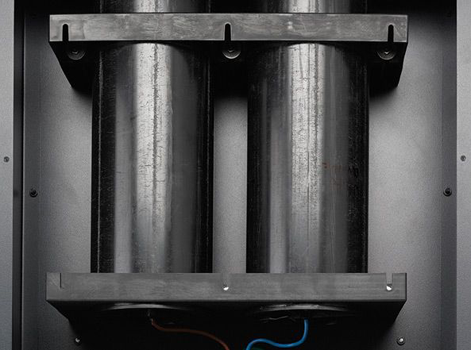 |
Shunyata's most current power conditioner tech shows cylindrical chambers filled with their own "Technology X" compound to fully embed their wiring.
|
|
Or so Paweł Czubryt explained. "For data proving an effect of RGC-2, we used the Radiation Technology's electric field-strength meter ELF-100E. The measured scale changed depending on the equipment but there was a definite decrease in electric field strength. We measured 900V/m before connecting RGC-24 and 750V/m afterwards. What was the bandwidth? How would it translate to improved sound? To show how our X Bulk is several times more effective becomes a complex issue depending on many factors. One would need to check the S/N of each component separately. This exceeds raw bandwidth figures as would be applicable for loudspeakers or amps. Generalities don't capture these effects. We are experienced audiophiles ourselves. Too many times have we seen that measurements don't come close to correlating with actually audible results. In our industrial company CTG Sp z o.o., we perform hundreds of measurements. For audio, we use our ears as the perfect measuring device."
In short, Paweł intimated that their refusal to provide bandwidth and 'power' specs wasn't evasive per se. It's because such figures wouldn't be applicable in the expected ways. Our contrarian Miss Hooey would wonder of course whether perhaps these measurements simply wouldn't look impressive enough to act as their own sales prevention if published? To wrap up our lengthy intro, does it strike anyone else as highly likely that embedding Technology X in equipment rack shelves could be ideal? You'd exploit the proximity/antenna effect by placing a component on top of such a shelf which would also shield it from/for the component below and vice versa; and one could easily connect a short wire between each component's chassis and its shelf in the back in X Bulk fashion, no separate add-ons needed. |
|
|
|
|
|
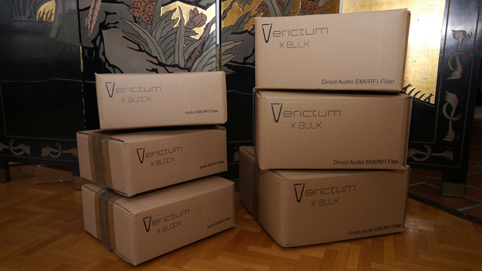
Verdictum. Whilst rather a few months flew by post solicitation including summer vacations and further product refinements, eventual delivery from Poland to CH took only 24 hours. The main system installed just then had the Fore Audio DAISy 1 tube-buffered DAC, the Crayon Audio CFA-1.2 solid-state integrated and the Voxativ 9.87 system. The latter combines 104dB efficient widebanders with 2 x 12" isobarically loaded H-frame style folded-baffle subs of 99dB efficiency driven by integral class AB 250-watt plate amps.
For ultra resolution purposes in pursuit of possibly very subtle effects, this was as ideal a hobbyist laboratory as I could imagine. Delayed timing proved most fortuitous indeed. Let's inspect these latest GenXers.
|
 |
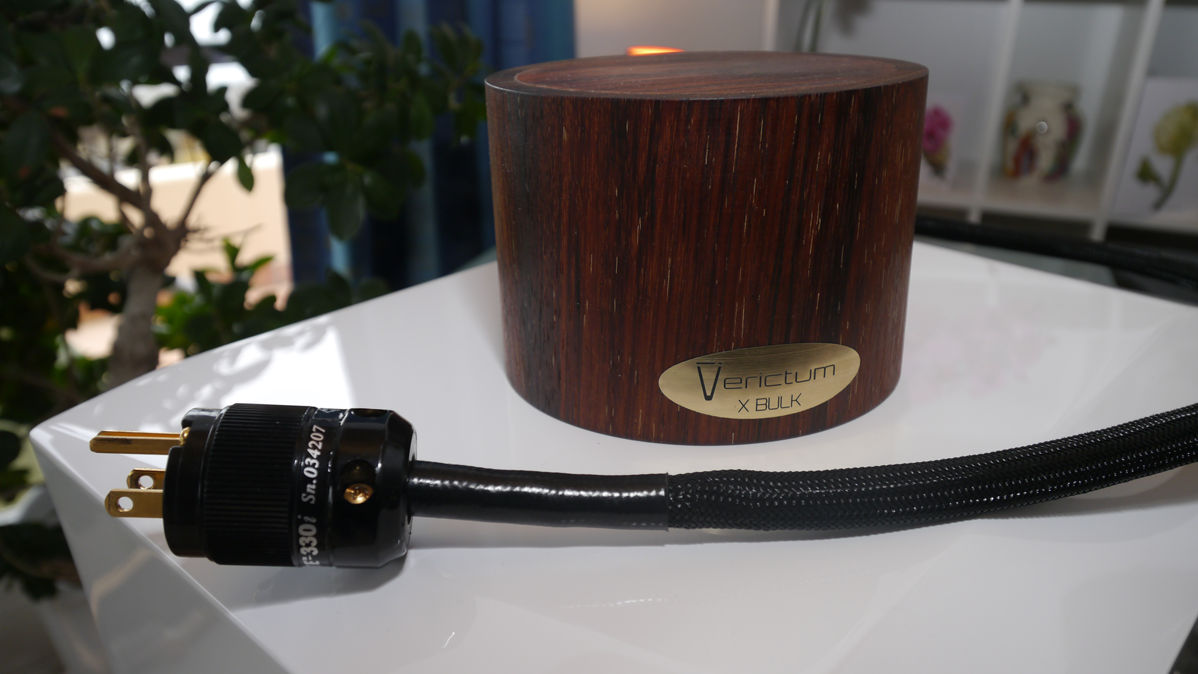
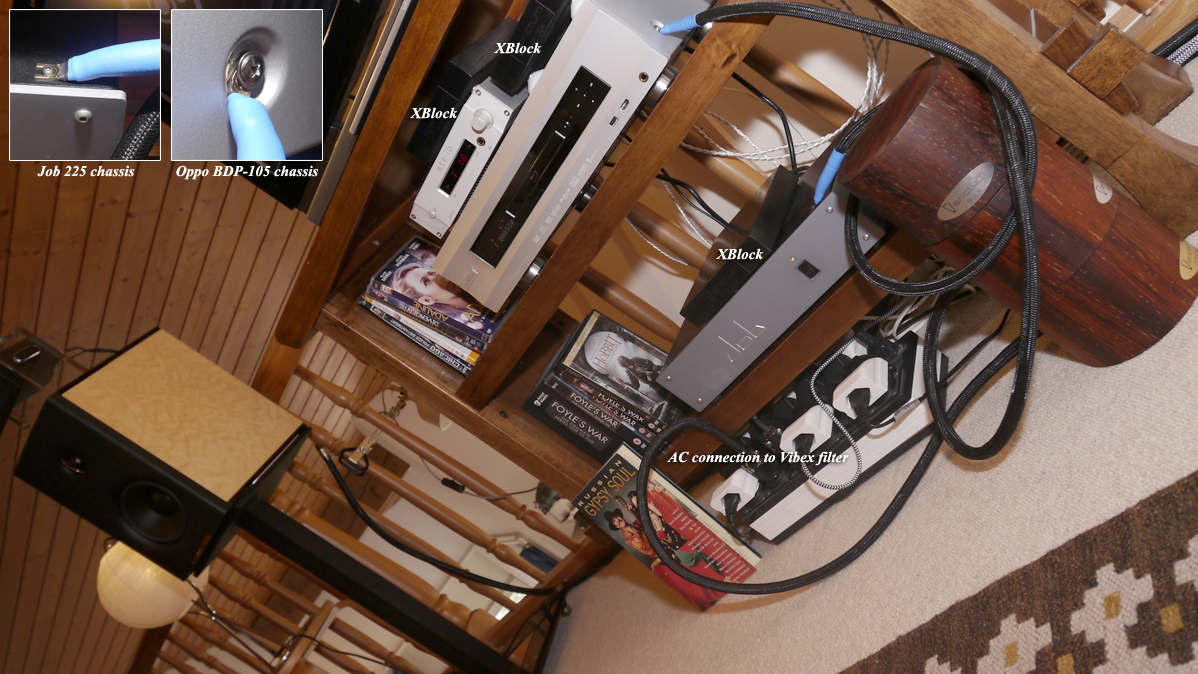
The X Bulk is sized much like a 50 spindle of CDR/DVD. It's encased in a reddish-brown wood on all sides and pigtails into a 90cm cord with a small silver spade or WattGate 330i power plug. There's a logo decal and serial #.
|
|
|
|
|
 |
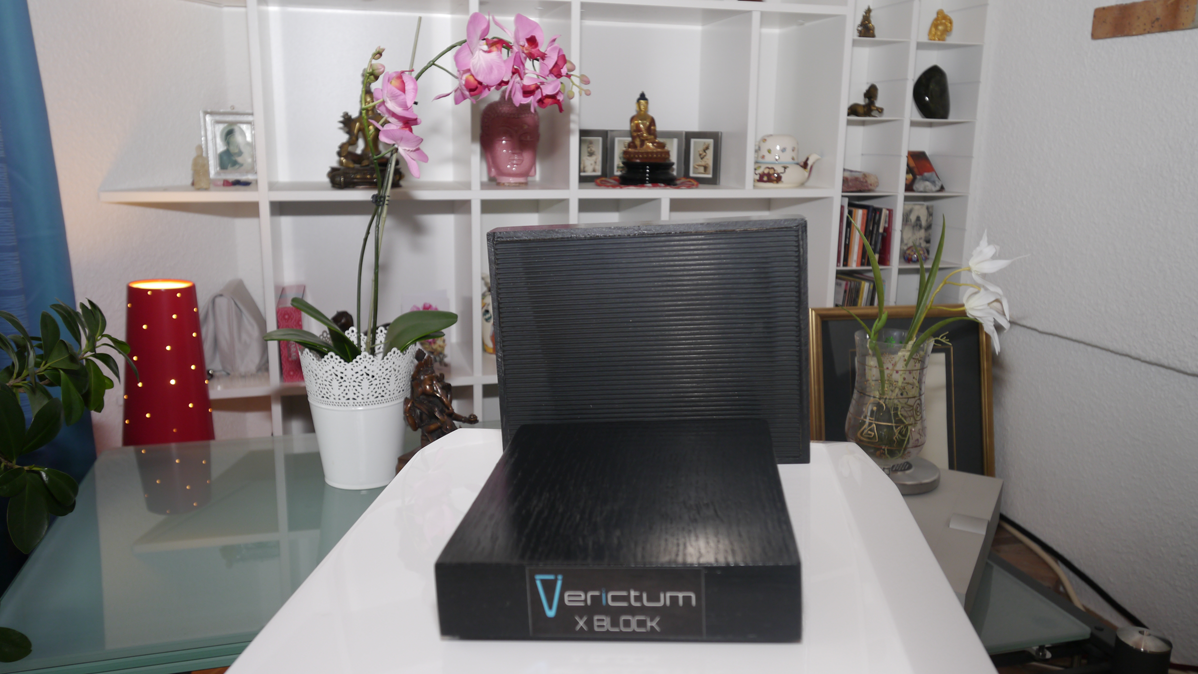
The wood looks naturally thirsty and for each unit a bottle of oil with a wipe is included to refresh the natural finish as it dries out. The X Block changes color scheme from reddish-brown/gold to stealth black and a whisker of blue. It also seals inside a differently grained wood species. Size mimics a Robert Ludlum paperback and there's a ribbed non-slip rubber mat glued to its belly. If you turn it so the logo decal doesn't show, you could pass it off as a small mass damper. Its light weight simply wouldn't serve that purpose. On either unit, nothing rattles, moves or hisses like early Shunyata power snakes. Whatever is inside is packed tight like sardines in salt and/or potted. No rainstick effects.
|
 |
Effects of a different sort began when the Polish stuff inserted into our upstairs 2-channel video system. Admitting this suggests a Heyoka, the contrary warrior of the Lakota people. Like with his alter ego, Medieval Europe's court jester, the chief or king couldn't take offense at his contrarious utterances or annoying behaviour. It was all meant to rattle taboos and provide for an alternate reality perspective. Verictum made for a decisive disccomfitingly easy on/off difference. Its chief contribution was a more robust organization of the soundstage and higher focus of sounds within in. A secondary effect was reduced HF glare which on vigorously bowed violins like our Russian Gypsy Soul compilation CDs sounded sweeter, less abrasive, less wiry.
|
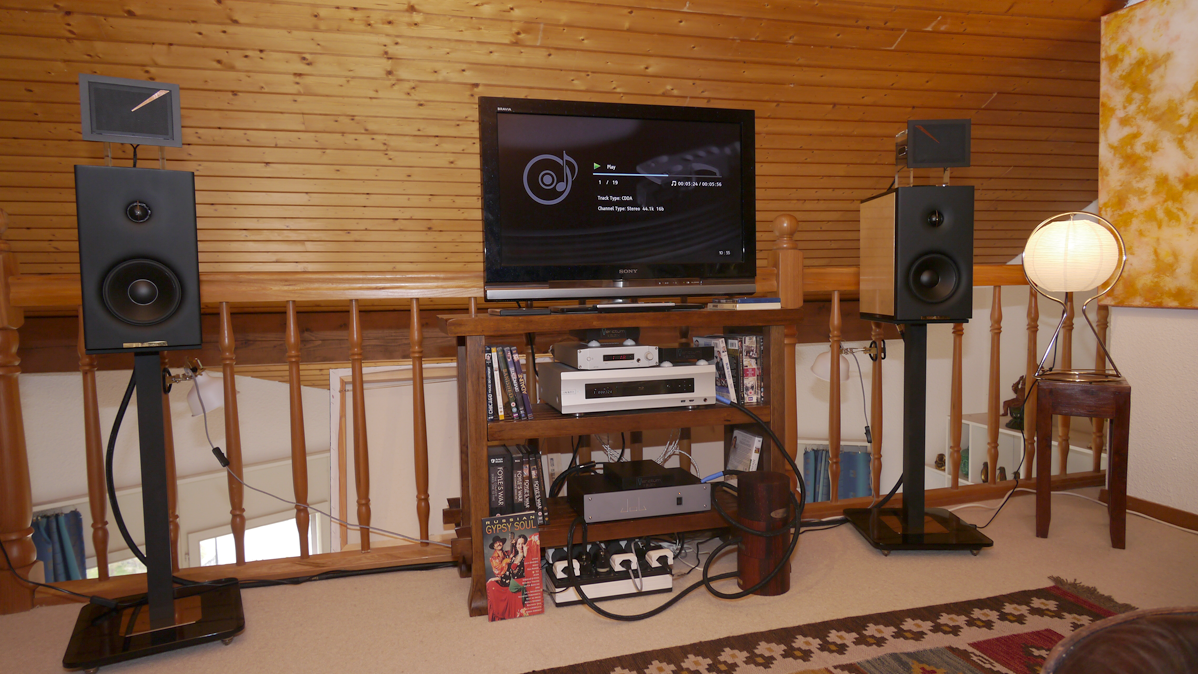 |
According to hifi's time-honoured truism of "you don't know what you don't know until you do", what Verictum address are things one wasn't aware of until after. Hence the most telltale exercise is to insert all of this stuff without paying any particular attention, living with it for a while, then taking it all out. Upon removal, a degree of HF glare returns, general focus and contrast ratio collapse to their previous states. Whilst certain tweaks can be subtle at best, hence ambiguous, this wasn't. The Heyoka's riding backwards on a horse with his clothes inside out only reared its contrarious head when I reminded myself. I had €4'950 of tweaks at work. They better did something that was audible. SST Audio's superlative 200wpc fully balanced Son of Ampzilla II stereo amp for example is $3'500. Hello! It's important to remember hierarchy. No amp, no sound. No Verictum, plenty of sound. These devices aren't cheap. Au contraire. Citing the Akiko Audio sticks again, they seem exceptionally costly. On the upside, my first audition justified itself sonically without doubt. It was time to move downstairs and itemize Verictum's contributions step by step.
|
 |
|
 |
|

|

|
|