|
|
|
Deliverance! An exclamation rather than question mark previews that after a bit of a shuffle—including replacing the darker Pass Labs XA30.8 with the lit-up very quick Crayon CFA-1.2—I finally saw the same light as my reviewer colleagues from around the globe had in their glowing reviews. With final placement having speaker baffles at 1 metre from the front wall, soundstage depth predictably collapsed. C'est la vie and something classical British reviewers focused on PRaT and 'playing the tune' wouldn't even understand as a complaint. On the other hand, the midband ringing had nearly completely disappeared whilst the bass descended lower. The general voicing was still a bit darker and short on ultimate presence-zone insight, hence my swap to our Austrian ultra-wide bandwidth amp to inject a bit more air and light from on high.
|
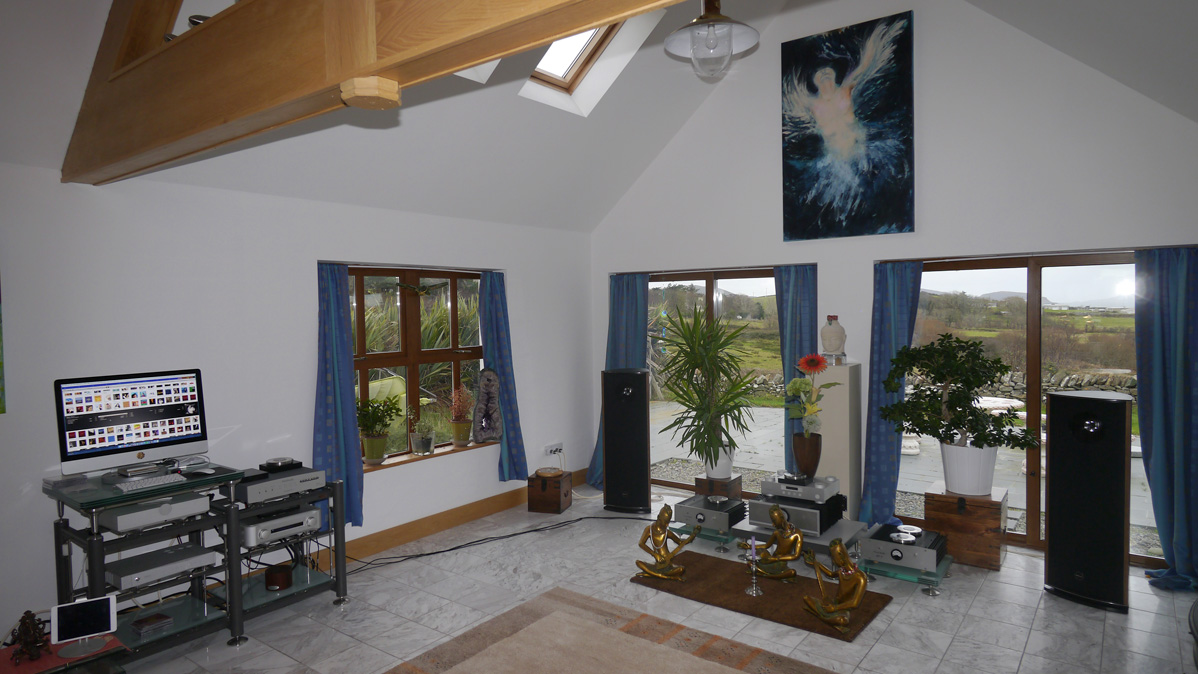 |
In the above configuration—iMac --> PureMusic to 352.8kHz NOS-style upsampling --> Aqua Hifi Formula --> Esoteric C-03 --> Crayon CFA-1.2 --> Model One—the oft-cited but due to its market rarity far less-heard quality of sealed bass asserted itself blatantly. Whilst lacking the last ten cycles of our equally sealed but actively EQ'd Zu Submission subwoofer, this bass was taut, grippy, free from all slop or ringing and potent without in any way acting overbearing or 'enhanced' (routinely a weasel word for unnaturally pumped up). But this bass also exhibited real fruitiness to counter the shadow side of control which can become excessive jackhammer dryness. This Slovanian could render far-left piano salvos with very believable rumble without putting a steel-shot damper on the instrument's oscillating sound board. Lovers of bass-heavy modern music who additionally like to listen loud will in this Ubiq find the ideal transducer. Crack, pop, slap, grunt, growl and sundry jungle animal words are all in the Model One's daily vocabulary. This injected a terrific sense of vitality and 2nd chakra rootedness. It made for a very distinctive bottom-up perspective that had both feet most firmly on the ground, i.e. not in high-heeled pumps but steel-toed construction boots. The Model One would likewise be ideal for tone freaks who dream of powerful KT150 push/pull majesty but could never commit to glowing glass. The 8+12 combo inches of diameter surface created that type of juicy rollicking big sound already with transistors pure, no valves in sight. That meant true black values in the color palette replete with their normal saturation effect across the rainbow range. Payment for these virtues came in the form of diminished stage depth; less finesse in the general violin/soprano/cymbal playground; and lowered walk-in transparency. |
|
|
|
|
Listeners keen on ultimate separation, air, lucidity and holographic lock will accuse team Igor's voicing of being too rich in red meats and fatty nuts; and not high enough in leafy green veg and citrus fruit. As we've learnt from their design brief, these were very intentional choices. They gift the Model One with a specific classic sound profile that positions it well beyond how regular reader Peter described a recent sonic encounter: "A couple of weeks ago I drove a couple of hours to attend a demonstration of the Magico M3 speakers. They were driven by top D'Agostino Momentum monos. Digital conversion was handled by the 4-box dCS Vivaldi. The Vivaldi costs around $108'000. The M3 list at $75'000. Stereophile lists the D'Agostino amps at $55'000. With music server, wires and other accessories, my guess is that this system came petty close to $300'000. I found the experience to be disappointing, boring, lacking in emotional impact and also fatiguing. If I owned it, I would find myself wanting to turn it off after about a half hour. Whilst the presentation was huge and very dynamic, I found it too big - unrealistically big. Voices when that huge don't sound natural to me but "amplified, amplified". Also, bass was bloated and lacked tightness and definition. It was hard to follow the musical bass line. The highs were not really strident but rather, hard sounding. This would account for my listening fatigue. Timbres, especially of stringed instruments, seemed just a tad off. The presentation sounded more digital than analogue. When sounds are too edgy, I get an ear sensation, a type of overloading, that's physically uncomfortable and almost painful. I experienced this several times during the demonstration. I found it exaggerated, hard and boring. I could not wait for its hour to end."
|
 |
Based on his experience, Peter might likewise accuse the Model One's reading of being perhaps still "too big" as in, profoundly robust. But categorically, he'd not find it fatiguing, dynamically overtaxing, suffering from LF boominess, digititis or nervous system assaultiveness. Admittedly, today's Ubiq recipe is based on running things just a bit louder. It behaves like a mondo engine happiest at full cruising speeds, not crawling along in 1st gear. It's not a wispy vocalist fairy. It's a big-mama power belter like a Chaka Khan. It doesn't mean anything excessive. It just means that the full power and glory of the design only show up at pay-attention levels. One might call it the sonic equivalent of comfort food but that wouldn't cover the boisterous elan. Where a heaping serving of bangers and mash washed down with ale might leave you in a slight digestive daze, the Model One wolfs down the same plate, then energetically digs trenches right after. It's the decisive difference. It's very generous gastro-pub grub with a pure juice-bar vitamin buzz. It's a happy meet of basso profundo and get-down gospel funk. Splashiness, tizz and nervousness are just as anathema to this picture as are bloat, ponderousness and hype. To come off as designed merely requires close front-wall proximity which, by implication, undermines the depth perspective of the soundstage. By the same token, the Model One goes places where many high-end speakers do not. Those rely on placement well away from boundaries. For many normies—those level-headed civilians who refuse to kowtow to hifi fuss and demand practicality in all things—that happy fact alone could put the Model One on a very short list of contenders indeed. It won't upset domestic peace. It wants to be out of the way rather than in the middle of the room. And it really does look like a high-quality piece of furniture, not a steam punk freak or hi-tech cosmic Devialet egg. You'll simply have to go over its cloth derrière with a sticky roller like you would a black wool coat when dust and fibres begin to settle on it.
|
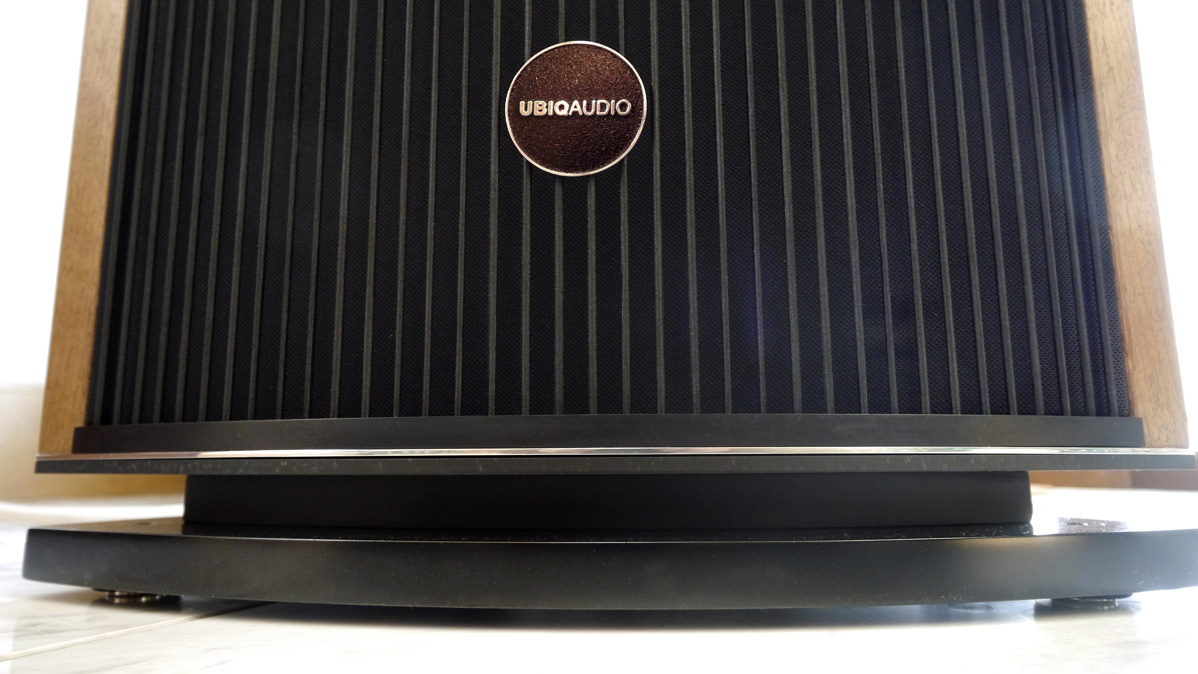 |
Ubiquette. To wrap up, etiquette for the Ubiqs wants them close to the wall not just to support their sealed woofers with extension but even more importantly, to minimize the time delay of the midrange's finger "ports". A contour knob behind the baffle cloth in the lower right corner can increase the hornloaded compression tweeter's output by one decibel for those who find the overall tonal balance too dark. (That's easily done because the BMS 4538 compression tweeter is a whopping 114dB sensitive. To match the speaker's far lower 88dB figure, Ubiq must kill off at least 26dB of driver gain though its horn loading probably raises that figure. The +1dB setting just alters the resistive value.) With its 8" papery mid and 12" papery woofer, minor darkness remains a central focus of the Model One either way and shouldn't be considered a defect. Rather, it's a strategic strength based on a different assessment of what's important for long-term playback satisfaction. The Ubiq is for folks who want their dynamics to scale in big-bore fashion; who want their tone to be beefy and robust; who want their mids centre stage; and their bass of immutable Rock of Gibraltar quality. No wonder 70 pairs of these already sold in their first year. Rarely does one witness such a mature first product from a new hifi company. Ubiquitous? Anything but!
|
|
 |
|

|
|
|

|
|