 |
|
|
With fixed not auto bias, an Eos+ owner gets to occasionally check bias current. Child's play. After having seated the clearly marked Russian Tung-Sol KT150 in the V1-V4 positions and done the same for the unmarked Slovakian JJ ECC99 and Dutch NOS joint Army/Navy 5687, fire the amp up. Let it idle for about three minutes. Sans signal, set the bias selector knob to V1. Look at the central meter that forms the 'O' of the Eos name. If its needle pegs under or over 50mA, insert the included screw driver into the V1 trim pot on the right cheek. Turn until the needle hits its mark. Repeat for the other three output tubes. Reset bias selector to '0'. Play music.
|
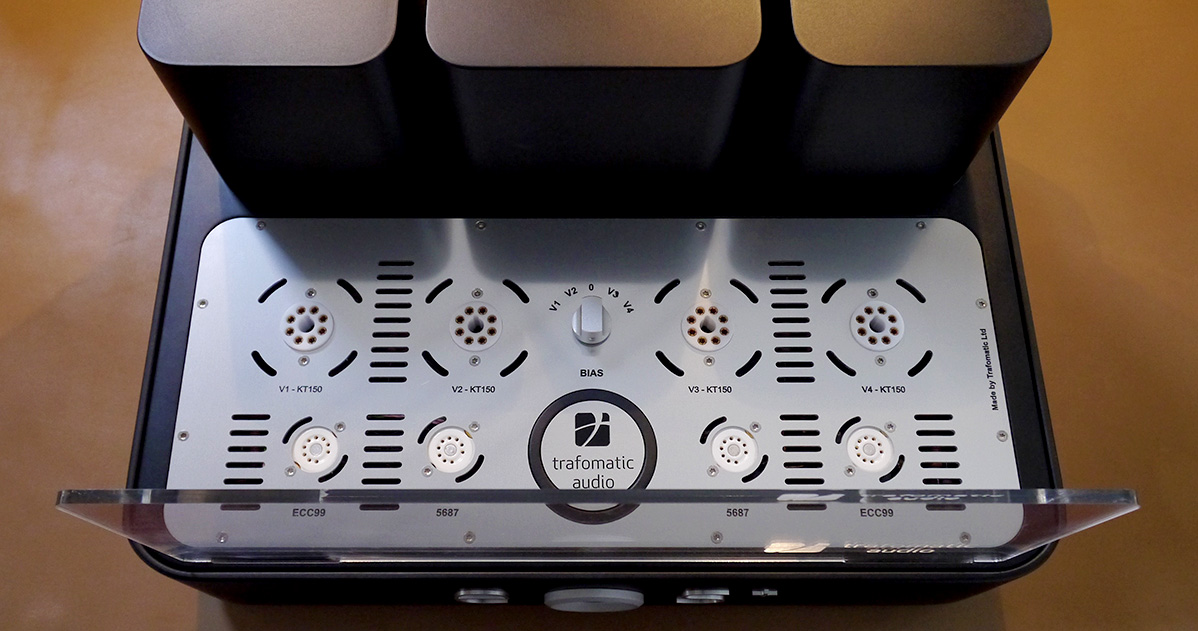 |
The plexi tube shield with engraved branding simply slots into two chassis recesses.
|
And so I would have done had it not been for a Murphy visit. Because the transformer bolt of the PSU had gone to barely hand-tight in transit (likely insufficiently torqued by its assembler), it had allowed the massive toroid to rotate some inside its bracket. That had eventually yanked on the 115/230 voltage selector's wiring harness to pull it out of its frame and in turn shear off its front half. Though all the wiring to and from its back remained untouched, one critical contact had broken. Without PSU, the amp wouldn't power up. So I retightened the errand bolt with a wrench, closed up the cover, repacked the power brick in its crate, emailed Sasa and benched the assignment until a new supply would arrive. As the Chinese sages knew already millennia ago, Tao happens.
|
|
|
|
|
Loopy grounds. A few days later FedEx dropped off the replacement. Now the bias'o'meter lit up white for a classy 'on' reminder which even in broad daylight when the bottle glow won't show tells you that the amp is live from across the room. With our COS Engineering DAC/pre, Wyred4Sound preamp and whether by RCA or XLR—this included Trafomatic's own Lara two-box flagship preamp—and in both wall-direct and Vibex filter modes for the amp, Eos+ caused a persistent ground loop. That this wasn't its power supply was plain once I pulled the interconnects on the amp. Instantly the hum disappeared for graveyard silence. Hmm. None of our domestic gear no matter the combination ever causes a ground loop. This was a novelty and an unwelcome one at that. Not wanting to run the amp or other gear off a wobbly cheater plug, I thought about how on our Nagra Jazz preamp, the balanced outputs are transformer-coupled. I reasoned that their gap really ought to snap the errand ground current like a twig. And indeed it did. Hey, solid hifi reasoning works; sometimes. Because I'm a religious allergic when costly performance hifi makes even small noise, I ran with the Nagra in XLR and zero-gain mode for the duration. That categorically shunned all hum for a perfectly quiet backdrop; a fine result with such a powerful valve amp.
|
 |
Running through a few playlists quickly demonstrated how compared to our usual sound (the same Aqua Formula converter-->Wyred STP-SE II pre-->LinnenberG Allegro monos), Eos+ showed decisively lower resolution and speed. Here its published S/N ratio of 82dB looked culpable. Our 1MHz German transistor monos rate at 120dB and 7ns rise times. If factual, such a 40dB offset in signal-to-noise would imply a greater than 6-bit resolution loss for the tubes. Granted, specs don't always correlate with how we interpret them. If they did, we'd all shop mail order exclusively and not bother with comparative auditions. Here sonics simply tracked how the numbers trended. But there's more to playback than maximal resolution and detail mining. Else we'd all listen to massive amounts of negative feedback in class D driving huge horns.
I first came across the term comfort sound with former Stereophile writer Chip Stern. To my mind then, he coined and owns it. Chip figuratively poured on the gravy over his mashers and roast to make a point. It's a persuasive image. It counters the three sprigs of asparagus and mushroom slices accompanying a sparse cut of lean meat in a drizzle of melted pepper butter. Chi-chi bistro fare meet honest pub grub. Starched linens meet paper covers. Everyone understands the difference. Everyone appreciates the subtext. One might taste sublime but leaves you hungry despite a big bill. The other satisfies profoundly for a whole lot less. Against our residential status quo which simply means that which we're used to, Eos+ celebrated uncomplicated comfort sound. With that on today's menu, what did it actually put on the plate; or take off? As transistor man, what I mainly heard were the effects of the output transformers on bandwidth and phase; and the effects of tubes on operational self noise more so than THD.
|
 |
|

|

|
|
