|
|
|
To shine some light on wishful versus realist thinking, I swapped Dan the d1-six-tube whilst I had his Tobian. Then we performed the same experiment, he on his 104dB Voxativ 9.87 system, I on our 85dB EnigmAcoustics Mythology M1. We replaced Vincent's digital attenuator with Vinnie Rossi's analog autoformers. Being Lio owners both, we thus used the same reference-calibre passive preamp, mine white, Dan's black. Of course he required wildly more signal cut given his ultra-efficient widebanders. That's actually an advantage for transformer volume controls. The higher the attenuation, the higher their current delivery. "It's a very good machine but sounds a lot better as converter than preamp." In short, for Dan amp-direct drive with the TotalDAC was noticeably inferior to inserting a passive preamp ahead of it whilst tapping the DAC's full output instead. Would my own signal cut fall inside or outside Vincent's window of lossless superiority? One other bit of needful intel for my scenario? I run 6-metre interconnects between the side-wall variable source or preamp; and the front-wall amp.
Prior tests had conclusively shown that Lio had zero issues with my cables. Conventional passives with carbon pots or resistor relays meanwhile clearly favoured sitting next to the amp with a short 0.5-metre cable whilst the DAC drove the long distance. How about the French?
|
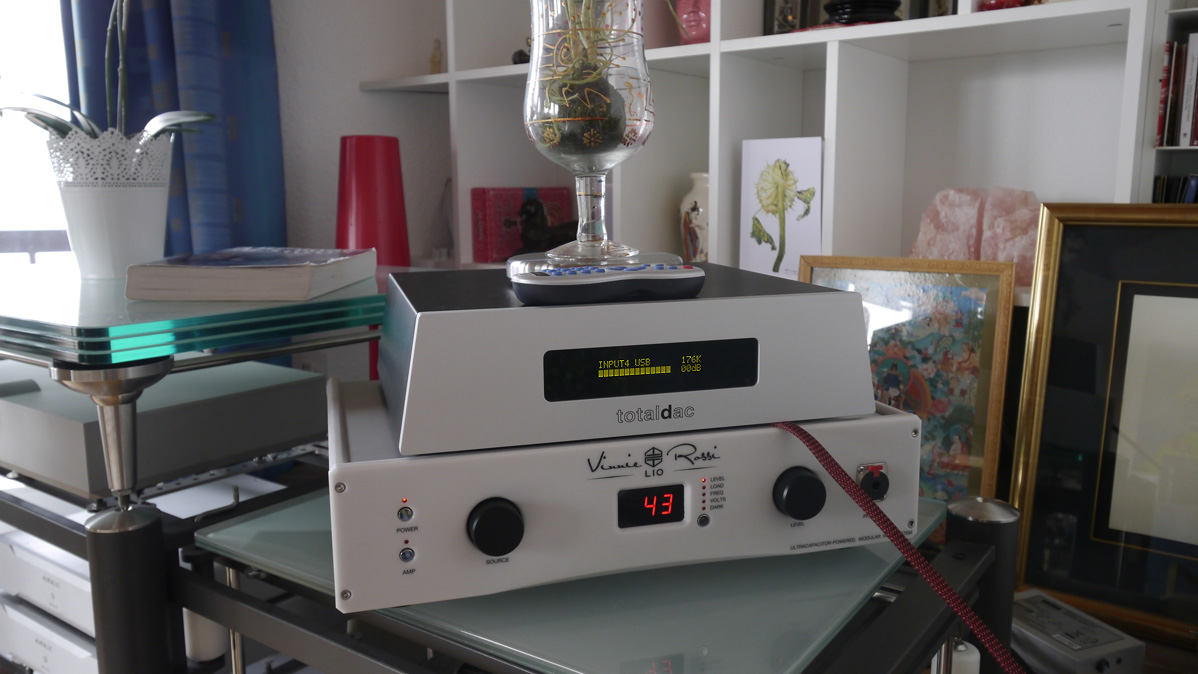 |
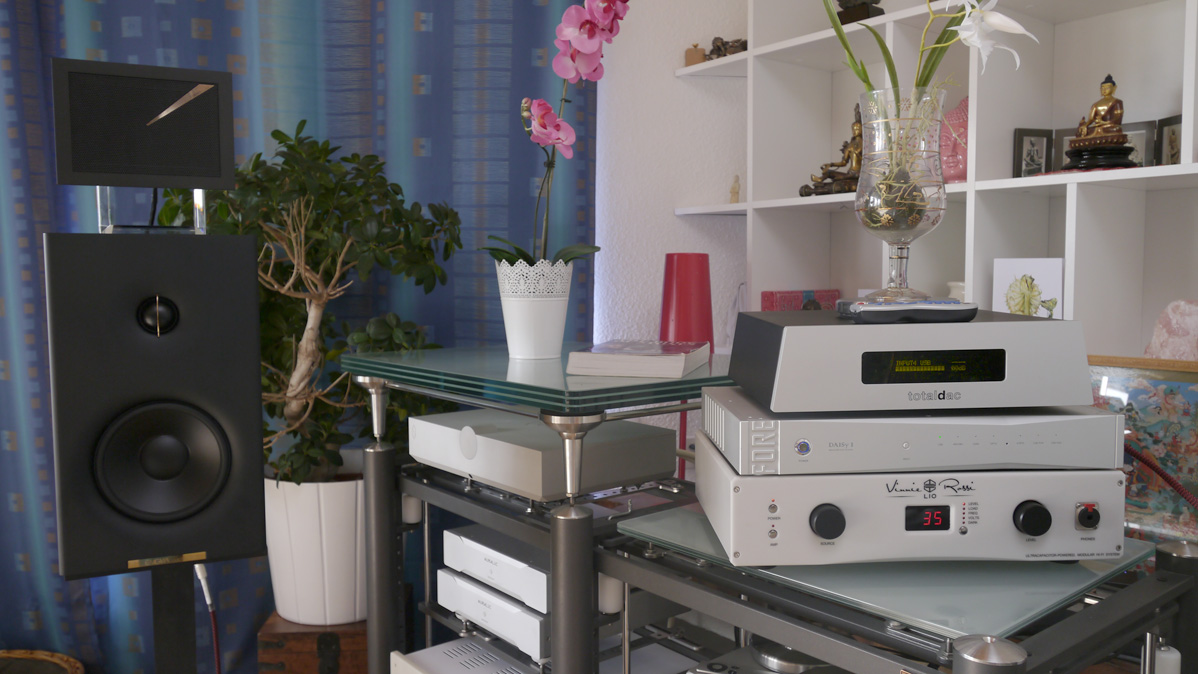
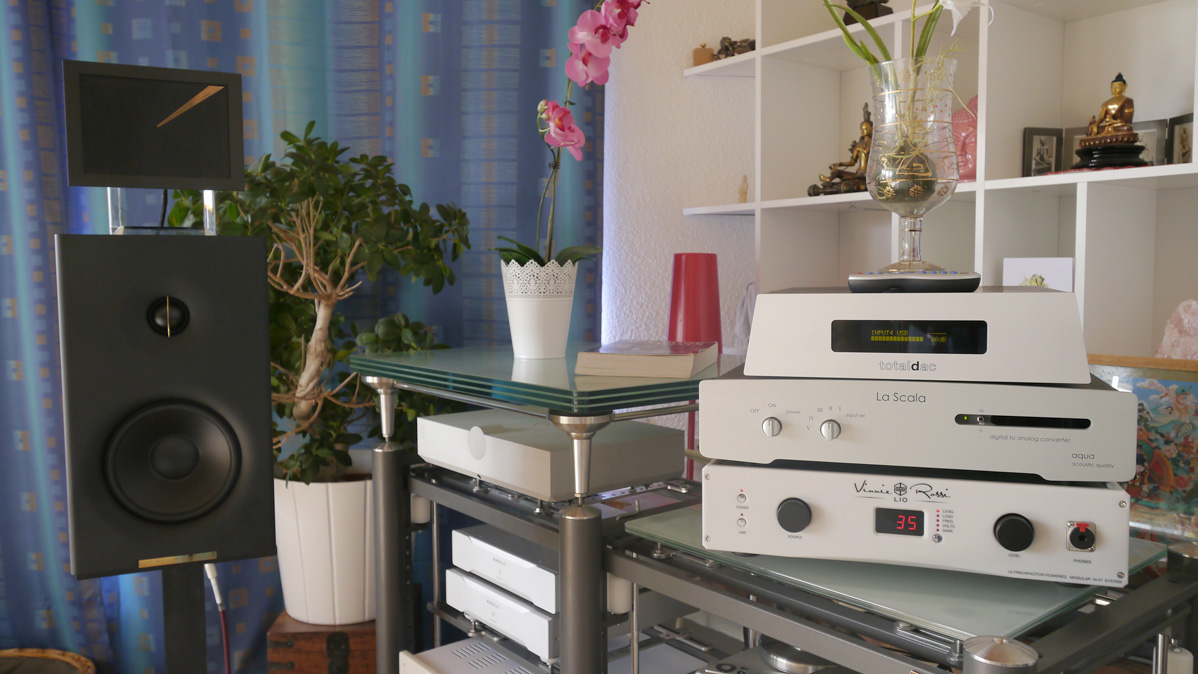
To distinguish between raw drive and attenuation, I compared the above stack as stack and individually. In the first mode, the long interconnect remained on the Lio. I simply attenuated either the TotalDAC (Lio set to 55 to avoid its 7dB of passive transformer gain) or the passive (DAC set to 00dB). In the second mode, each deck handled both attenuation and amp drive, long interconnects toggling between them. Using 12dB of cut on some brilliantly recorded Tord Gustavsen piano trio Jazz, I thought mode 1 a wash. In mode 2 however, TotalDAC direct sounded leaner and a mite washed out. Replacing Lio with Nagra's Jazz preamp showed what the addition of a proper valve output stage accomplished: noticeably more heft and tone mass, higher 3D sculpting, bigger dynamics and nary any sacrifices in lucidity and ambient micro resolution. By comparison, Vincent's 12AU7 buffer seemed more tack-on than ground-up mature valve circuit. If I wanted bona fide valve contributions, I'd go after the d1-six and a real tube preamp with thermionic voltage gain. With inefficient speakers and an amp of standard input sensitivity, I'd also be liable to run out of gain with the d1-six-tube's max 1.4V. On the other hand, in my hardware context, 12dB of digital attenuation Vincent style seemed perfectly benign. To not muddy these waters with a pile-on of tube stages in series, I now stuck with Lio as volume controller whilst comparing the TotalDAC at full output against my two resident fixed-output valve converters: the Fore Audio from South Korea and Aqua Hifi from Italy. The former runs on ESS Sabre silicon like so many others; the latter on BB1704K on-chip R2R. Conceptually, the LaScala MkII is closer to the TotalDAC. The DAISy1 represents this religion's evil ΔΣ twin.
|
|
|
|
|
The evil twin pleaded its case with clearly more explosive dynamics and stronger more intense tone colours. That alone convinced this jury that its exactly half sticker of €6'700 was indeed a most attractive alternative. It even meant sturdier build, albeit no volume control. My tube DACs require a preamp or amp with pot. The TotalDAC does not. Truth be told, I didn't hear any real advantages for the discrete R2R scheme. As Juan-José confessed, it does read more advanced on paper. Costly nude Vishays engender all manner of supremacy expectations, no radical leanings required. On the other side, converters riding ESS sound far from all the same. There is zero implication that just any old 9018 DAC would compete with Vincent's. This is elevated terrain. The Fore Audio had simply battled it out already against Gryphon's mighty €20'000 Kalliope and of the same Sabre interpretation to win my Gryphon-lite sobriquet. In my system, the Gryphon extolled exactly the same virtues of intense tone and accelerated dynamics, just a bit more. For my consumption, getting better of 90% of that sound at 35% the cost was the happy decider. I don't earn enough to justify the Kalliope even though my ears know that it's still better and more of this same flavour. Back to the d1-six-tube, it's futile to speculate whether its paler politer demeanour versus Miss Daisy was due to its converter tech or output stage. To isolate cause would require very different experiments. Suffice to say that on raw sonic competitiveness, I must call the French deck costlier than necessary if one knows of the right alternatives; far from a given.
|
 |
At €4'890 and on coin count,
the Italian made for an even firmer secret handshake. Again, I detected nothing to suggest a lower tier of performance or any loss of information. On flavour or belonging to an identifiable sonic school, the LaScala shifted intensity away from the DAISy1/Kalliope aim at tone colour and dynamics. Instead it directed intensity at timing tautness. It's what our British colleagues peg as PRaT: pace, rhythm and timing. Versus the TotalDAC, the Aqua Hifi was more coppery, less silvery. This meant a lower centre of gravity, with subjectively less emphasis on the upper treble with its misty cymbal fades and pungent upper piano harmonics. The Aqua also struck me as a bit grippier where the d1-six-tube was very articulate and airy but temporally a bit less driven or tensioned.
|
 |
This segues into the TotalDAC's trump card. Its treble was the most explicit yet finely teased out of my lot. Running EnigmAcoustics' Sopranino electret super tweeter maximized that quality. Tiny tickles and swirls of cymbal brushes netted the most shimmery action. That this had the usual psychoacoustic effect of suggesting a slightly leaner cooler manner always comes with this turf. It's the perennial issue of framing a red-rose photograph with different-coloured mats. Each framing seems to shift the rose's tint even though the photo remains unchanged. If you're the type listener who favours the Sennheiser HD800 headphones for their exceptional airiness, you'd fancy this DAC's similar talents at very informative lit-up resolved high frequencies; and what it does for performer halos, venue reflections and the illumination of space. For me it's a repeat observation. To resolve maximum space goes counter to hanging maximal flesh on the musical frames. Density goes darker and thicker. The caricature extreme is the solid wall of sound that lacks distinctiveness and depth but seems cut-the-air there. Ultimate lucidness and air must shed some ballast of weight and density to let in the very last ray of light. Where on this axis one wants to sit is utterly personal. My two tube DACs dig deeper into mass and displacement for more black, less white. The TotalDAC prioritizes articulation and adroitness. From a customization perspective, it's deliberately modular, offering add-ons like headfi, higher output voltage, multi-way crossovers and more. It's not extreme value, however. Sharp-penciled shoppers have on-the-level alternatives for a lot less. But on the level doesn't mean identical sound. On the level means the same number of Michelin stars for the same dish but a little less salt, a little more pepper and so forth.
To conclude, the d1-six-tube is a heavyweight on soundstage sorting, image lock, localization focus and recovery of recorded space. It's exceptionally illuminated and fully revealed on top and all that without pixilation artifacts or what audio lingo calls spot-lighting. It's premium super tweeter turf instead - not sharp and needly but suave. It's a poster child for a modern definition of high resolution. If your amp/speaker pairing leans into the heavier and thicker; and if their gain and sensitivity have the TotalDAC hit your SPL sweet spot inside its -15-00dB window... you can even diss a separate preamp. Steer your volume directly off this converter without penalties. For deeper attenuation during critical listening, you'll probably prefer a different solution. Not having compared the 'six' platform with tubes against its transistor option, I can't speak to what these stock 12AU7 add or do different. I can say that the usual effects of dedicated valve output stages don't apply. If it's those you want, you'll need a proper tube preamp; or a DAC which embeds its tubes in a more convincing manner. Should you dream direct-heated triodes for the full dose, there's probably only LampizatOr. If you want today's sound as described and are married to the idea of discrete R2R - then your options narrow indeed. Now TotalDAC is one of the relative granddaddies of the genre. And they consider this their finest one-box effort yet. Time for a little tête-à-tête perhaps?... |
|
 |
|
 |
|

|
|