|
|
|
Given that I've played the DHT card, it's only fitting to say that compared to big direct-heated power triodes—PX25, 30A, 45, 50, 2A3, 300B—this triode-wired 4П1Л/4P1L pentode played it more damped and less Chopin. I did get some of the rubato effect, just not the fullest possible extent. More decisive than this temporal elasticity might in fact have been the rounder transients. Their pencil drew them with a blunter softer tip than a freshly sharpened ultra-hard lead variant not yet put to paper. This attack behaviour meant that on a cellulose widebander, the rise of tones was very minorly 'smudged' as though one had brushed over a pencil line with a finger. Very subtly this softens the transition from black mark to white paper. Those who find digital needly like nails tapping on glass would naturally gravitate to tapping with their finger's fleshy tip instead; or even insert some paper or cloth between it and the glass. All of it points at percussive qualities and how, quite like the angle of lean on a seat's back, leading edges either rise vertical like gun shots; or more leisurely and in an angle against time. Mating paper-cone widebanders which already exhibit this softer reading to equally weighted electronics obviously emphasized this quality. Whilst I fancied the tonal density and lovely colours, for my tastes I wanted just a bit more chorizo-style pimentón in the mix. Enter Nelson Pass' FirstWatt F5 with its more incisive 3rd-order THD signature. That countered the Lilt/Wave 40 trend for more apparent zip without getting frisky. This was a very successful example for how just the right mix of tube and transistor qualities—in this instance tubes in the pre, transistors in the power stage—creates a very desirable hybrid. This was a system I could live with over the long haul.
|
|
|
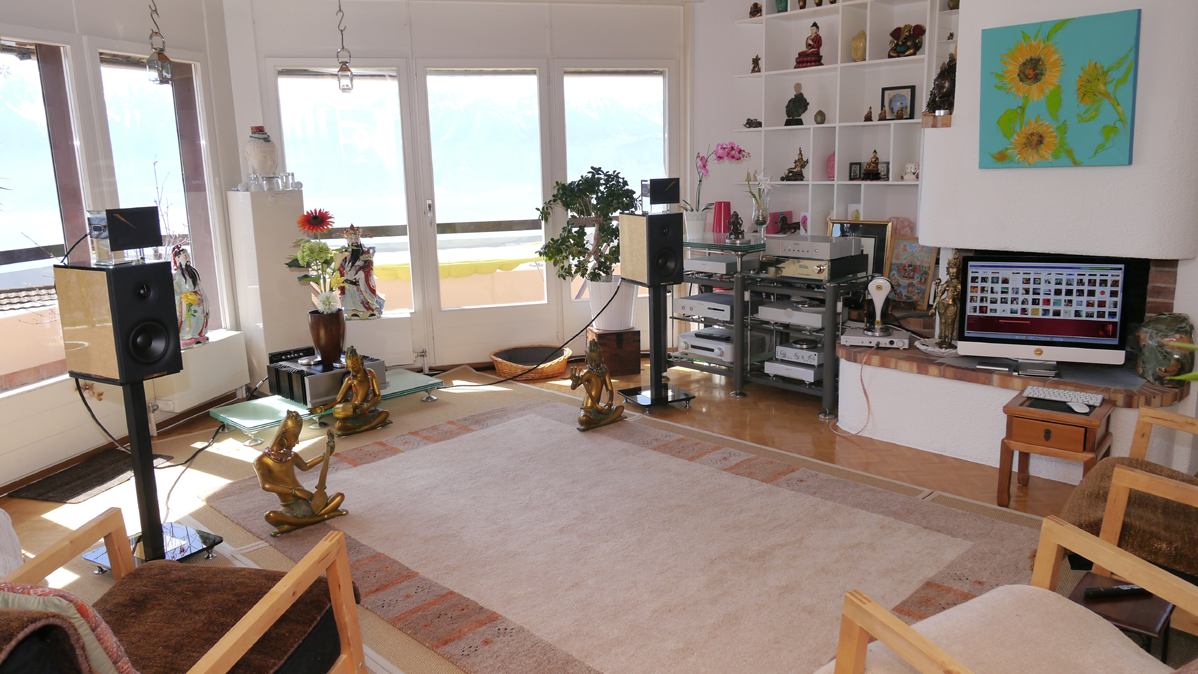
To check up on raw resolution, I took advantage of Cees Ruijtenberg's latest Pavane R2R DAC whose dynamic range and S/NR figures park it right at the edge of the current art. That fed one of the Lilt's analog inputs to isolate the discrete DAC by contrast. To rez up the far end, the SIT1/widebander combo departed in favour of the XA30.8/M1 trio. In our digs, the dual-tweeter array of the EnigmAcoustic Mythology 1 rules the roost when it comes to ambient retrieval, air, upper harmonic succulence and general space illumination.
|
 |
Starting off with the Pavane handling the digits, the Lilt linestage proved fully capable of transferring dense detail across the full bandwidth even though its minor operational noise bothered me in such a costly high-resolution context.
How would seating the dual-header red KingRex cable in the Lilt's USB port and switching to input 5 alter the raw information aspect? In the temporal realm of subjective time, the Lilt DAC sounded more stately. It seemed to meander more lazily as though something somewhere had slowed down. On general insight into the musical fabric, the frequency extremes felt as informative as the Pavane. In the vital midband however, the Dutch held the ace. And so it did in the depth domain of so-called layering, tiny venue reflections and the spatial context they help create. As tends to be the rule in this sector, these offsets weren't major. To identify them relied on better recorded material like the terrific sampler of the Norwegian label which handles Kari Bremnes.
|
|
|
|
|
Substituting the XA30.8 with the Goldmund Telos 360 monos upped voltage gain from 26 to 35dB. This finally made what I now suspected to be a ground loop and as such utterly independent of volume setting completely unworkable even over 85dB inefficient speakers. This hum had grown into a steady-state disturbance which was betrayed between each cut whilst raising the system noise floor during playback. This was even audible from the corridor 10 metres away. Floating the Lilt's ground with a cheater plug was the remedy. And, the "passive magnetic preamp as amplifier" paradigm of the €40'000/pr Swiss amp certainly appreciated the tone/texture assist of Alexey's transformer-coupled valves.
|
 |
Conclusion. Let's add up the evidence: an R2R converter executed with discrete resistor arrays and proprietary control logic; low-distortion direct-heated Russian pentodes run in triode à la Siemens C3m in Yamamoto kit; transformer coupling plus a very serious power supply. This nets converter performance on par with competition in the €4'000-6'000 bracket. Then it throws a 4-input active analog linestage with remote-controlled resistor-ladder attenuator into the deal yet still only wants €6'000. Whilst industrial styling and finishing aren't yet completely on par with the very best challengers, the sheer amount of raw stuff aka iron and other parts packed inside exceeds most. If you're leery of paying for mostly empty boxes done up with tiny surface-mount bits and ICs, S.A. Lab give you the full boat load. One look inside and you see where the money went. In short, Alexey Syomin's pricing is very fair.
Bundling his specific set of functions into a single deck means just a power amp, speakers and computer or CDP front end to be done. With finer valve virtues built in, a transistor amp will get virtually transformed into a tube hybrid. That's one of the established ways to arrive at the simultaneity of often mutually exclusive snap and curves, impact and languor. As you'd expect for an old hand with refined tastes, Alexey's choice of valve dosage is mild and predominantly focused on mellower transients, richer colours and an emphasis on melodic rather than rhythmic time keeping.
That's an effective antidote to the hyper-pixilated pushed-for-time urgency of modern sound that must be most explicit, sharp and rushed about it all. Ours is the Pornographic Age. Here's your vacation from it.
|
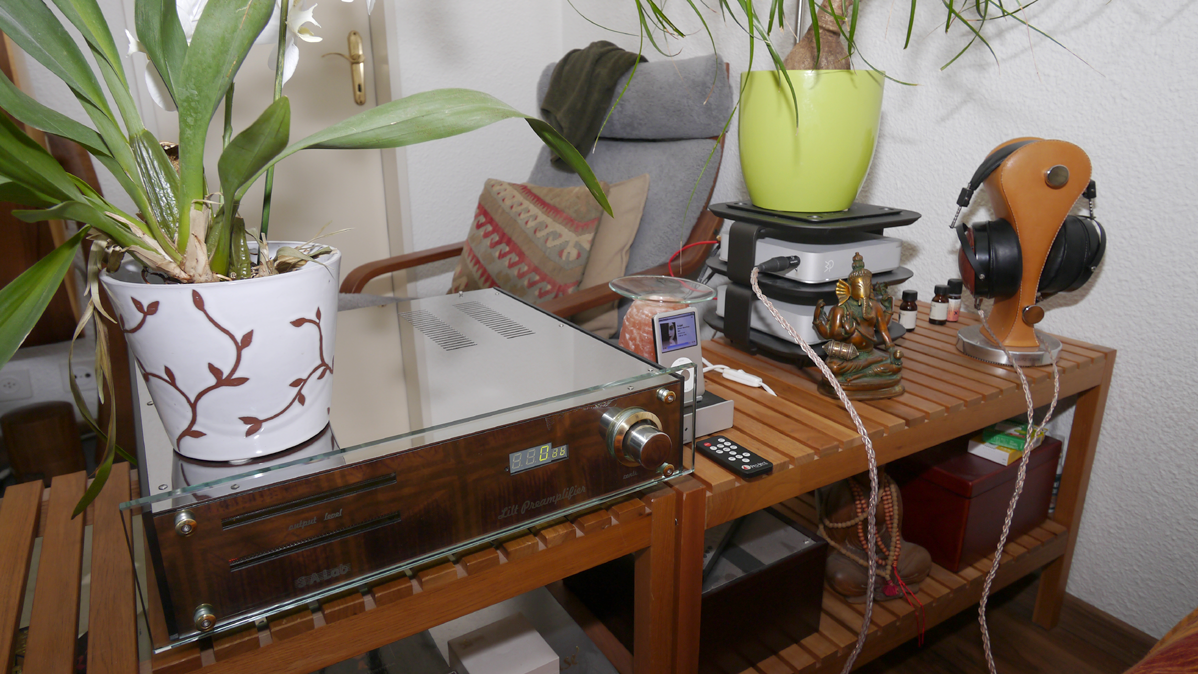 |
As a final move into my bedside headfi rig proved conclusively once floating the deck had already banished the noise in the big system, this circuit was indeed dead quiet. In this setup it didn't even require a cheater plug. Running fixed out into the hi-gain Bakoon AMP-12R into a pair of quite efficient Audeze LCD-XC would have been quite the on-ear disaster with any noise in the pipeline. Yet even under such mission-critical conditions, I had no evidence of noise whatsoever. Artjom Avatinjan was right. Alexey Syomin really knows his stuff and deserves wider exposure beyond the borders of his homeland!
|
|
 |
|
|
|
|

|
|