 |
|
|
At first, neither. Kevin had run into surprises when converting his machine for EU operation. "It’s been up and running for several days working quite well.
But I’ve been struggling with some combination of SSD/PSU issue at 230VAC/50Hz. After chasing tweaks to the power supply, I think the issue may actually lie with the SSD. I’ve got an SSD replacement coming shortly. I’ll let you know when I’ve got an ETA. If you have time to review the DAC first, that would be great."* The DAC in question was the $8'297 Virtuoso companion, a dual-mono fully balanced 24/192 affair with four converters per side, differential tube gain via 6H30P, shunt volume control, the usual digital inputs plus la pièce de resistance, I²S implemented on HDMI. When leashed to the matching I²S of the Acapella II, Kevin insists that it obliterates coax, BNC, AES/EBU and USB. With bandwidth of 10Hz - 100kHz -0.3dB, this looked to be a direct challenger for my Aqua Hifi LaScala MkII, albeit for rather more dosh. Obliteratum moribund?
|
| ______________________________________________________________________________________________________________________________________________________ |
* A subsequent email detailed the exact issue: "We tracked down the power issue. Our 5V PSU that feeds the SSD in the A Cappella II needs some minor rework to handle under-voltage scenarios when set up for 230VAC/50Hz. It's a non-issue on small SSDs which have lower current draw. It's a non-issue at 120V/60Hz and even at reasonable under- and over-voltages. It's even a non-issue at 230V/50Hz and reasonable over-voltages. But when the voltage drops below 230V @ 50Hz, the issue rears its ugly head. Our supply sags a touch and the SSD (which pulls peak current at boot up) is underpowered. That's caused me substantial headache and confusion trying to track. We've been using an AC power regenerator to create 115V/50Hz and a step-up transformer to ultimately create 230V/50Hz for testing. Now that we're clear on the issue, we've set out to fix it permanently. We're working through a minor redesign so that we can use the same PSU regulation circuitry for US & non-US customers. Ultimately we want to make sure our new design has no negative impact on sound quality."
|
 |
Time for a look beneath the cover. It's something the Musica Pristina website plays coy about. On circuit descriptions too it only gives the very basics.
|
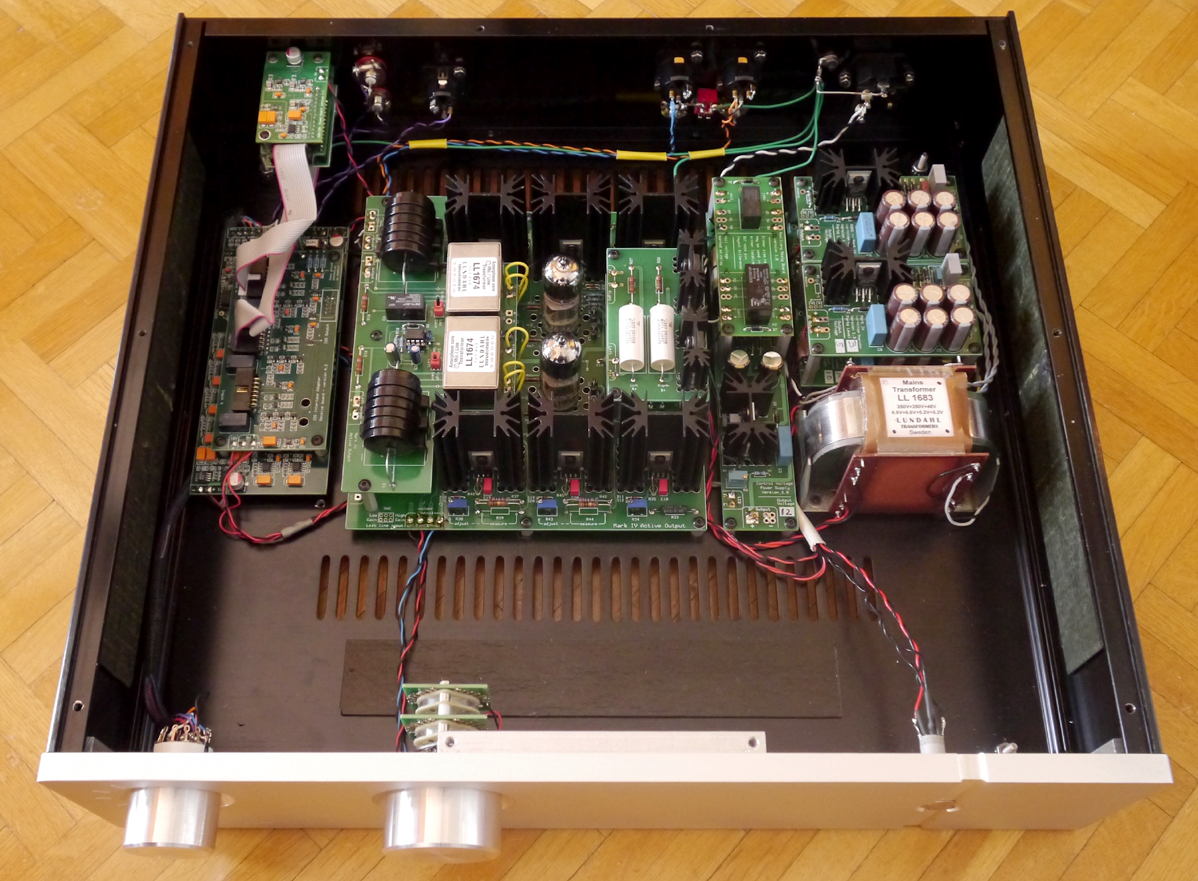 |
A look-see wouldn't get one any deeper into DAC mysteries as the I²S adaptor board conceals them. Clear is that box depth is 1/3rd larger than needed to accommodate the actual guts. Time to get Kevin involved. "I wrote the code that runs the A Cappella II and am intimately involved with it and our chassis design. But I'm not an electrical engineer. Dave Davenport is the engineer behind our DAC.
As the name digital-to-analog converter implies, there are two equally important parts to a DAC: the digital and analogue sections. We all know that careful component selection and circuit configuration are hugely important for an analogue circuit. Most of us know that component quality as well as attention to circuit design is equally important for digital circuits. This notion has been spreading more widely in the past few years. But to me, few people seem to appreciate the importance of isolation in the inter-connection of audio components. I think we nailed the right mix of these factors in the Musica Pristina Virtuoso DAC.
It has five digital inputs: S/PDIF (RCA), AES/EBU (XLR), AES-3id (BNC), USB and I²S. To prevent ground loops, each of these inputs is galvanically isolated from the internal DAC circuitry. The first three are isolated with high-quality digital pulse transformers whereas the USB and I²S inputs are isolated with giant magnetoresistive technology.
The USB circuitry has been painstakingly developed with extensive listening evaluations at every step. Particular attention has been paid to voltage regulators for critical circuitry and robust drivers for the internal connection. The power for the USB circuitry is isolated from both the external source (PC) and the internal DAC.
The I²S input is intended to support the Musica Pristina A Cappella II. Separate power for this interface is also isolated from the rest of the circuitry in the Virtuoso.
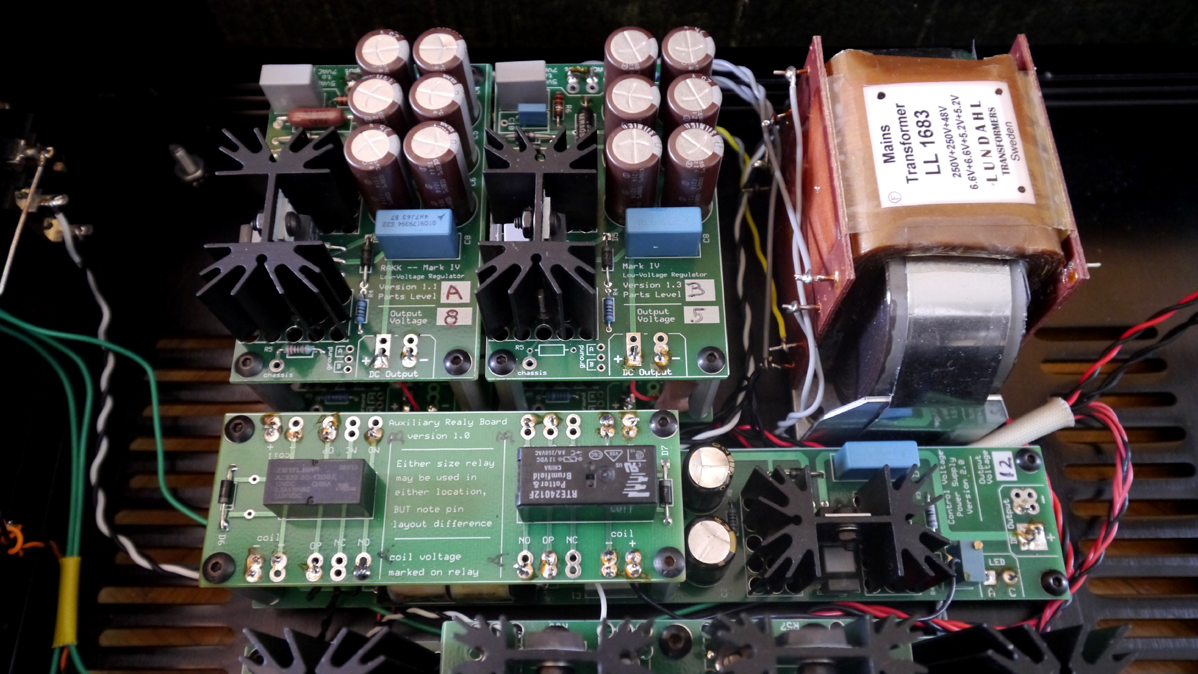
All in all, seven bulk regulated power supplies that provide power to the various sections of the DAC are carefully isolated and strategically interconnected only where needed.
The digital circuitry is developed around the Burr-Brown PCM1794 and Burr-Brown SRC4392 asynchronous sample-rate converter. These parts were chosen for their superior audio quality after extensive evaluation of many competing devices. Two PCM1794 ICs are used in mono mode, one for each channel. Great attention is provided to the quality of the design for clocking as well as voltage regulators for the clocks and PCM1794s. For example, there are ten Jung-style regulators on the DAC board to power critical circuits.
|
 |
"The analogue circuitry is fully balanced input to output. The DAC chips provide a differential current output which is passively converted to a differential voltage with tantalum resistors. This differential voltage signal is passed to a differential valve amplifier that provides the gain and drive to the balanced output. Because the output of this amplifier is transformer-coupled, the user has the option of selecting balanced or unbalanced output mode with the same output level. Thus the user may choose to use the balanced XLR output jacks or the single-ended RCA jacks with the same quality of performance. In addition to providing flexibility for output connections, the transformer also provides critical galvanic isolation, thereby eliminating ground loops. Two very important aspects of an amplifier are its circuit topology and the parts chosen to implement it. The Virtuoso contains two differential amplifiers, one per channel. Let me explain the design of one of these (one channel.)
A differential amplifier amplifies the difference between two input signals. The two signals in our case come from one DAC chip. Each signal is the same except that one is an inverted version of the other. These two signals are presented to the two sides of the differential amplifier. Each side of the differential amplifier has a triode. Each triode has one side of the primary winding of an output transformer connected to its anode (plate.) The current through each triode is regulated by a constant current source (CCS) which is connected between the plate of the triode and the power supply. This current does not pass through the transformer; rather the transformer is connected to the plate in parallel with the current source. Thus there are two triodes, each with a CCS to its plate, with the primary of the output transformer connected between the two plates. This is called a bridged parallel feed or parafeed configuration. The advantage of a parafeed configuration is that the plate current does not flow through the transformer. This means our transformer can be much smaller and lighter than a transformer of equivalent quality which must endure plate current. This is certainly an advantage for a transformer used in a component like a DAC or preamplifier. One other thing, we must now ensure that there never is DC current flowing through the primary of the parafeed transformer. We do this by placing a small capacitor in series with the transformer. This parafeed capacitor is the only capacitor in the signal path."
|
|
|
|
|
"Volume control is implemented by a high-quality stepped attenuator that was specially designed for this circuit. The volume control is effectively out of the circuit at its fully clockwise maximum position. With this setting the output level is 2VRMS for a 0dBFS digital signal. This is considered the preferred level for the typical system configuration. However, on-board switches configure the output transformers to provide 6dB of attenuation providing 1VRMS maximum output that may be appropriate for driving a more sensitive amplifier.
Special attention is paid to the quality of the power circuitry in the Virtuoso differential amplifiers. Each amplifier has its own current-regulated B+ power supply (dual mono) and each amplifier has two constant current sources (one for each triode.) Thus there are two high-voltage regulators and four high-voltage constant current sources that occupy the six large heat sinks on the amplifier board.
You could think of this amplifier as a small tube power amplifier with a transformer output. Of course, the circuit is designed to drive a line output rather than a loudspeaker but it is only the application parameters that are different.
The valves we chose are the robust 6H30Pi dual triodes. The output transformers are the superb Lundahl LL1674 amorphous core line-level audio transformers. The parafeed capacitor is the stunning Mundorf MCap Supreme silver/gold. Tantalum resistors are used in the signal path. All of these were chosen after many hours of careful listening evaluation for best possible sonic quality. The components used elsewhere are carefully chosen for their particular attributes to provide their intended functions.
Hopefully this sheds some light on our thinking and the magnitude of engineering and componentry at work in the Virtuoso. Of course there are a few pieces of magic I didn't mention. But at the end of the day, the thing that matters to us the most, more than specs and parts and circuit designs, is when people hear it and love how this DAC sounds."
|
 |
|
|
The overall motto upon full inspection might be, insufficient power corrupts, absolute power doesn't. Or better, inferior voltage regulation compromises the sound. Real estate's location, location, location becomes hifi's power supply, power supply, power supply. Here the Virtuoso's got major curb appeal.
Where things grow rather fainter is on basic creature comforts. The chunky 5-input selector lacks proper identifiers. It's as though such concessions—even plain numbers matching those on the back would do—might invite punters who are interested in more than just ultimate sound. And who wants those? Yikes! Ditto for the lack of remote on the volume control; and a mere 23 steps between min and max volume. Vinnie Rossi's LIO has 63 steps despite its use of an exotic autoformer; my COS Engineering D1 kills it with 256 x 0.25dB steps plus remote control and analog inputs. For many, these pedestrian items will preclude consideration of the Virtuoso as a preamp replacement. After all, we live in an age of playlists. Recorded levels can jump from track to track. Who wants to get up every five minutes? Or get louder than desired with just one click on the control?
On industrial design, finish and features then, the Virtuoso is plain overshadowed by much more modern kit which could be priced half or lower. Yet its metal work is unapologetically robust, its paneling reassuringly thick. Here it plays it rather more yeoman than city slicker to reflect a small-volume boutique operation. In keeping with Musica Pristina's overall mantra repeated in self-deprecating humour on their website, it's all about the sound and how eliminating unnecessaries improves it. |
|
|
|
 |
|

|

|
|

