 |
|
|
Headphonia. With only an impedance-dropping buffer between Transient modules and on-ear membranes, an Amethyst-powered headphone is like a direct connection of converter to cochlea; today's version of still futuristic neural hardwiring. With HifiMan's 83dB inefficient Susvara planarmagnetic flagships, I had a perfect tell-all scenario for max drive. One might give this combo no chance precisely because the Metrum lacks a conventional output stage. But into this 60Ω load, the little guy had the current and gain required to get properly loud and with full control in the bass. With its headroom for an ultimate scenario, my yard stick was Bakoon's 15wpc AMP-12R. Amethyst wasn't its equal but very close. Sources were either Soundaware's SD card transport via coaxial S/PDIF; or our usual music iMac via USB. Matching HifiMan's HE-6 on punisher load status, the upshot of the Susvara showing was plain. Headbangers excepted—or those who bizarrely must hear large-scale symphonica on headphones where median recorded levels might be unusually low—Amethyst should really drive any headphone extant. Quelle surprise. This petit Dutchman really flew even if rather than call it a DAC with headphone amp, we might call it a DAC which also drives headphones; and very well at that.
|
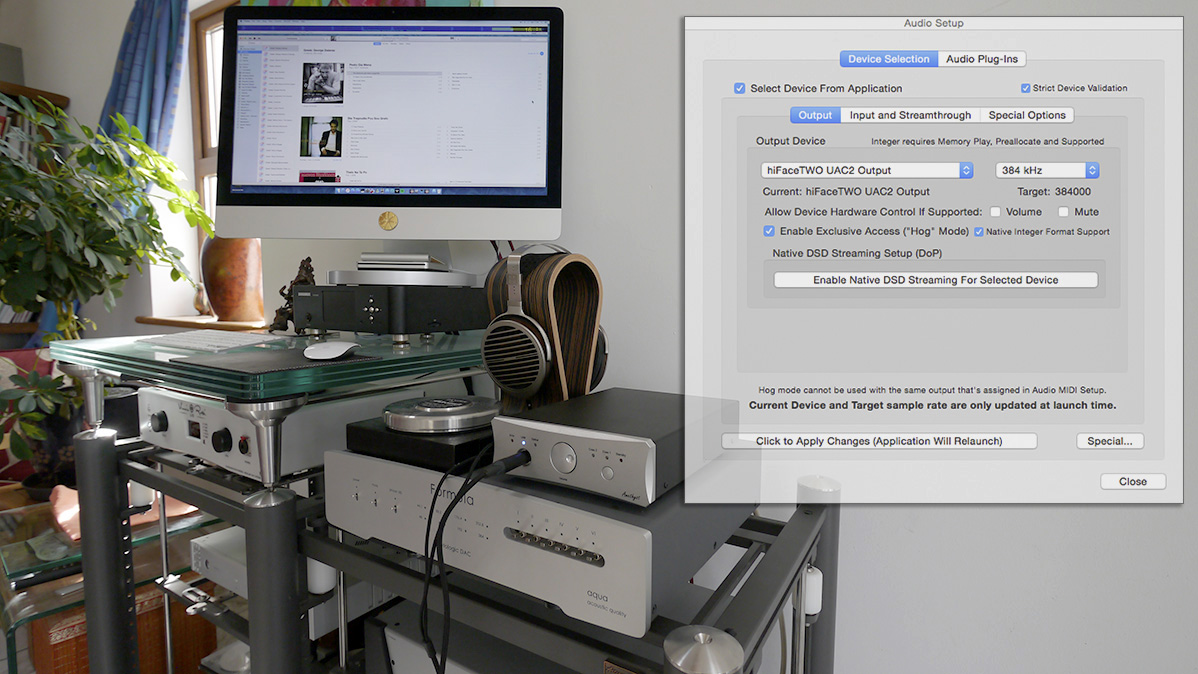 |
As the overlay shows, Amethyst runs the hiFaceTWO USB module for support of PCM up to 384kHz with hog mode. Unlike vintage Philips NOS DACs, here upsampling in player software is possible. Before we talk sound, let's talk loads. Sennheiser's HD800 is 300Ω. I had solid SPL at high noon. Final's Sonorous X is a low 16Ω and very efficient yet had zero noise with stiff output at 9:30. At 600Ω, Beyerdynamic's T1 were sleepier on the dial and got up and dressed only at 2:30. At 70Ω, Audeze's LCD-2 v1 already saluted at 11:00. Granted, everyone has different ideas on 'loud'. One guy's chirping cricket is another's assaultive wood chipper. Still, Susvara/HE6 excepted, nobody should come up short. And if your loud is my loud, even the notorious cans lift off beautifully. So Amethyst really would seem to be an equal-opportunity can opener.
|
|
|
|
|
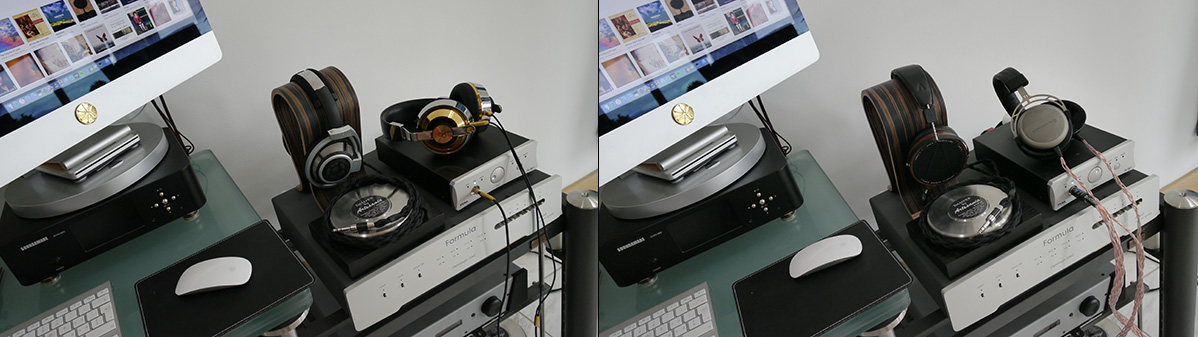
In my little black book, Final's over-the-ear heavyweight flagship is a perfected Sennheiser HD800. Hence the performance of these two, with the Germans wired up with a custom Forza Audio Labs pure copper leash, made perfect stand-ins for the lot. The HD800 has a built-in peakiness in the upper presence region. This throws a massive amount of apparent detail but does so with a brightness which soon tires. Dumping its stock leash rectifies some of it but one still wants an amp which doesn't revive the issue but heads in the opposite direction of augmenting bass mass. As sealed designs, the Final have superb and linear bass. This legitimises the fun but elephantine excess of our pre-Fazor Audeze LCD-2. On resolution, the Sonorous X equal the HD800. Very much to Amethyst's credit, even the Sennheisers were stunning in their fleet-footed airiness and enormous staging by staying clear of the usual sins. They put me in the midst of nearly holographic action, a bit like a miniaturized curved iMax screen. This goes back to the earlier image of neural hardwiring. It seems maximally pure and direct.
|
 |
It's an illusion of extreme intimacy with the musical muse. As such, it was actually related to nearfield studio monitors of the linear active sort. One hears everything; or at least believes so when nobody except the recording engineers know what everything is. Rather than needly, strident or starchy brisk however, even on the HD800 this mastering-console lucidity came off in what I will call gentle fashion. We might think of pure water-like clarity without the bracing temps of a winter spring. Contributing to this intense reveal was the lack of 'additive' bassiness with its darker black values. The very driven Pass Labs HPA-1 excels at that. Amethyst wasn't that muscular and propulsive. It was light-filled and quick. Hence the Sennheiser didn't fill out down low. The Finals which need no help played it linear not enhanced.
Good recordings left nothing to the imagination. Poor productions showed their warts. It meant little identifiable self sound or a clear fingerprint; only intense directness. There was no neon glare or white shift, only that rhythmically adroit timing-centred signature I've heard with all Metrum R2R DACs. With Amethyst, headphones jack straight into that quality like a needle hits a vein. The usual intermediaries—of added gain stages, more traces and the extra external cabling if a dedicated headfi amp is involved—are eliminated. For €1'295, such gripping one-box performance from a small unobtrusive deck really seemed outstanding!
|
 |
|

|

|
|
