 |
|
|
Anyone with half a crystal ball or perhaps a full marble might have seen it coming? Between Tim's and my findings of amp-direct Adagio and the Forte's non-tube tube cloner voltage gain... why wouldn't the amp arrive with its own special preamp sauce? For those unfamiliar with the sonic benefits of premium active preamplitude, perhaps because they run a passive or no preamp at all, they tend to act as dynamic expanders and body/weight builders. In my review of the Pass Labs HPA-1, I cloned the phrase muscle preamp because this action duplicates how a bona fide muscle amp will exert more gravitas and dynamic scaling than a wimpier specimen.
|
 |
Whenever one considers ultimate transparency, one deals with its implication. It's why a massed chorus tends to stand on steps. Now the deeper rows aren't obscured by those standing in front. Their heads loom above. If our singers were ghosts, steps would be unnecessary. By definition, ghosts are translucent. We'd see and hear right through them. A flat chorus ten rows deep would present no problem. Ditto audiophile transparency. As it ratchets up like a Photoshop slider increasing an overlaid image's opacity to reveal a second image underneath, body of the first row/image must diminish. Ultimate density, what audiophilia calls wall of sound, stands in the way of depth layering and separation. Want more of one? Get less of the other. This balancing act is what each listener must walk alone with hardware, setup and tuning choices. Personal taste becomes the final arbiter.
|
|
|
|
|
Following the adage that detail lost in the source can't be recovered later (it's been deleted), it's sensible for a reference DAC/pre like the Adagio to maximize the transparency aspects of micro-detail magnification. Particularly from the same stable, it's sensible for the partnering Forte amp to then attend to our equation's second half. If in this line of thinking we now cross the final 't' in triode not pentode (Cees cloned a 12A_7 not C3m), we arrive at more 2nd than 3rd-order dominant THD. At a strategically light dose, that produces 'active preamp' tone body and minor warmth/mass. Voilà, le Forte!
|
 |
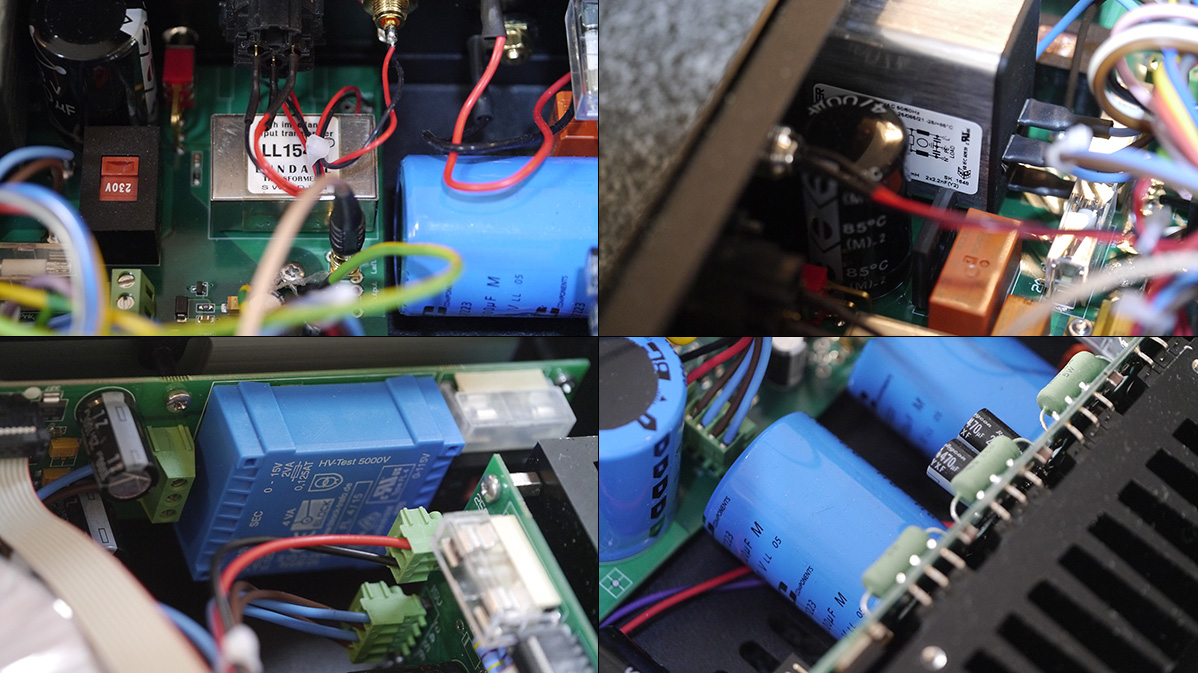
Having extended my Adagio loaner to accommodate the amp's arrival; and still having a review loaner pair of Linnenberg's superb high-speed Allegro monos; confirming the Forte's action was quick work. Whether on our customary Albedo Audio Aptica or the above 4-way Audio Physic Codex in for review, the same thing happened. By contrast to Ivo Linnenberg's ultra-fast 1MHz circuits which lit up top-down illumination, the Forte shifted emphasis down onto the midband. Better than actual tube hybrids I've heard—perhaps because those were designed by tube not transistor experts—this didn't breach solid-state virtues of control, low S/NR and bandwidth. It simply shifted a virtual spotlight onto the vocal region and with it, emphasis. The extreme lucidity of the Adagio/Allegro combo with its ultimate retrieval of upper-register finesse, air and subjective speed, hence leaner demeanour, morphed into something heavier and denser. This prioritized tone and weight over zip and illumination. This behaved very much like inserting the Nagra Jazz valve preamp between Adagio and Allegro monos (an actual test I performed). Ergo, the Forte really did include its own 'special preamp sauce'. Source-direct listeners like Tim get the particular shot of body/density they crave. The class A 350V faux-tube gain circuit acts like an active preamp stage. It plus the high-current buffers to drive speakers with all happen inside one surprisingly heavy case with acrylic lid. That established, we still need more contrast via the class A/B Allegro monos and class A Pass Labs XA.30.8. Isn't hifi all about give'n'take? Personally, I'd not trust anyone claiming otherwise. What kind of above/under-table trades would I observe when swapping between these three amplifiers? With their 28Hz-40kHz bandwidth, the Audio Physic with their invisible 10" long-throw woofer would certainly have an opinion.
|
 |
|
 |
|

|

|
