 |
|
|
It's a fact. Most amp manufacturers don't really know how theirs will react to ultra-efficient speakers. Such types aren't common, hence few keep a pair around just to check for noise. That can leave devotees in a lurch on compatibility data, especially for transistors where valves are traditionally preferred drivers for Lowther types. Shouldn't you want tubes but still go after such speakers, it can be hard to know what solid-state amp might be up to the task not only on silence but sonics.
|
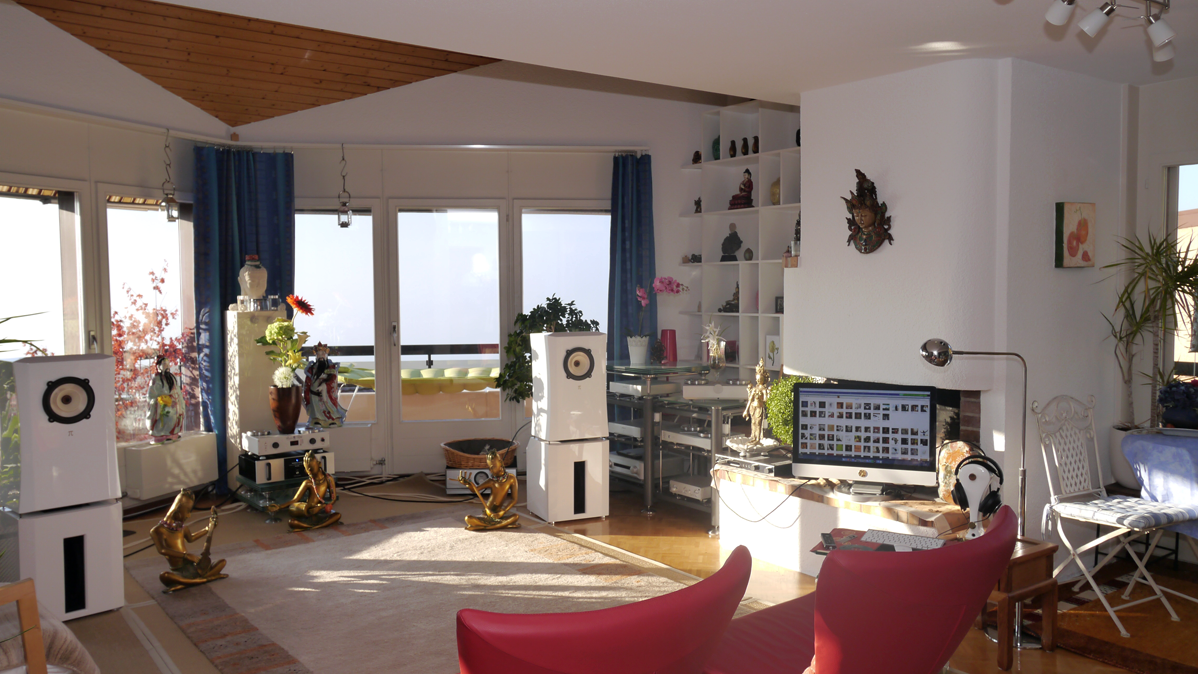 |
For a fine start, the MA-260 turned on/off without any salutary flatulations. Preceding it with Vinnie Rossi's LIO as an auto-former passive preamp for a scenario most favouring the amp, I had some noise on the widebander when volumes sat at ~18 to equate standard SPL into this speaker. At 63 on the dial aka bypassed— the amp now saw a quasi direct connection to the Fore Audio DAISy 1 DAC—that steady-state surf increased to far more significant but what'd still be considered typical for a lesser no-feedback SET. In my book however, you'd not pay extra for higher resolution only to bury some of it in self-generated noise which you could instead avoid. This disqualified the Magnus when there were sterling solid-state alternatives like the FirstWatt SIT1 monos, Crayon integrated and LIO's own Mosfet amp, all so quiet that even with this 104dB loupe, ear straight on, you'd not hear whether those were powered up or not. On this third-kind encounter, reviewer insanity failed. This was no black mark on the Magnus, just no counterintuitive find. Reverting to normal, I moved the Voxativ out and the 92dB Sounddeco Sigma 2 in.
|
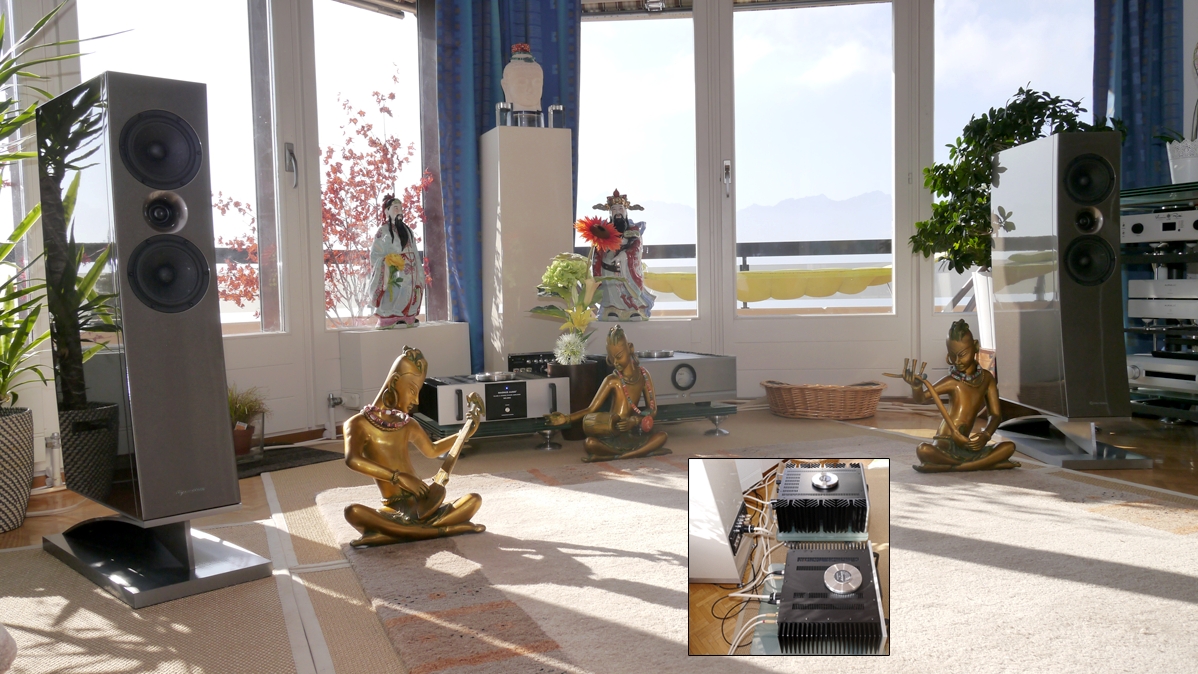 |
Referenced against the Artesania Audio amp stands, the insert shows how the Magnus is less deep than the Pass and sports less dense heat sink stubble whilst the frontal view speaks to height difference.
|
Now running a fully balanced signal source to amp (Fore Audio DAISy 1 --> COS Engineering D1 as preamp --> Magnus or Pass), all was dandy. Time for some time before auditions would go earnest. Here the Magnus was no tropical sauna fauna. It barely warmed up. The class AB Ampzilla does far more heat as does my XA30.8. Whilst that runs twice the output devices, another reason could be hotter bias. Magnus might bias theirs a lot more conservative. Could this be in response to earlier failures? Reader Paul B. Fløholm had those. "I bought their MA-300 some time ago. It hummed from the very start. They claimed something was wrong in my house. No other product ever had that problem. This one broke down a year ago. I then had it completely upgraded with MA-500 parts inside. It came back and was very promising for the first 2 hours. Then it got hot and broke down. Now a local repair shop changed the broken parts including the transistors. It still overheats after some hours." Leaving this model on all day long and/or playing it for five hours straight never turned up the sweat. For transistors which always conduct, the MA-260 behaved uncharacteristically mellow. No multi tasking space heater but chillin' with Bob Dylan as they might say where it's from. |
|
|
|
|
Comparing the two class A champs netted two quite distinct flavours. The Magnus played what seemed like a virtual stand-in for the EJ Sarmento-rebooted James Bongiorno Son of Ampzilla II. I obviously couldn't isolate whether this was down to shared versus dissimilar transistors types. Here the play pen was about BJT versus Mosfet. Did this difference merely reiterate their core signatures which anyone intimately familiar with either device would recognize? Regardless, the MA-260 focused down on the more compact, with sharper crisper edging and a cooler more bluish colour temp. The XA30.8 was the spatially more expansive and generous, its focus not locked down as hard, its outlines softer and the overall hue more honey and warm. Purely by outcome, I thought of the Magnus as endowed with more 3rd-order THD than the Pass. Shifting harmonic distribution from 2nd to 3rd-order preponderance usually nets exactly this offset. Whether here it was the actual cause is wholly academic. The task is to describe sonic flavours in terms experienced listeners can relate to. If you've more versed in basic tube types, the MA-260 played to pentode-run EL84 precedents like Trafomatic Audio's Kaivalya monos, the XA30.8 more to 845 triode specimens.
|
 |
If you're a Baroque freak and very familiar with the sonic distinction of period and contemporary ensembles, you know how the core timbres of the legacy brigade are brighter and thinner.
Additionally, period ensembles often fancy fewer players per group, i.e. fewer first and second violins, violas, celli and such. Smaller forces and older instruments shift the flavour. If period woodwinds and brasses get involved, they turn more nasal and clangy. All of it translates as quasi immersion into higher odd-order harmonic effects to point at the Magnus, not Pass. In piano terms, think Fazioli, not Bösendorfer. To weigh in on just how similar to the class AB fully balanced SST Audio amp the MA-260 actually came, that replaced the Pass for a direct A/B.
|
 |
|

|

|
|
