This review page is supported in part by the sponsors whose ad banners are displayed below |
 |
 |
In fact with my South African ovals the Serbians demonstrated outstanding finesse, control and slam. The power available in the low range might have been especially useful with the particular crossover of the K1. In comparison with my Luxman M800a they delivered a wider soundstage, more slam and a bit more resolution in the low end and 400–600Hz region. By contrast my Japanese bridged stereo amps had a bit more finesse in the highs and upper midrange with an even more lifelike rendering. Another striking feature of the Serbians was their holographic nature. I never did previously enjoy the sensation of such a homogenous 3D image. This became a definite strong point for these big boys.
|
 |
The KA M2000 also provided optimum results with the Lawrence Audio Violins. This Asian monitor speaker was incredibly responsive to these big amps. The tonal balance between the Karan amps and small Lawrence Audio speakers was a good match too. The Taiwanese speakers obviously need huge power to a far lesser extent than the Vivids and Magnepans. Yet when one seeks real-life SPL, there’s a most persuasive argument for very large powerful amplifier. In a certain way you can never have too much power. Of course lower speaker sensitivity and greater listening distances increase power demands significantly.
|
 |
Moving to Magnepan’s flagship, the Karans in my listening room met their most demanding partners. This most current release from the North American company relies on huge amounts of power to match the dynamic range one would expect from a more conventional bass-reflex design. With most amplifiers the 20.7 planar tends to flatten dynamic contrast. These latest Maggies run a newly designed quasi ribbon midrange driver of half the mass of what’s in the 3.7 to better blend with the light ribbon tweeter. They have great bass extension. My initial plan to use them with additional infraplanars—the same as in the Audionec Answer—fell apart rapidly. In my opinion the 20.7 don’t need any reinforcement in the bottom end if they've been accurately set up and broken in.
|
|
|
It made for a nice audiophile show to combine these two enormous planars with the massive Serbian amps all in black and silver. Again the Karan KA M2000 provided the by far most open soundstage from amongst all the amps I listened to with the Maggies. They were definite wall breakers. Can you imagine such a flow of liquid power through one of the most holographic speakers extant on the high-end market? I think it’s quite difficult to even approach a concrete idea without a first-hand experience of such a match.
|
 |
The KA M2000 amps also highlighted outstanding treble as was the case for any speaker I threw at them. This sensation was perhaps strengthened by the initial assumption that they might be all brawn and no finesse. Despite power reserves which for all practical intents and purposes were unlimited, these godzillas also showed the warmth and delicacy of the best transistor amps.
Somehow the Karans seemed so solid and unperturbed by any load that I had the impression of unprecedented freedom from listening to physical/mechanical transducers. Yet despite their obvious transparency and accuracy in the treble, the KA M2000 during my two weeks with the big Magneplanars did not really get the best from them. That’s because they delivered surprising poor performance in the low end and recessed dynamics. Moving the speakers around the room to find a better response, I reached no satisfying conclusion despite a few improvements here and there.
|
 |
I knew that early Maggies had a rep for needing high damping factor to avoid what was called driver flapping. More recent generations use bi-sided magnet arrays. Now huge damping seems to have become less mandatory. Indeed the problems I faced whilst chasing better performance seemed to be based on typical overdamping*.
|
| ____________________________________________________________________________________________________ |
* Kudos to Joël for broaching this subject. In certain marketing quarters extreme damping factor is sold as a universal panacea. It's not. Just as it did for our writer on the Magneplanars, it can also backfire with very efficient widebanders. - Ed
|
|
|
|
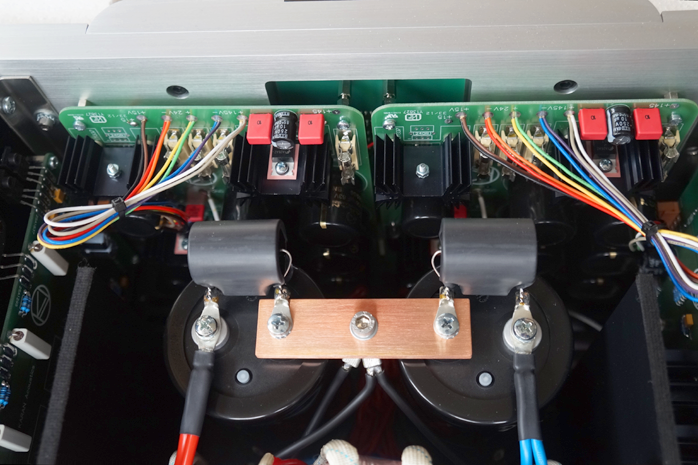 |
Keeping the Maggies in their position unchanged, my two Luxman M800a immediately recovered a healthier bass response and airier sonics. If I hadn’t had such fantastic results with my Vivid K1, I might have suspected insufficient break-in. I thus became convinced that the issue was excessive damping to prematurely roll off the panel speaker’s bass response. In terms of damping factor it seems very difficult to get any precise idea on the actual requirements of Magnepan’s new flagships. Some swear that they need very low output impedance. Others would remind us that their impedance plot is very nearly flat where the lack of back EMF translates into virtually no way that an amp could control the membrane with feedback. I also understand that Magneplanars are deliberately underdamped to achieve a 6dB/octave amplitude rise with falling frequencies to compensate for their usual dipole cancellation. That being the case, excess amplifier damping would seriously counteract the intended speaker behaviour.
|
 |
|
 |
  |
 |