At this juncture, it's really the most sensible plot to exploit a trickle-
sideways effect into my Amphion One18
review to recap its ported vs. auxiliary bass radiator discussion. First off, what
is a passive radiator? It's a driver without a voice coil or magnet, hence it's not even wired up. Hello passive. What controls it is its own mass. A basic recipe to calculate its mass is that the passive cone's weight should approximate the air mass of the port it replaces. Why go for an ABR? It eliminates potential port chuff and pipe resonances; reduces motion compression from high air velocity particularly for narrow ports; damps the main driver for flatter response and bigger head room; and adds cone surface for more air displacement. Over a bass-reflex port, it also slightly accelerates roll-off below the tuning frequency; and creates a notch at the ABR's free-air resonant frequency.
A properly selected passive radiator will be large enough relative to its box volume to move the notch below audibility. An ABR can shrink the size of the box over a ported version which must house a certain tube length, hence depth. Port length relates to ABR weight.
For an extreme example, a sub with dual 15-inch 1.4kg passive radiators would need an 18" diameter port of 46-foot length to do the same job. Of course an 18" Ø port isn't feasible. Nor is one 15 meters long.
Enter the rationale for a passive radiator.
One special requirement of successful ABR use is a main woofer of lower Q than appropriate for sealed boxes. If properly chosen, a passive radiator creates lower bass from a smaller box than a ported alignment. That rosy theory and hard-nosed practice don't meet that often would seem indicated by the rarity whereby ABRs show up in hifi speakers. One expects that there's more to successful execution to prevent living up to its old nickname of
drone cone. But the basic passive radiator promise really is more and better bass from a smaller box.
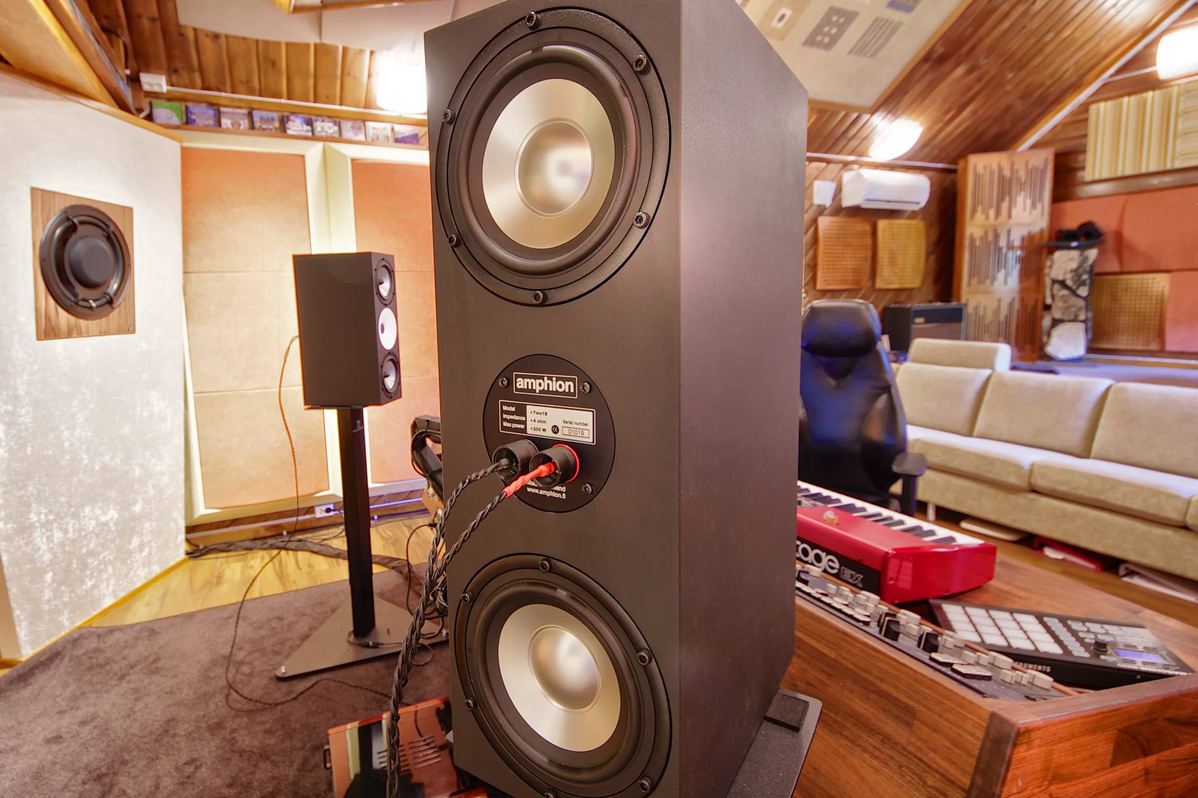
When I'd asked Amphion's Anssi Hyvönen on how passive radiator bass differs sonically from ported bass—his below pro-audio model with twin radiators counters his extensive consumer speaker portfolio with ported bass systems—he likened the general ABR behaviour to how a sealed box creates more natural in-room pressurization, hence fewer room issues; suffers lower group delay; and exhibits far better start'n'stop speed for superior time-domain performance.
To paraphrase the ABR gist according to Amphion, it's ported bass on quantity, sealed bass on quality. Back on the Chiara, it now should make perfect sense why a small speaker tweaked for very good time-domain behaviour
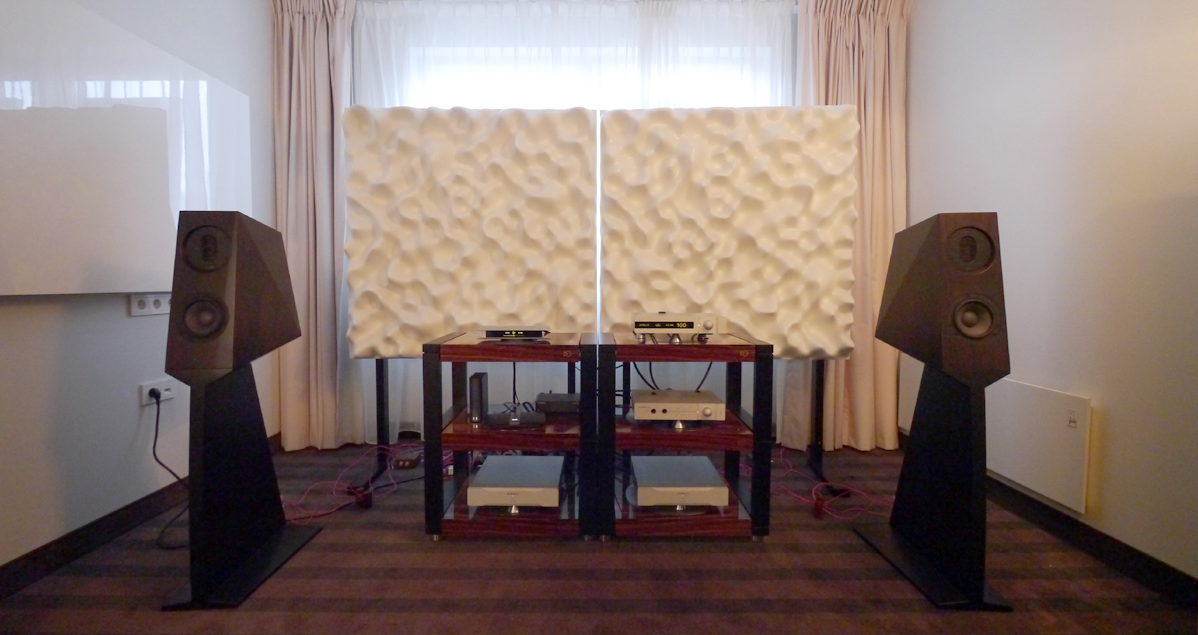
would (have to!) favour ABR over ported loading unless it went fully sealed to throw away extension for equivalent cabinet size. Back on where the Chiara is made, readers fluent in German will enjoy a virtual visit to Rainer's listening room, then Kaiser's impressive factory on HifiStatement.net
here. Yet even English readers should appreciate the photos in a nod at amusement with comic strips where words really aren't essential.