|
|
|
|
| Remote interview with Fang Bian, owner/founder of HifiMan. |
• Hello Fang. Most of us know that you were born in China but studied in the US where you now make your home. Tell us something about your upbringing in the East and whatever formative events, ambitions and dreams led you to where you are now. Also talk to us about your field of formal study, how it relates to HifiMan and your involvement with music in general.
I was born in China in 1979. My parents were working in a public hospital near a large coal plant so most of my childhood was spent in the school that belonged to that plant.
My college career started in 1996 when I took up chemistry at a teacher's university 40 miles away. It was at this point that I started listening to Western music and became fascinated with its variety. In 2000, I got a chance to enter a top 20 university in a big city where I kept working on my chemistry major. In 2003, I received a big opportunity of a US fellowship so I moved there to commence my PhD studies.
• Tell us about how you decided to become a headphone maker; and more specifically, one who is focused on planarmagnetics (though we do know that you also make dynamics and IEMs and electronics including portable players).
In the early '90s, my parents bought me my first cassette player. I quickly noticed how different earbuds sounded different; in fact, very different. The more expensive ones didn't necessarily sound better that the cheaper products. Sometimes not even as good. I wondered how that could be. As soon as I noticed this, I decided to someday find a way to make headphones that delivered better and more consistent value. Fast forward to 2007. I made good on that goal and decided to build headphones. My actual company started around 2005 when I became a distributor for certain Chinese headphone brands. I realized that I knew how to improve them and decided to make my own instead. The planarmagnetic approach is interesting. It is actually a simpler system than the dynamic headphone concept but open to a whole host of new ideas and approaches. And they have great potential to apply scientific research methods. My nanotech expertise could be put to good use as well. |
|
|
|
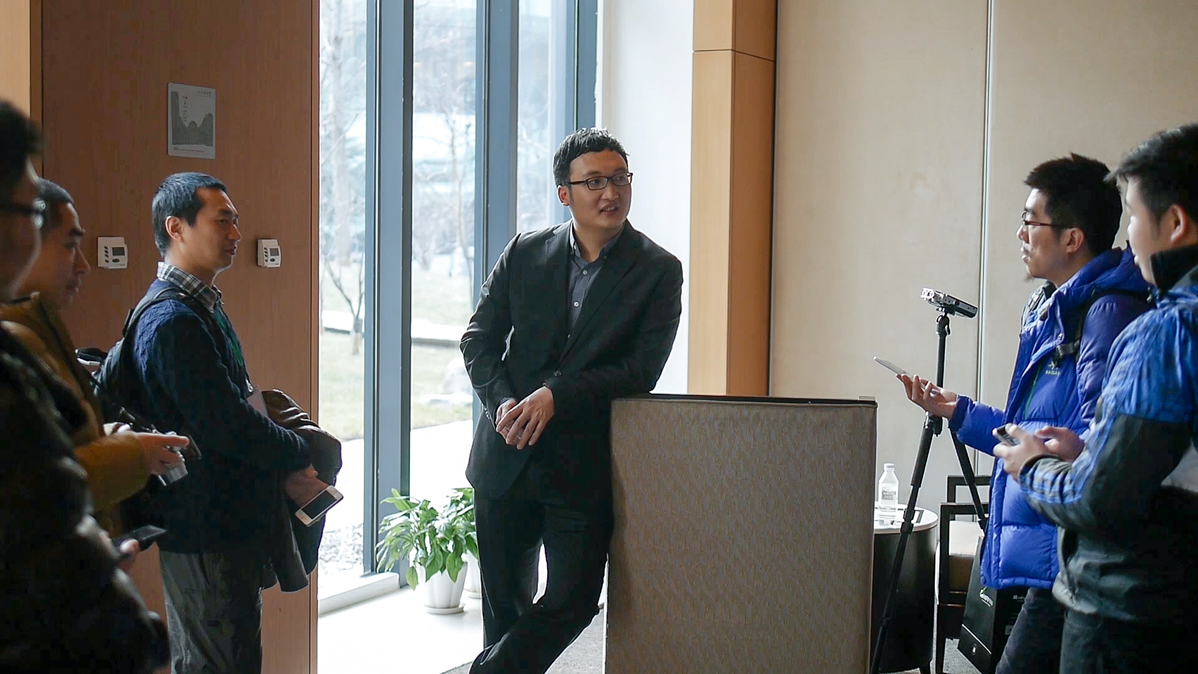 |
Chinese journalists interview Fang Bian in Beijing, 2014. |
 |
• I can't remember who rang in the planar revival first, you or Audeze. Give us a rough time line, from your beginnings to launching HifiMan the brand to 2015.
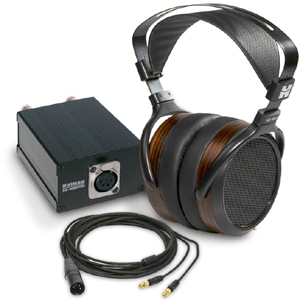
We started the HE5 project in 2008, showing samples as early as 2009 and then started to sell them by mid 2009. So I believe we were to market before Audeze. Here is the Cnet review from November 2009. The HE5LE followed in early 2010, the HE6 came later that year. By early 2011 we had the HE500, a year later the HE400. The HE560 bowed in early 2014, the HE400i in mid 2014 and the HE1000 by the end of that year.
• Tell us about the man HE behind the first two letters of all your headphones.
Mr. Binwu He is our business partner at HifiMan. He is an experienced hifi DIYer and an engineer who introduced the original idea of a planar headphone system to us. Binwu holds an aircraft design undergraduate degree from the Nanjing University of Aeronautics and Astronautics. As a great tweaker, he led our team for the HE5, HE5le, HE6, HE500 and HE400 projects. After I graduated and returned to China by 2011, we set up a headphone research lab where we've conducted a lot of R&D ever since. Binwu is engaged as counselor and advisor to our research team even today. He thus was involved in the HE1000 project and is already working on future projects. Since 2011, I've been the team leader however.
|
|
• Given that this review will focus on your newest flagship, we’re all curious to learn more about the diaphragm and magnetic technology behind it, particularly how it relates to your formal studies and your previous planar models. What is different, why is it different and what are the specific benefits?
Our planar headphone technology still belongs to the audio sector, not to formal chemistry research. But we did apply some simple nano tech methods to just the diaphragm which proved to be extremely effective. However, the thinking behind our work derives from scientific research, not an industrial background. We treat the headphone as a system with a whole array of parameters and attempt to adjust every part of this system quantitatively. Over the years we have conducted thousands of experiments and built hundreds of samples. You will see a big time gap between the HE400 and HE560 models. For two years, between 2012 and 2014, we did not release any new planar design. That's because after I graduated and went back to China in 2011, I was busy setting up our headphone research lab and conducting a lot of investigations in it. As a result of that work, we raised our R&D from the initial DIY-type level to a true scientific research level. When we applied these new findings, we cut down the heavy weight of planar headphones, improved their sound quality, applied nano tech etc. These were major changes across the board. For IP reasons, I can't be more specific."
|
|
|
|
|
• How do you view the advantages of planarmagnetic headphone technology vis-à-vis the more conventional dynamics which dominate the market? How about ribbons and electrostats?
Electrostats can't challenge the market dominance of dynamics due to the high voltages involved. Planars however will heavily disrupt the music headphone market because we just learnt how to make a planar headphone of very high sensitivity, significantly better sound quality yet similar weight and cost to dynamics. This is the $299 HE400S,a planar headphone that is sonically superior to all comparably priced dynamic headphones. It is light, comfortable and easily driven from a cell phone. The HE400S is truly a game changer, even more so than the HE400 was in 2012.
|
 |
Kunshan City, Jiangsu Province, home of HifiMan's electronics factory, 20 minutes by high-speed railway from Shanghai. The Acoustics Lab is in Dongguan, Guangdong Province, 1 hour by high-speed train from Hong Kong. HifiMan's HQ are in Tianjin, a big city of 10'000'000 and 35 minutes by high-speed railway from Beijing.
|
• When I saw you in Munich at the show this year, I was shocked to learn just how many workers you employ in your two Chinese facilities. Paint us a picture of your mainland China operation, ideally with some photos to accompany so we better appreciate the scale of HifiMan today.
We have our headquarters in Tianjin and two small factories in southern China, one for players and amplifier, the other for headphones. We have about 40 employees at HQ and another 50-60 workers in each factory. Our production facilities are about 2'000m²
each.
• What is a rough breakdown of HifiMan sales of portable players between West and East?
Our portable players have a much bigger market share in Asia because traditionally, Walkman-style products there have enjoyed popularity for a long time. In addition, we have strategically focused on the Asian markets with our portable players where today we enjoy a very strong position compared to even big players. In hard figures, about 70% of our player business is in Asia.
|
 |
Kunshan is situated within the Suzhou district of mainland China.
|
 |
• As a China native who, one assumes, has become quite ‘Westernized’ from his prolonged immersion in the US, how would you describe the cultural differences as they pertain to audio design, work ethics, quality standards, honouring individual IP and prospering in a competitive environment? What type of progress do you feel the better Sino makers and parts suppliers have made over the last five years? Aside from labour fees, are there other advantages for producing in China today?
My personality is a combination of mad scientist, wildling from the coal plant and hifi/music fan. I have more of an American than Chinese way of thinking but I have a Chinese stomach and a Chinese family. As an agriculture culture for thousand of years, Chinese culture lacked the industrialized element. Traditional Chinese culture has more emotion and lacks rational thinking. It's more qualitative less quantitative thinking. However, mainland China has gained a lot from foreign factories which set up shop there. We learnt about manufacturing, QC, management etc. There now are some hugh traditional electronics companies which began in the previous decades like Huawei and Lenovo. Now there are more companies with IT/Internet elements which became huge like Baidu, Tengxun etc. For the 2010 decade, some consumer electronics companies have become very successful with their web and financial backgrounds, such as Xiaomi and Qihu. In the future, cheap labour—which is no longer cheap—won't remain key to developing China. Instead it will be a matter of being the biggest industrial market; and cash flow.
"Today it's no longer the case that the Chinese industry at large suffers QC issues. Of course ultra cheap products tend to have more and a lot of those did originate from China years ago though much has changed since. Today there are many very large mainstream companies like Huawei, Foxconn, Lenovo and more who don't suffer QC issues at all. We do see certain of our own HifiMan concepts and products copied or mimicked at some level. That is true for our headphones and players but interestingly, many of those copycats aren't Chinese. The solution is to keep investing into your own R&D to continuously improve your products. Remaining a moving target is the best defense against being cloned. I don't want to get into politics but where Internet control is concerned, today it's a global issue. Here China is neither the worst nor are Western countries the best."
|
|
|
|
 |
|

|

|
|