 |
|
|
1 review. 2 writers. 3 listeners. 4 rooms. 5 amplifiers. 10 pairs of speakers. Having taking our lengthy journey this far, a few things should already be clear. In general, standard reviews in which just one 'reference' component is replaced by a short-term loaner must be very limited by design, hence only partially useful. They miss a lot of subtext. For this assignment, we've learnt that a far larger variety of hardware and venue contexts didn't really end up with ten different opinions but showed how the same core qualities worked more or less ideally. More relevant, it showed unexpected application scope. Within its design brief of acting bigger than its raw figures would suggest—at least to popular opinion which thinks 100 watts per side are the bare minimum—the First Watt 20/30wpc into 8/4Ω model F7 proved perfectly matched to loads from 85dB to 100dB sensitivity. It's not just an unusually quiet stand-in for the sort of valve amps which are typically mated to highly efficient loads. It can be just as brilliant on low-efficiency ported boxes with their 'drunken signature' impedance plots. We arguably stayed clear of 3- or more-way vertical sarcophagi for ugly aliens. By that I mean very big speakers with beastly woofers and more drivers than sense, of the sort neither Dawid nor I care to own or had on hand. Obviously the F7's mighty-mouse antics will only go so far. Just so, certain of our ten different speaker examples pushed quite deep into terra unexpectica. What's more, my two favourite resident loads happened to be my two least efficient ones, hence the most counter-intuitive. If you don't try, you'll never know.
|
 |
If we revisit what those two were, we appreciate that both are perfectly contemporary in their pursuit of fully illuminated endless trebles. One gets there with a 3/4" inverted ceramic tweeter, the other with a dual-tweeter system of larger wave-guided soft dome and self-biased electrostatic super tweeter whose surface area alone is 30 times that of a conventional dome tweeter. Combine the two and there's far broader radiation, higher dynamics and with it, a very uncanny sense of micro-ambient recovery with its tiny reflective flickers, trails and auras. These expansive trebles compensated for the F7's more genteel top character to net superb intelligibility without any grating nasties. By the complimentary token, the F7's non-wiry bass character got an injection of punchiness and slap from a very well-implemented transmission line or a small-diameter port in a super inert compact cab. Those who fault many modern hard-driver and/or high-rez speakers for lean tone and pale colours have in the F7's terrific colour weight and image heft a fine antidote. They get to enjoy their drivers' transient articulation and what it does to soundstage precision without wanting for tone and density. And they get to do it with a $3'000 amplifier, not one 5 times as dear or even just double. On certain of our own speakers—and frankly not those I expected—the $6'500 Pass Labs XA30.8 did indeed prove to be overkill. That didn't diminish my regard for it by one iota. I now simply understand better what's really required for certain jobs; and where excess begins.
|
| |
 |
For potential fratricide—mostly figurative since the F5 is after all discontinued and just in that sense dead already—I spun up a 24/96 version of Youn Sun Nah's Lento to feed the super tweeters with potential ultrasonic content. As you'd expect given the F7's genesis, there was very clear genetic resemblance. However, with a quality recording of this type, the F7 played the "younger, stronger, better" card in three areas. One of those might have been particular to this load but not the other two. First, bass was a bit weightier. Without access to the M1's impedance/phase plot, it's academic to speculate whether this was due to the F7's superior absorption, hence disregard of impedance peaks and dips. Regardless, the F7 portrayed a bit more down-low heaviness. Two, its depth specificity as the clearer sense of distances for individual sounds was higher. It layered more precisely. Three, when the lady ripped into scatting to fly some vigorous high notes, the F5 exhibited more bite, more virtual spittle and edging around the voice. Such outline limning, though unnatural given that it never shows up in live music, is quite popular in hifi. On that score, the F5's friskier top end did more edge illumination. The price to pay was a sooner crossing of that subjective reflexive line where the presence region and lower treble sound too peppery and one reaches for the remote to notch down the volume a click or two. |
|
|
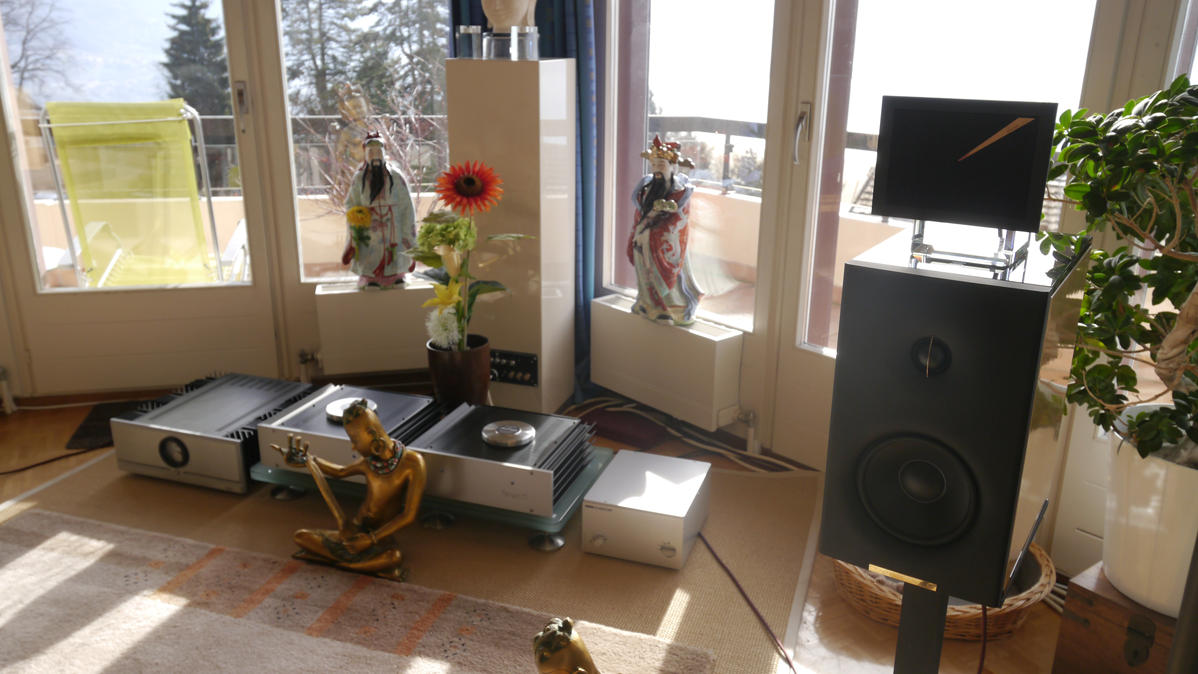 |
Interestingly, the F7's subjective pixel count was no lower. Its sonic projection wasn't coarser. I didn't see/hear less nuance or detail. I simply didn't have that subtle Photoshop 'sharpen' effect which lightens/punches up transitions to produce higher demarcations around objects and with it, manipulates contrast in unnatural ways. A useful visual tie-in for that effect is the 'Theatre mode' button on our Sony Bravia TV remote. Since most end users like us are buffoons when it comes to properly calibrating a television, the Sony engineers offer this foolproof factory preset to emulate movie theatre values. This does not mean punching up the contrast slider to the max à la Electric Avenue telly alley. Theatre mode is softer and gentler. On quality material, it doesn't mean you see less. Not at all. What you see is more natural, with richer colour hues and gentler transitions to be easier on the eyes. It lacks that punched-up needlier ultra-contrast hype which, taken to the extreme, might as well be stark black and white with very few intermediate gray values. To a fine extent, the F7 came with that 'theatre mode' calibration built in. The F5's virtual contrast slider sat higher. The practical upshot was that the F7 tolerated higher SPL on more critical recordings or peaky passages.
|
 |
Handling its precision with less intrinsic sharpness didn't trigger the 'turn it down' impulse as soon as the F5 when intense female vocals, close-mic'd violins, hammered upper piano registers and such cross the line. Sure, placing a highly dynamic microphone within inches of a powerful singer should create sizzle, spit, teeth reflections and near diaphragm overload. But just because recording engineers indulge in such acts of hard-core pornography doesn't mean listeners have to suffer them in their own four walls. That argument bypasses the what's-true question to focus on higher listening pleasure instead. Here it means the ability to accompany higher voltage swings and close-captured transients through the critical 1kHz-4kHz range without constantly fiddling with the remote. You might say that by perhaps benefiting from Nelson's accumulated experience since the F5, the F7 accomplishes its equivalent resolving power more nonchalantly and with a bit less show-off bravado. And for reasons unknown, its depth perspective was even more teased out, sorted and mapped. With space demons like our ultra monitors and albums catering to such special hifi effects, the F7 thus eclipsed its precursor on front-back vastness and locked-in dimensionality.
|
|
|
|
|
With Nagra's €14'500 Classic Amp standing by for its own review, curiosity and self preservation—just imagine the countless emails wondering why I avoided that obvious challenger—meant a final A/B. This amp's claim to eventual fame won't be its 100/200wpc into 8/4Ω rating which neatly doubles when bridged; nor its push/pull class A/B Exicon power Mosfets; but the fact that its 400VA linear power supply is followed by an SMPS for built-in power factor correction. It's a scheme Nagra claim results in superior instantaneous peak energy delivery to have their smallest amplifier act a lot bigger than it is. Ah! Since we already heard and explored exactly such behaviour for the F7, a battle between our combined eight fetty mosses seemed unavoidable. If the $3'000 FirstWatt could hang with the posh Swiss, it'd be my final nail in the overkill coffin. A 5:1 ratio is quite drastic after all.
|
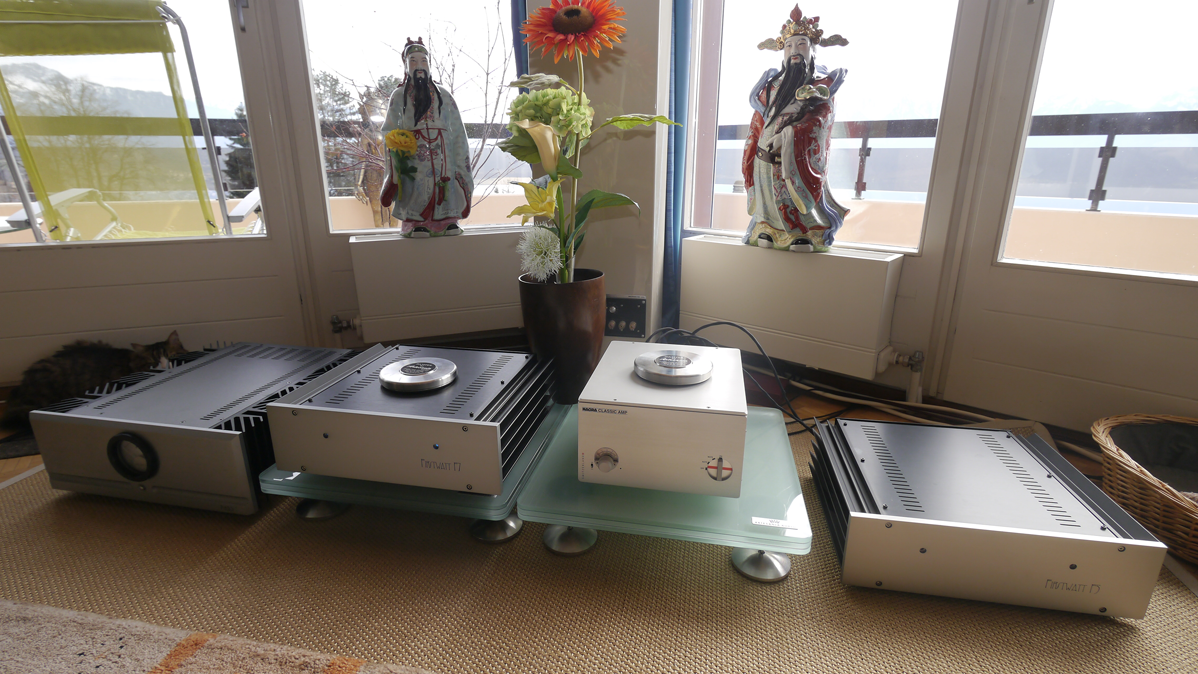 |
As had the XA30.8 before it, the 'I'm the bigger amp' fact of the Nagra manifested in greater overall mass including a bit (but surprisingly little) extra bass weight and more resourceful dynamic reserves in the macro domain which I barely tapped and only noticed slightly on peaks. Combined this meant that it sounded a big bigger and more robust. The Nagra then managed greater incisiveness—like more pronounced 'k' endings on Youn San's repeat "don't kick" lyrics—without defaulting to the F5's trick of getting slightly crisp and turned up around the edges. I felt like a time-traveling fly which had returned to Warsaw to secure a front-row spot on Marek's wall whilst Dawid and he ran the same comparison on the big Bastanis speakers. Yes you'd call the Classic Amp as exhibiting even greater resolution and more top-end separation power as well as one should for the price difference. More relevant to my way of thinking was the magnitude or rather, narrowness of difference between both readings. To equalize the 'bigger' aspect, I'd cheat and play the F7 2dB or so louder. That'd be well within the realm of practicality especially if I stopped comparing. If I wanted seriously more substantial low-end welly quite beyond the Nagra, I'd loop in the Zu Submission tower sub and still leave €5'000 on the table. Since we don't do bombast, the greater dynamic reserves of the Classic Amp would mostly sit there untapped. Its more incisive yet not sharp separation advantage wouldn't be missed on speakers as adroit as our M1. The F7's extra few degrees of colour intensity meanwhile would be welcome particularly at lower volumes. In short, for our purposes and on these speakers, I'd put on my smuggest faux Brit accent and call the F7 perfectly adequate - which is cool understatement code for what else could I possibly want.
|
 |
Counting to F7. With our endless review nearing its end, I'd call our subject a definitive overachiever; a worthy more refined replacement for the super popular F5—from our team, it's found a home with me, Tim Smith, Frederic Beudot and occasional contributor Michele Surdi—and an unexpected multi-kulti when it comes to possible applications. As such, it steps out of the special ops slogan of the FirstWatt brand. It specifically invites people into its revivalist tent who run more regular speakers which previously weren't really catered to; and who perhaps assumed that they needed something bigger and costlier to be happy. I shall call the F7 endowed with high very natural resolution as opposed to extreme contrast; and unusually adept at retrieving high colour temperatures and deep incarnation factor as that special something which counters the see-through ghostliness of hifi musicians and renders them as more flesh and blood beings which block the light and cast shadows. At the same time, the F7 didn't get too dense (if music were a loosely woven wool garment, it didn't throw it in the dryer to shrink and thicken into quasi felt) to interfere with recreating big audible space. That struck me as quite a mean balance between sound and silence, between substance and emptiness. As soon as you want more of one, you get less of the other. Walking the middle struck me as quite perfect.
Pure class A bias means about 30 minutes of action to hit the thermal sweet spot; and higher energy consumption than the output specs might suggest. FirstWatt genetics mean more than a decade of intelligent experiments into maximizing simple circuits for best sonics. Within this catalogue, it's not excessive to perhaps call his latest Nelson's best yet. No matter how many times I tallied it all up and down, I always ended up with a well-deserved award of quite universal usefulness. So scratch that F7-year itch. Say tickety-boo! (If you didn't know this colloquialism, it's believed to have originated in British Imperial India where the hindi tikai babu meant, "it's alright, Sir". Subsequent use by British airmen and then Canadian soldiers as British allies during WWII turned the term into its current expression. At least so one theory goes.)
|
 |
 |
|

|
|
|

|
|
