|
|
|
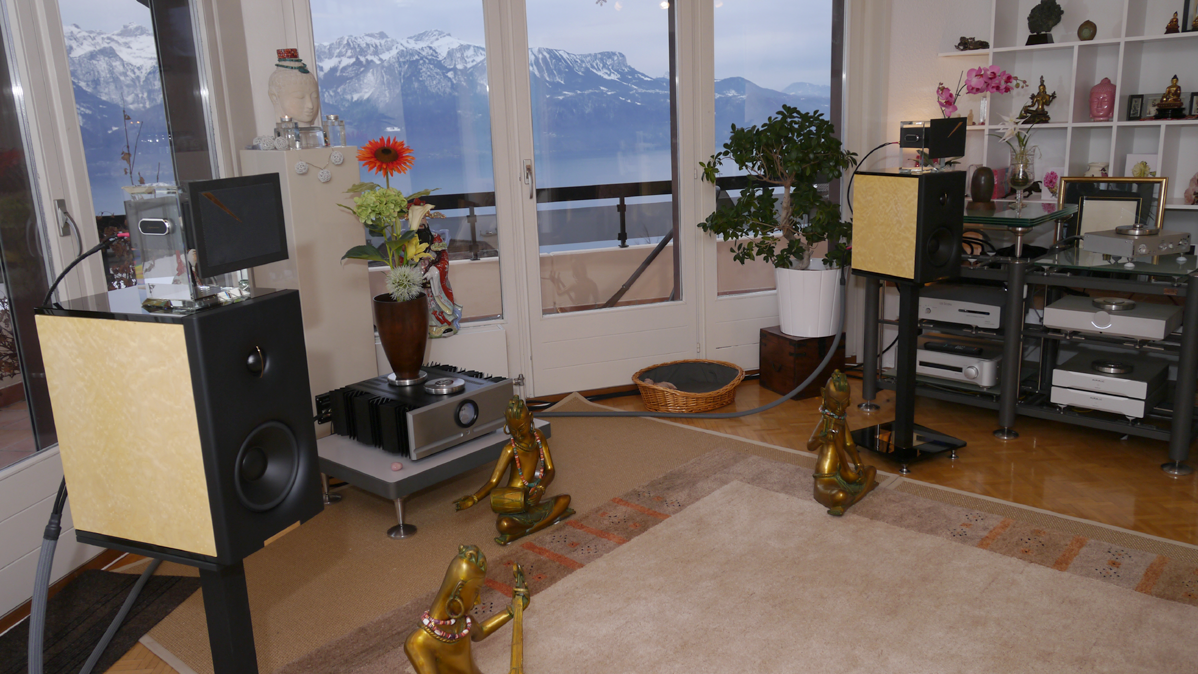
For the M1/Sopranino on stands, it again started with a >200lbs shipment over five cartons. There was minor assembly of the classy stands which repeat the aluminium/tempered glass theme. Then came a few days of break-in which starts out stiff. Bass is underdeveloped and the presence region lacks energy. That's followed by deciding on which hairline marker of the M1's top to align the super tweeter; then whether to set its high-pass at 10, 12 or 15kHz. For the M1, compact dimensions with ambitiously low port tuning enforce weak efficiency. Here Sopranino's -3dB sensitivity adjustment is the native match.
Mating such a speaker to an XA30.8 caliber amp practices a familiar motto: big amp + small speakers = big sound. Very conservatively rated at 30wpc, the class A Pass Labs actually delivers 90wpc before it hits 1% THD. Were it biased in class A/B with just the first 5 watts in class A, Nelson Pass confirmed that its unchanged hardware—20 Mosfets per side, big heat fins, a stout power supply—would make 300 watts. It's a bona fide muscle amp. It's exactly the type you want on this speaker. I simply didn't quite have that the first time around. Hence this revisit.
|
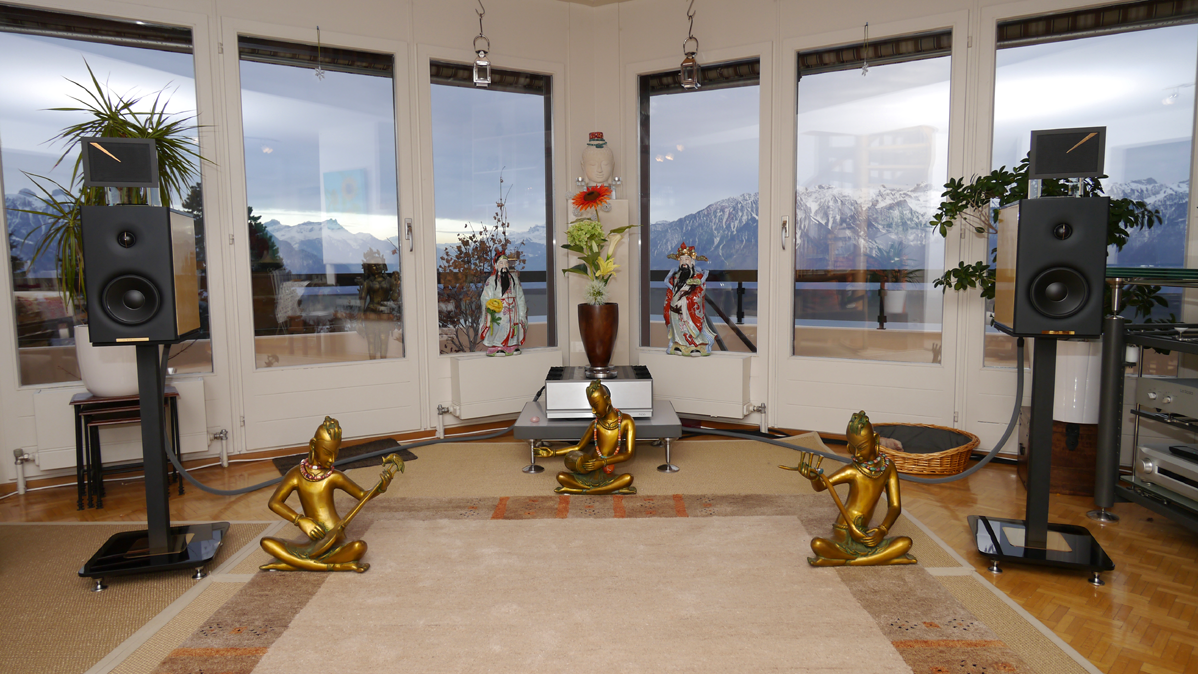 |
Big vs. small midrange. Though their filters get more complex, 3-ways use dedicated midranges. That affords opportunities for 3"-4" units. Two-ways with bass ambitions logically use bigger diameters. Extreme examples reach 12-15 inches. Many vintage boxes pursued those. Curiously they often only made about ~50Hz. But certainly they create different air motion and textures than today's high-output smaller mid/woofers. With its 7er, the M1 splits this difference. It creates a meatier denser midband than Anthony Gallo's 4-incher yet doesn't get slightly opaque in the presence band as Zu's big 10.3" widebander does. Fronting that driver with an XA30.8 type amp—chunky, robust, very material, slightly dark—further counters today's monitor trend for speed over curves, wiriness over succulence. Enigma's larger-than-usual soft-dome tweeter supports a happily lower handover. The port loading driven from a muscle amp with properly low output impedance solidifies 40Hz. And that becomes an ideal handshake region for a true subwoofer which will essentially just provide the very lowest octave for proper anchoring in 20Hz.
|
|
|
|
|
Precisely in this carefully dosed administering of weightiness, the Pass Labs now pushed the M1 deeper than I'd heard on my first encounter. If we apply big sound not just to breadth, depth and height of the virtual stage action; and not to silly SPL levels which would be socially offensive... then we arrive at chunkiness and beefiness of tone and related image density. It's a common advantage which large speakers with bigger or multi-paralleled drivers enjoy over their more dwarfish brethren. As it turns out, Enigma's custom 7-inch mid/woofer is capable of surprising heft. That's the real muscle-amp contribution. Personally it's also the truest interpretation of what it means when a compact box acts bigger than it is.
|
|
Because of Sopranino's height, its contributions to enhanced HF ambiance include subtle but very attractive space above the performer heads. Rather than cut off the scenery on top like a picture frame, there's an effervescent dome of 'something' above. That heightens the illusion of scale. It's not so dissimilar to opening horizontal sky lights without also retracting their blinds. Whilst you don't see through them, your body senses that the room's air no longer stops at the ceiling. It now connects to something larger beyond.
That's partially earable, partially sensed otherwise but adds itself to the bigger effect.
In our setup, it also plays counterweight or better, gravity inverter, to the XA30.8's downward anchor and densifier. Falling into the same line are the COS Engineering DAC's higher resolution and what replacing my power repeater with two very long power cords accomplished. If behind this narrative you sense the proverbial scales, you're very astute. In a quite vital sense, calibrating one's personal hifi is an endless balancing act between speed (rise times, impact, transient precision, separation) and body (mass, weight, decay, incarnation factor). The final result should neither err on the side of ghostliness as ultimate see-thru-ity without compelling in-room presence; nor on the side of poor definition coming from one solid but sadly congealed wall of sound. Where on this axis one wants to sit and watch is completely personal. Just by swapping M1 amps from XA30.8 to FirstWatt F6, you'd get lighter and more nimble, less here and more there. That being the case, ultimative statements about 'the sound' of any given component are a bit deceiving. Very few components—even front-to-back integration like Devialet's Phantom still needs a source signal—make a sound of their own.
However, with sufficient triangulation and component swaps, one can whittle away certain key features that stay put no matter what.
|
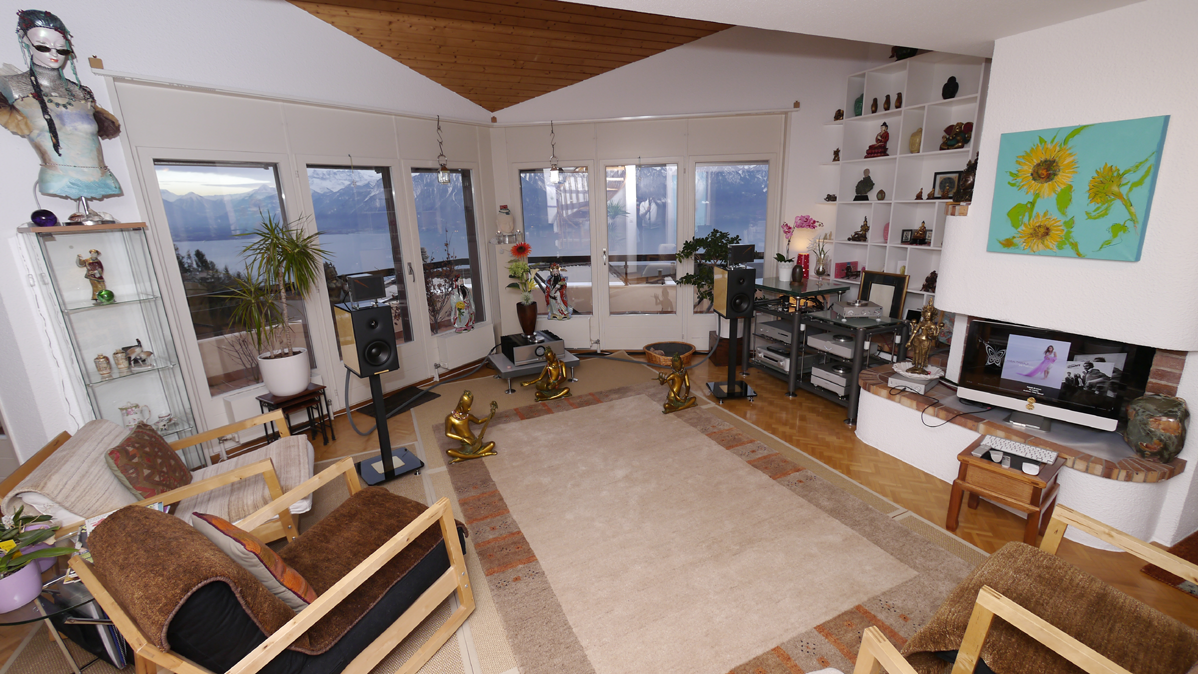 |
With EnigmAcoustics' Mythology speaker, the highlight is the integration of 38mm dome tweeter and monopole electret ESL. This dual-tweeter concept sets it apart from other cost-no-object super monitors by Crystal Cable, Focal, Kaiser Acoustics, Sonus faber and Wilson Benesch. Those all suffer narrower dispersion with rising frequencies. As a result, the M1 is really an überstager. Already monitor speakers excel at this soundstage discipline. The Sopranino's ambient restoration function simply pushes that even further. Its relatively shallow high-pass extends its response sufficiently low to still capture the upper harmonics of many instruments. That and the improved off-axis response create good harmonic saturation. From the other end, the 180mm mid/woofer builds it out from the fundamental upward particularly if goosed by an advanced muscle amp at its lower end and through the power region. Nobody sane expects 30Hz kungfu from this kind of box. To get into that, your $14'690 would flow into a bigger floorstander. For imaging fiends, space explorers and friends of compact costly speakers which also look the business on finishing and quality build materials, the M1 topped by its Sopranino dominatrix is one truly superlative proposition. Just plan on a properly powerful amp to get the best from your investment, preferably a transistorized chap to absorb the steep port-induced phase angles and impedance squigglies. Our deceptively rated 30wpc Pass Labs strikes me as an ideal match on that score even in our 100sqm open space plus loft. It's happy ears now and many future review accompaniments down the line...
|
|
 |
|
|
|
|

|
|