|
|
|
Upper bass: punch. As owners of downfiring subwoofers know, bass which first hits the floor before its pressure wave reaches the ears registers differently than front woofers. The latter are more visceral. Without having heard the Avanti which makes do without the 3rd way of the 7-incher, I can only predict that the power zone impact of the Codex is greater. Its hidden woofer operates lower. That lets the vital upper bass create a pressure wave with its own driver, firing it direct at the listener. This adds physicality and on-skin assault as the very things which headfi can't do because its sounds funnel straight into the ears and bypass the rest of the body. If you like your upper bass snappy, the Codex rings that number. Anybody home to pick up?
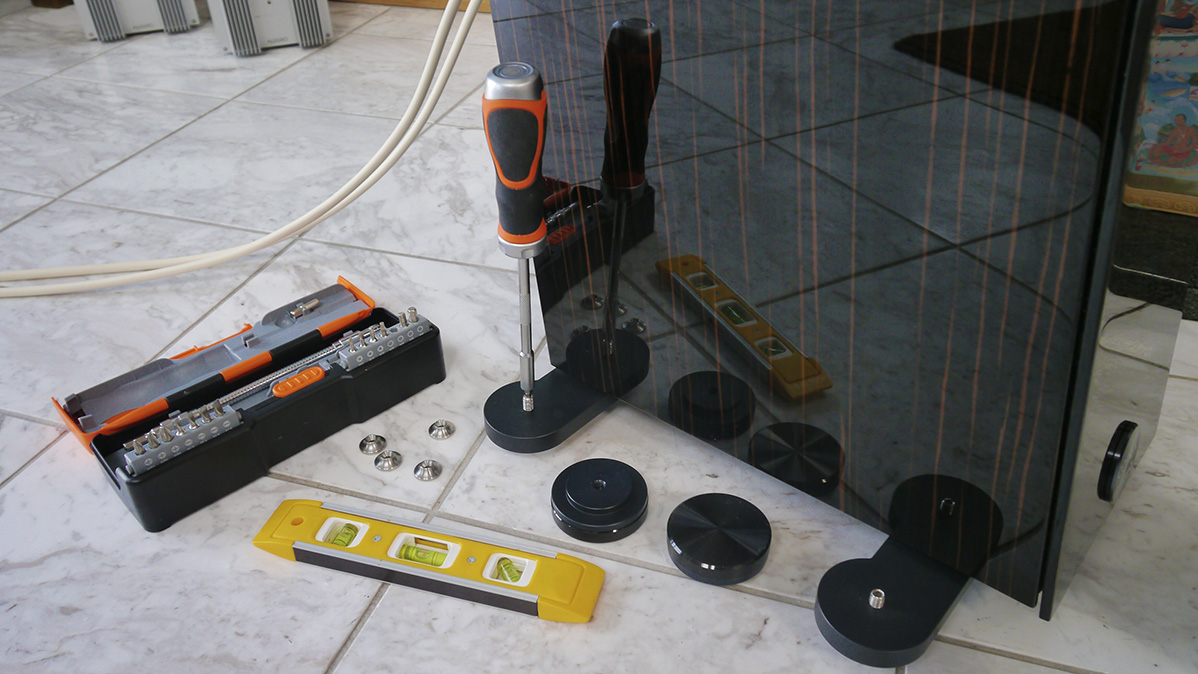
Swag: useful. Different companies walk different swagger. Some include bumper stickers or lap pins, hoping that you'll advertise for free. Zu instead include de-oxit metal polish to keep your connections clean. Audio Physic include a bubble level on a key chain; perfect to get your speakers perpendicular on uneven floors. The spike cover discs remove to insert a hex driver for length adjustment. Does gap height matter? I tried both narrow and taller and thought that the latter gave just a bit more output; as though the bass was breathing more deeply. Given our 100m²
space, that's what I went with.
|
 |
Class bias: none. Of course no speaker is truly racially biased for or against class A, A/B or D amplification. Just so, certain voicings might lead to quite universal preferences like the well-known widebander/SET aesthetic. With high QC boxes like these—quick and clean—the sound can veer into the lean and dry when powered by matching amplification. Strapping our nCore 500 class D Nord monos to the Codex did warrant a minor course correction. This substituted the direct-drive Metrum Adagio DAC with the Fore Audio DAISy1 tube DAC and Wyred4Sound STP-SE Level II preamp. With this small turn of the steering wheel, I thought the Audio Physic thundered right down the middle of the road. A small loss was the last word in treble finesse. Moving to the Pass Labs class A XA-30.8 segued into a warmer sunnier climate with a more refined top end and mellower transients. Going to the Linnenberg class A/B Allegros lit up the treble even more to get the very most from the special Audio Physic tweeter. Naturally, this airier more energetic mien also was a tad cooler and subjectively faster than the weightier darker Pass. Metrum's class AB Forte shifted emphasis onto the midband to grow warmer and denser but slightly opaque on the very top. Surprisingly, bass power stayed constant between 250w class D, 25w class A, 55w + 100w class A/B. This suggested benign load behaviour. The Germans didn't really benefit from gobs of power or class D's ultra-low output Ω for woofer control as many sealed alignments can. Despite big-boy bass, the Codex didn't need big muscle to get out of 1st gear. To my mind, that was another very practical feature.
|
|
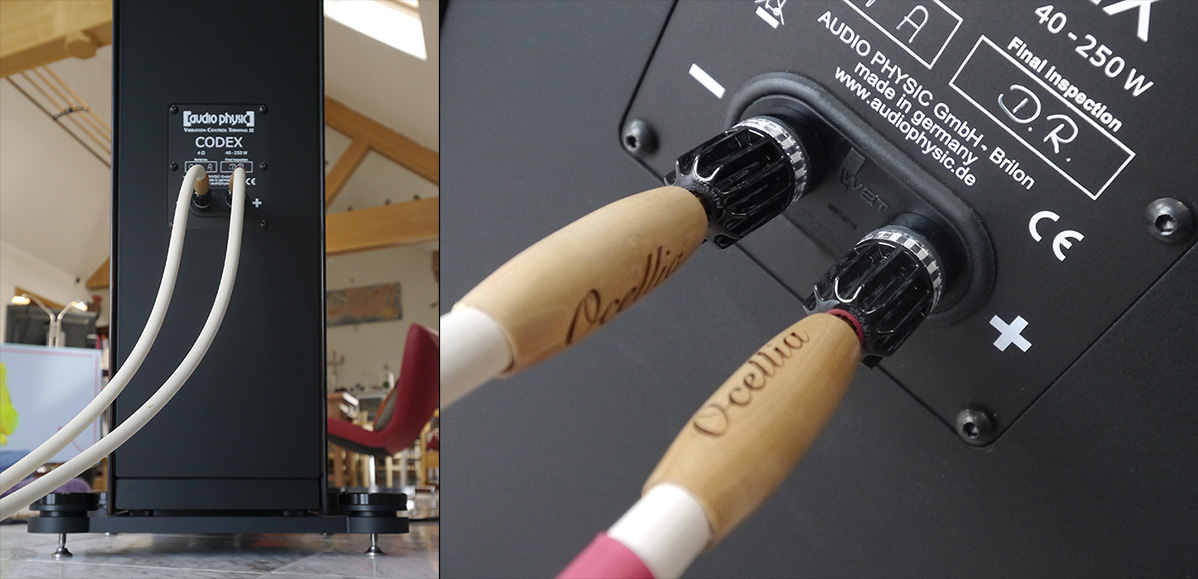 |
Here we see the mechanically isolated WBT terminals embedded in their own rubbery interface. Even the terminal plate claims boilerplate 40-watt happiness. It's true! Back on sound, while my descriptions of stupendous bass might at first predict a bottom-up perspective, this was categorically not the case. Why? Precisely because of this bass quality. Being truly cut from one cloth top to bottom—without the LF getting even a hair thicker or embed in more resonance/reverb than the higher bands—this presentation didn't have a 'directional' perspective such as top down or middle out. It didn't fit those terms. Instead, I'd call out full-bandwidth speed, clarity, precision and accuracy. Even though bass integration, reach and power did become first attention magnets because they're so uncommon in a world dominated by ports, my ear/brain quickly clocked a new normal. Now the bass stopped registering as 'different' because it in fact no longer was different. That's the whole point. It was as tensile, taut and crystal as everything else. It didn't stand out to create emphasis. The perhaps best summary then is a mini-monitoresque sound with perfect twinned subwoofer integration. It meant giant super-finessed staging with the scale and anchoredness beyond most monitors unless they're a Mark & Daniel Maximus MkII driven by kilowatt/2Ω class D power. Against that specific example reviewed earlier in these pages, the synthetic marble boxes from Shanghai prioritized chunkiness, dynamic vigor and muscular drive. By contrast, the far bigger Germans were the more transparent and easeful, with superior in-room power and solidity of very low bass not pushed through narrow pipes.
|
|
|
|
|
Horse: mouth. After his return to the office post Easter, Manfred's answers arrived. He kept stumm on filter slopes but divulged crossover points as 100Hz, 350Hz and 2'800Hz. As to the new inner-box woofer over the previous force-cancelling sidefiring woofers, "this is a longer story. Over the years, the sidefiring woofer array was improved in many aspects. A very important one was lowering the crossover point to the midrange unit(s) from about 400Hz to 150Hz. This made setup much easier compared to the older designs. When we started the very straight-looking Classic Line about four years ago, we launched the first version Classic 20 with a grille on each side. Now we were criticized for the looks. For the planned next larger model, the Classic 30, I started to think about a new design without lateral woofers and grilles. The result was the inner box. I had some doubts whether this would compromise performance but the results were far better than expected. So I implemented the inner box design into the redesigned Classic 20 [right], now the most successful speaker in the Classic range. I also continued it with the new Avanti. The Codex became the next logical step to follow up the Avanti. We decided to continue with both designs as they show a different character; but at a very high performance level." On the company's transition from Joachim Gerhard to Manfred as chief designer, "in 1999, I started working for Audio Physic as a freelancer. Joachim sold the company in 2004/2005. We first met in the early 80s in the DIY scene. From 1993 to 1998, Joachim had engaged another designer to assist him. In the beginning, I refined the original designs but over the years more of my own ideas found their way into the products. The key elements and motto were always very good imaging and 'no loss of fine detail'. Highlights of the 30th anniversary model changes were the launch of the 3rd generation HHC tweeter and midrange." |
|
|
Bass: foamed. "Yes, the front wave works on the complete cabinet volume except for the three small tweeter, midrange and lower midrange chambers. Its slot exit begins with a ceramic foam tile of 10x15cm. This creates small losses at normal volumes, then gets more resistive at higher levels. This behaviour increases precision and the open pores help avoid chuffing in case of overload. Four ceramic foam elements connect the woofer chambers. This silicon-carbide foam combines special properties: it is very rigid; has a huge surface; and takes less than 15% of the net volume compared to solid braces because it is more than 85% air."
|
 |
|

|

|
|