|
|
|
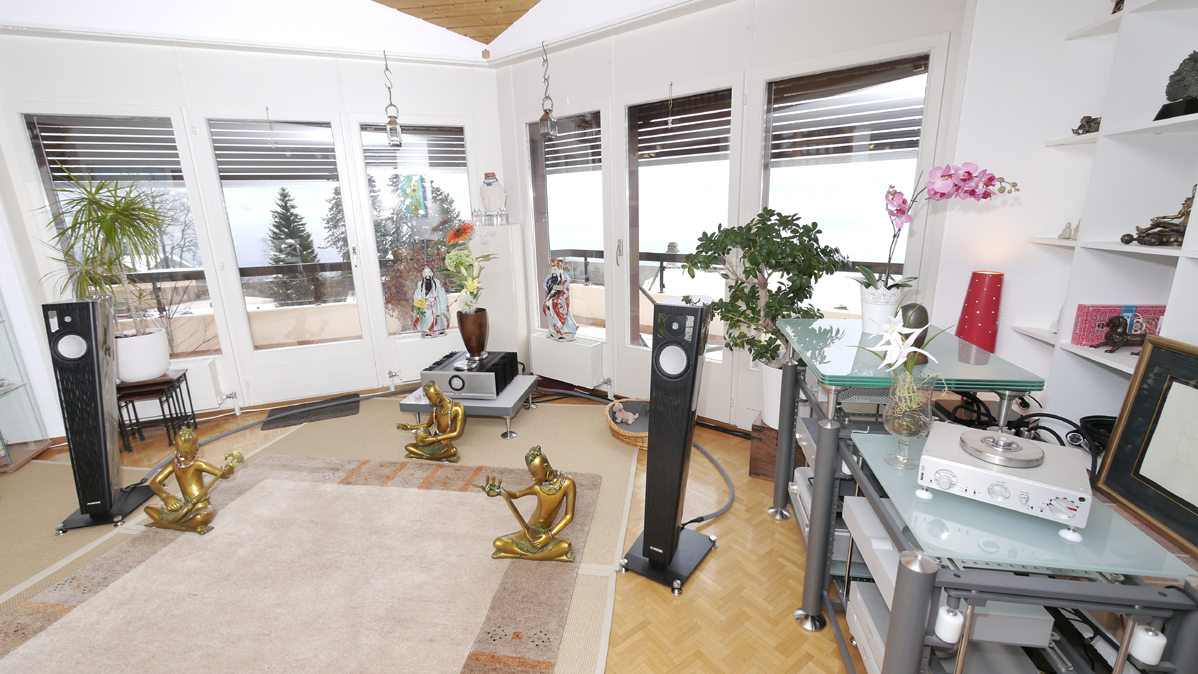
Whilst still living in Taos, New Mexico, I'd performed a direct comparison between Grand Prix and EquaRack. From that I knew how different such equipment supports have different effects. You don't need accelerometer tests to prove that. You can hear it. Whether you care enough about that difference to pay for it—let's face it, this stuff isn't cheap—is another matter. In our first Swiss residence, my two Monacos became too big for the narrow but deep listening area. By the next residence, they'd been replaced by the double-wide Exoteryc. Just how much swapping shelves on a single component might do now; or for that matter, vis-à-vis having an amp squat unceremoniously on the floor... I was frankly far from sure. As a reminder, our tall Zu Submission sub with its downfiring sealed 12-inch woofer sits right behind the amp. By design, that's a constant generator of very low bass. You'd obviously not place a turntable right in front of it. But would a power amp prove susceptible to isolation from the floor (all whilst being engulfed by potent LF energy in very close proximity against which the amp stand would be useless)?
|
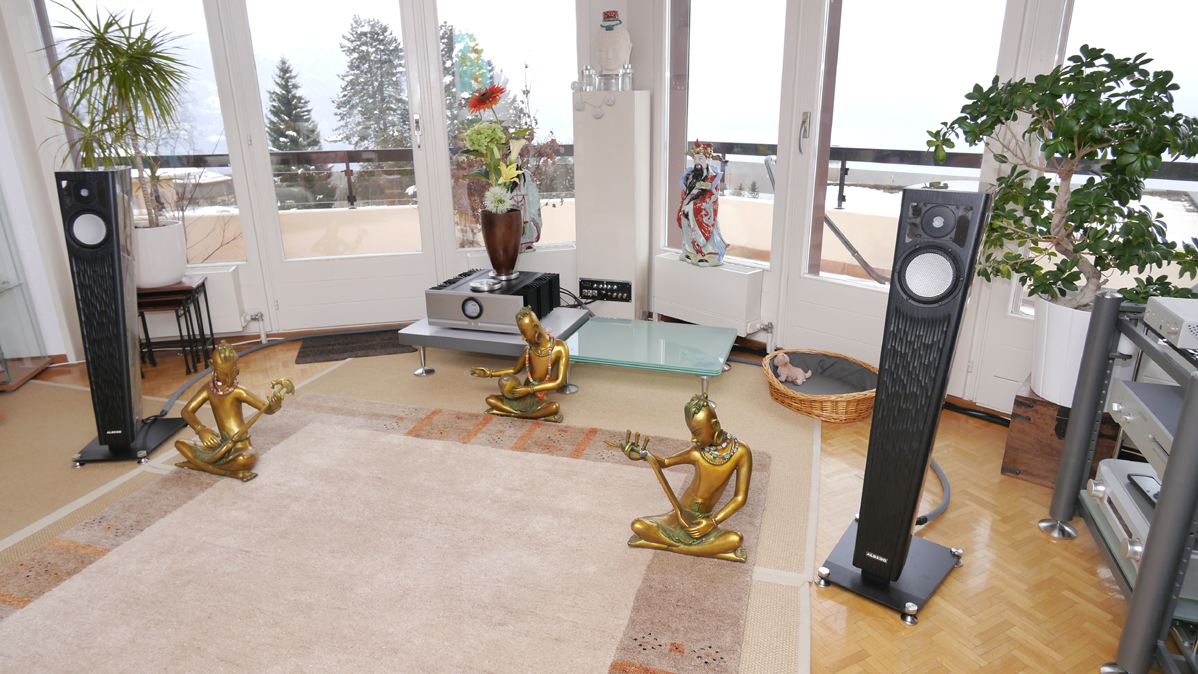 |
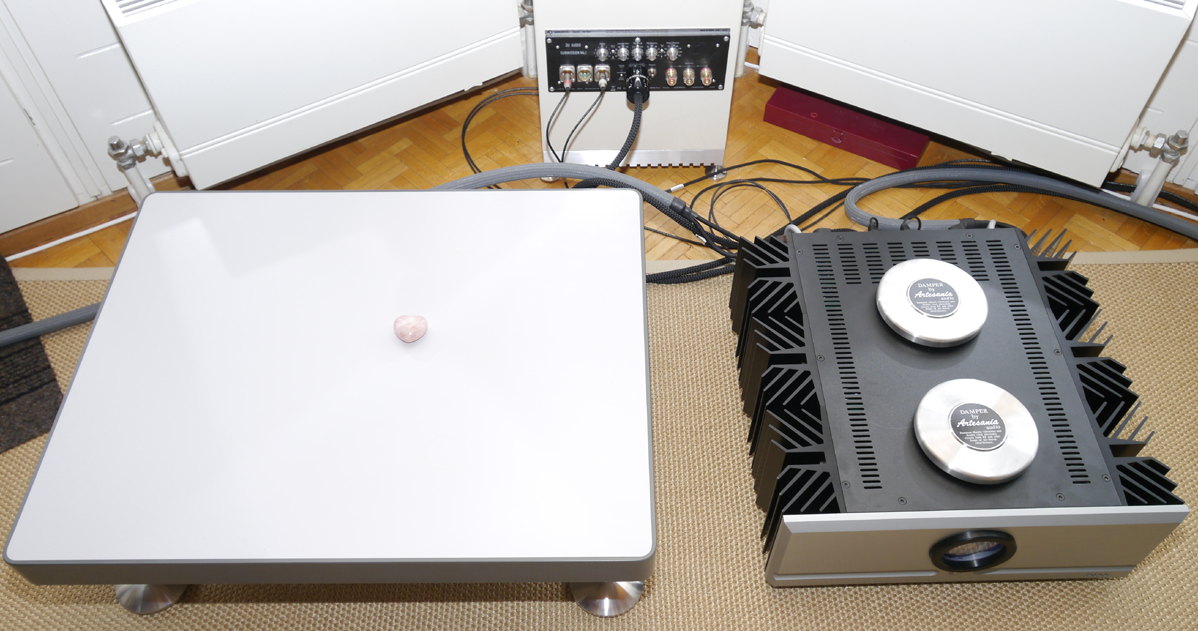
It took me a few cuts from different CDs before I thought that on the Krion platform, the amp created better focus. This wasn't per se like suddenly wearing corrective glasses when one's vision has gone a bit soft. I keyed into it with how specifically solo vocals contrasted against and stood separate from their backdrop. Once I'd found my marble, I could more easily find it again in subsequent cuts. That said, it didn't strike me as a global effect like people talk of removing veils or cleaning a window. This struck me as being more specific to slightly enhanced midband clarity. I never understand how certain writers assign 83 out of 100 points. That part of my brain isn't wired up. Just for illustrative purposes—we always want to know about the magnitude of an improvement—I'll call it a 1% - 2% gain. It was a small thing which required some digging to latch on to at first. Whilst I did develop a preference for the Krion, if you took it away, I'd very quickly get used to the glass. Those with less patience or no interest in analytical listening might as well shop this decision on pure looks. Don't we do it for shoes and clothes all the time, even for cars?
|
|
|
|
|
In lieu of the massive wooden furniture freezing in the snow-covered garage in late February, my bypass test came from the XA30.8 on the floor. Unexpectedly, this had an immediate negative impact on the soundstage. Most noticeably, there was lateral shrinkage to get more compact. Just so, I also had less depth. Some fine information about recorded space had been obscured. Unlike the Krion/glass swap, this clouding over and clumping together like cat litter took no fussing to identify. Obviously the amount of spatial compression or loss was related to how much of it was recorded in the first place. m.a. recordings' Sera una Noche was rather more telling than a synthesized wall of ambient sound from Al Gromer Khan's paisley music. Grasping for figures, I'd call this a 5% gain just to create context with the earlier numbers.
|
 |
The most useful takeaway here ought to be that resonance attenuation has an audible impact; and that all materials have a kind of self sound which influences their behaviour or effectiveness for these purposes. From ceramic to marble, granite and shale tiles, tempered glass, Ikea bamboo cutting boards and Corian/Avonite kitchen-counter resources, a resourceful DIYer has a plethora of options to explore. Those after ready-made solutions have in Artesania Audio a proven resource for good-looking highly functional solutions at a price.
|
 |
One should obviously care deeply about better sound before one allocates serious funds to purely mechanical devices which don't plug in to be in the electrical signal path. And it's probably true that with more effective circuit board suspensions, transformer and heat sink isolation and resonance-optimized enclosure geometries and materials, future gear could be designed and built to become less sensitive to external vibrations. As long as we're still dealing with 2015's status quo however, our apparently impervious components are more jittery than they look. Should you feel curious about the subject, there's a lot of untapped performance to be mined. It's not free because effective turnkey counter measures cost money particularly when they're high mass and expensive to ship. But tapping this forgotten performance is free by being applicable to all the components you already own. Getting the most from what you already paid for seems most sensible. This assignment thus also became a personal reminder. Where for most home dwellers, big acoustic treatments aren't doable, addressing the resonance control issue is. Your equipment has to sit on/in something after all. Why not transform that something into a very deliberate active contributor to better performance and higher resolution?
|
|
|
 |
|

|
|
|

|
|