|
|
|
Modularity in action. Though you might think it silly to complain with a non-sampling filterless DAC, I told Cristian that "you still have minor issues, perhaps because it’s a beta firmware version. I tried to upsample to 352.8kHz in PureMusic’s 64-bit player software. Sometimes it works, sometimes it takes multiple attempts before it does. Then it suddenly interrupts mid tune and doesn’t come back. No issues at all without upsampled straightahead material." Cristian emailed back the very same day asking more questions, then promised to look into it. Exactly 10 days later he had this: "Problem solved. It was a bug in the XMOS firmware with PureMusic upsampling. Is it good for you if tomorrow I send you a new USB board?" Contrast this with experiences elsewhere. Reports of certain issues would be dealt with variations on "we've never had any complaints and got many units out in the field. There's something wrong with your setup." What a relief when feedback is embraced to improve things, not brush them off.
|
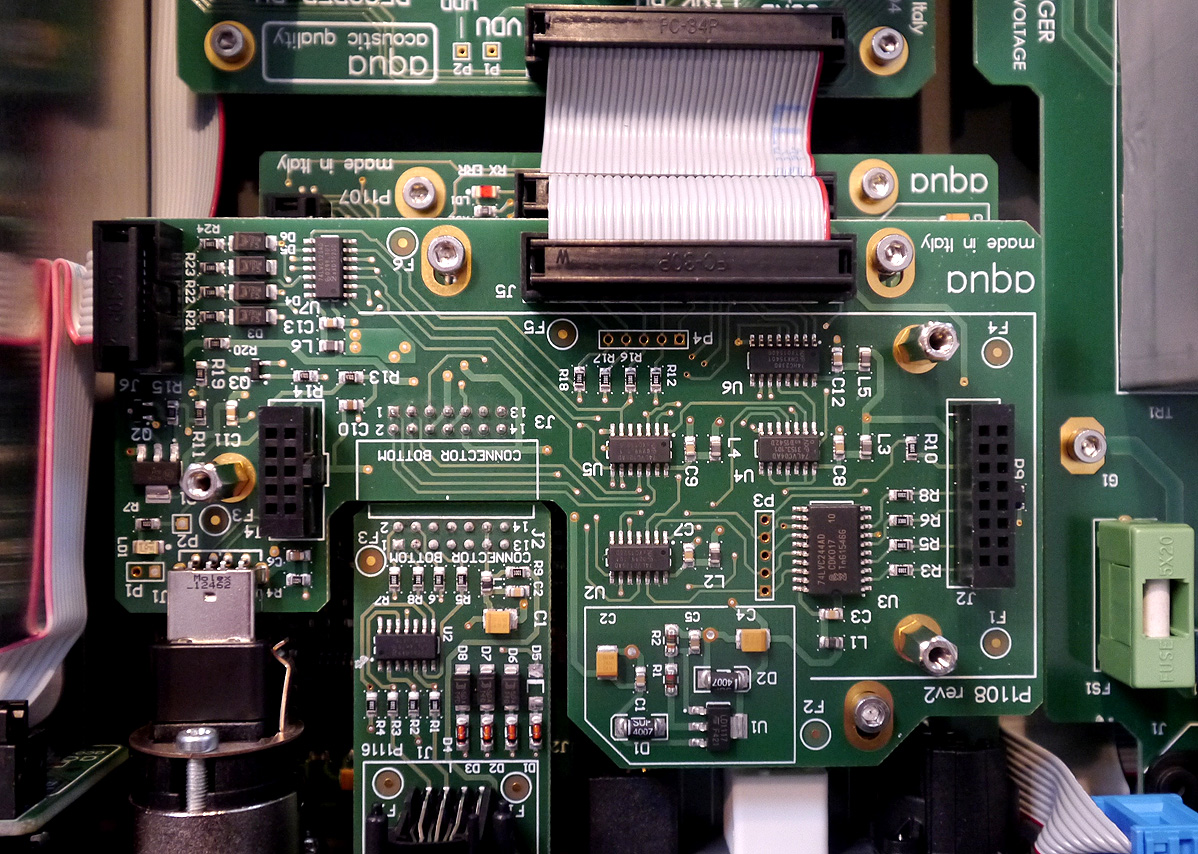 |
Here is the board beneath the removed USB module.
|
Computer audio is in constant flux. Like smelly cheese, it's ripe to misbehave. There are OS changes, unforeseen interactions that prompt firmware rewrites in player softwares like Amarra, Audirvana, PureMusic, JRiver & Co., customers using aged computers with more or less current OS albeit loaded with programs perhaps not fully up to date, hence not fully copasetic. It can be hell to replicate a user's particular issue when the designer's bench finds no faults. If an engineer can't replicate an issue, he can't fix it. Yet sorting it has become a modern digital designer's never-ending responsibility. Clearly, some are more up to it than others. It's what separates the men from the boys. There's no doubt what Aqua Audio are. Needless to say, the reflashed USB board solved the issue. Bravo.
|
 |
|
 |
Sibling rivalry or sororicide? BB1704K+tubes vs. R2R ladder. You'd expect them to do something definitive that's different or extra to earn their respective raison d'être. The LaScala Optologic upgrade proves that Cristian Anelli isn't prepared to give up on his Mosfet-coupled valves yet. How old and new MkII compare will be for an upcoming comparison. In today's A/B, the LaScala was the thicker, coarser, spatially more opaque. Surprisingly, on certain strings it was even a tad glassier in the presence region. By contrast, the Formula was the spatially more explicit and revealed; the texturally finer, with some cobwebs or connective tissue removed; and the tonally purer and more elegant. The only advantage I heard for the LaScala was its macrodynamic swing potential. Peaks rose higher as though there were more mass and displacement at work. Otherwise, think of a teenager's physiognomy with its remaining baby fat and gloss-over roundness; and the later adult's greater definition and personality imprinted on the facial features. That gives you a visual facsimile for the Formula's greater sonic maturity. By virtue of higher magnification power, there was more micro detail both on tonal objects and their spatial context mapped by recorded reflections and decays. |
|
|
The more specific spatial context—what I earlier called the recorded atmospheric mood—and more finely gradated tonal definition also meant that the performance was intrinsically leaner and of greater transparency. The LaScala was less teased out and subtly grittier but also plumper and denser. Here it remains my observation that on this axis, gains on one side entail losses or at least a shift on the other. More mass and textural thickness mean less transparency and less tacit overlay of recorded acoustic on our own. |
|
|
|
|
|
On premium recordings like Switzerland's sadly departed female Andreas Vollenweider, harpist Asita Hamidi, the suchness of percussive hits was very high with the Formula. To appreciate that meaning, drop a glass on the floor so it shatters. That most direct shock to your nervous system and adrenal glands is how real-world transients can register. Playback transients too can unsheath from their cotton wadding to trip our inner alarm. That blurs the line between recorded and real. It simply relies on premium recordings to come off. To recapitulate, aside from very refined tonal full-of-insight details and R2R's easy listenability which comes through most with simple speakers, the major forté of the Formula was its differentiation of recorded space. As space is visually empty—we normally can't see air which is why exceptions like scintillating hot air pockets on a cold day are so exciting—recorded space is silent. We don't hear it directly but as an absence of sound. Still, venue qualities imprint themselves on tones and how attacks and fades intermingle. Clearly this isn't primary data. It's much finer. It's embedded associative stuff. It's far lower in amplitude, extremely short-lived and masked/overlaid by louder primary things. To gain access to this gossamer fourth dimension is more subtle than obvious 3D markers of width, depth and height which define a soundstage. One can enjoy music without ever noticing it. But for connoisseurs keen on the total experience that's encoded in the pits or bytes, these hidden aspects justify far greater expense and more involved system calibration to access. That's the performance pedigree and capability of the Formula DAC. It can unlock that hidden dimension.
|
|
|
A very practical 'normal listening' benefit was excellent whisper performance. With the Formula in the loop, playback levels can be subdued yet already give full access to this inner world. It's a personal pet peeve that not enough audio commentary mentions the vital importance of low-SPL satisfaction. Whenever a hifi must be played loud before it communicates, it invariably gets used less often than it should.
If one can listen quietly and feel fully immersed, far more opportunities arise in a conventional household to enjoy playback. On that score, the Formula nets two enthusiastic thumbs way up to borrow movie critic Roger Ebert's trademark endorsement. It's an instant when populist obsessions with ultra resolution actually matter. Rather than fluff that's of relevance only to bats, Tektronix scopes and spec sheets, the Formula's resolution advantage over its older stablemate had practical utterly non-geeky benefits. And, as always, to fully benefit from its performance headroom over its far more affordable stablemate will require a properly optimized system that's sensitive and reactive to this extra potential. In the same vein, at €13'800—more than twice the €6'600 Optological LaScala MkII—the cost/return curve obviously flattens significantly over what it was for the overachieving hence award-winning original €4'890 LaScala MkII. The Formula plays in a very different league. But as our inside photos demonstrated, for once an expensive DAC isn't a mostly empty box with op-amp outputs in a massive bling case but one that's loaded with actual hardware.
DSD. Other than check that it could—for which purpose I keep a few such files on my dedicated music iMac—I didn't delve into DSD playback. Like MQA's 2016 catalogue, DSD is utterly irrelevant to my personal music consumption. What I listen to isn't (yet?) touched by these formats or coding schemes. Suffice to say that after the USB board swap, the Formula processed the rare DSD files I fed it as either 176.4kHz or 352.8kHz PCM.
|
 |
XLR/RCA. Whilst the balanced outputs do go the extra distance on transformer windings to be more complex, in my setup I slightly preferred them even though our Esoteric C-03 preamp doesn't use a fully balanced i/o path (single-ended volume control). The transformers added a subtly oily or viscous tone texture which made the RCA feed a tad more dry or matte. Given how this translated without real front-to-back symmetry, it would seem to be a worthwhile test for would-be owners to undertake. Whilst preferences vary, the RCA and XLR outputs do not sound identical. Experimentation is recommended to see what you fancy more.
Final words. Aqua's Cristian Anelli must be a pointy-eared Vulcan or elf who knows how to transcribe superior listening skills into the language of circuit traces and parts selections. Working as a digital specialist—no preamp or amp from this brand yet—he nonetheless belongs to the school which believes in a dedicated analog output stage and linear power supplies. Some R2R DACs today eschew analog output stages because their resistor ladders already produce all the necessary signal voltages (Metrum and TotalDAC are two such examples). Cristian is also big on modular everything. This protects the investment of his clients. Each primary and secondary circuit function is executed on individual PCB modules. This enables swaps should updates come along. "No obsolescence inside" is what that invisible sticker reads. With the original LaScala 2 being one of my two reference converters and the top deck in contributor John Darko's DAC index, exploring audible space beyond it seemed, truth be told, a rather tall order. How much room was there left for improvement? What ungodly reference gear would it take to hear it? As it turned out, the Formula delivered a demonstrable lead with €6'500-class ancillaries like a Pass Labs XA30.8 or pair of Zu Audio Druid V speakers. If you're an audio aboriginal who goes deep walkabout into gargantuan soundstages to cherish size, scale and utmost specificity about recorded space, this Italian formula has your number. But it's not merely about the usual 3D markers and how precisely and widely spaced they are. It's about an added dimension. That accesses the emotional mood or climate of the playback scenery. Whilst costlier decks came through earlier, none of them did it at that potency. Granted, to fully matter relies on superior recordings. Lesser or purely synthetic efforts reveal that they lack that particular magic. Finally there's this peculiar easy-digital aspect as though your brain's usually active aural processor went on holiday because it's not needed. As such, I must highlight Aqua Hifi's Formula with one of our sparsely administered awards. True, it's serious money. But it's seriously well built. And it delivers very serious performance. Yet all this multi-stage seriousness melts away when one is faced by such deep holistic listening satisfaction. That's what the 'high' in hi-end should be all about. Cachet, pride of ownership, resell value and bling to impress the ignorant with all factor. But they pale to nothing against delivering the actual experience. The Formula does. So it pays to study its recipe in detail. It really is something else!
|
 |
 |
|
|
|
|

|
|