 |
|
|
Personal beliefs. In my experience with well-done R2R converters of Aqua Hifi LaScala MkII, Metrum Hex/Pavane and Schiit Yggdrasil calibre as well as a few TotalDAC machines, they can share a very special quality. The kicker is that this needn't be apparent. If 'special' and 'hidden' would seem mutually exclusive, here's my pet theory behind it. Time-domain fidelity in upstream hardware gets obscured if the final transformers of electrical into mechanical energy—the loudspeakers—are "time confused". Be it steep crossovers or multi-driver integration issues, if the final link in the signal chain misbehaves in time, any gains (or really, avoidance of errors) made in that domain by preceding equipment won't translate fully or at all. A superior converter will still demonstrate its pedigree on any number of other fine hifi qualities. It just won't shine on the one which the speaker destroyed. I don't think it coincidence then that Holger Adler of Voxativ ended up with TotalDAC discrete R2R converters for their reference and trade show systems. Whatever potential weaknesses single-driver widebanders might suffer, filter-induced phase shift and multi-driver integration problems aren't amongst them. Following this train of thought, I picked the Zu Druid V widebander driven by the very simple FirstWatt SIT1 single-stage single-ended transistor monos for my first sessions. You may disagree with my belief but at least now you know what to disagree about.
|
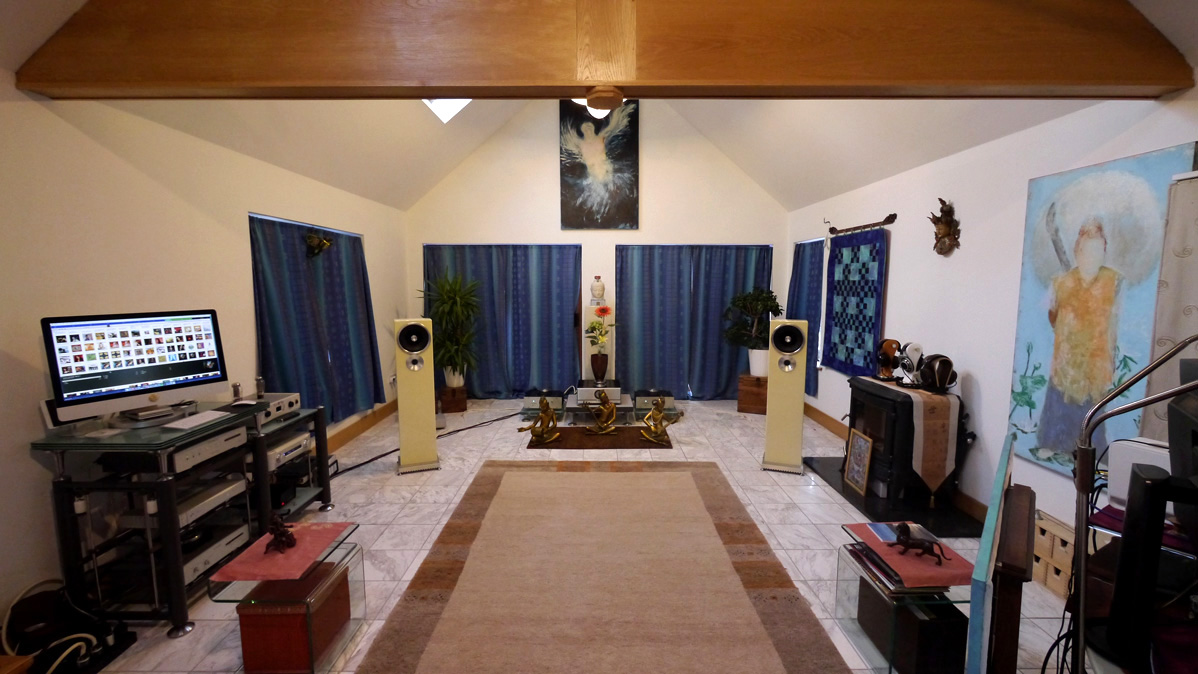 |
To eliminate accusations of favouritism, my other chief DAC, Fore Audio's DAISy1, is a valve-hybrid Sabre-based ΔΣ affair. On matters of hifi, I really don't believe in the monotheistic absolute sound. Like a hindu, I happily worship at the altar of numerous deities. Like headfi vs. speaker fi, I can enjoy oversampling 5-bit converters and zero-sampling multi-bit competitors for their different flavours and perspectives. Where the Aqua Hifi decks are special and blossom that specialty into a load like the Druid V is with their quality of ease. Far from a weasel word like musicality, it can still seem far less concrete than soundstage scale or treble brilliance. That's because like physical tension in the body, you only notice it when your muscles relax; never before. This then is an observation about process not detail. It's not about things—tonal weightiness, separation, bass power, transient quickness—but how those things are perceived. If you don't know where to look, you won't see it. Once you do; and if your speakers are translucent to that quality; it's easy to recognize that flavour. Going back to a ΔΣ deck then shows you how that doesn't have it. It might have other qualities you prefer; or where it does more. It simply won't have the same temporal ease. Now it becomes a matter of how much you desire that quality; and how it rates relative to the many other possible virtues you find important, too. This acknowledges an essential. Like time coherence in loudspeakers, "easy digital" isn't the only or even primary criterion to matter. It's simply that if/when everything else that matters is perfectly handled or well enough, it could become the decisive difference because, somehow, listening to such a DAC has your ears and brain relax and more at ease.
|
|
|
|
|
|
This ease still differs from soft or insufficient drive. Some systems are tuned for adrenaline, excitement, spunk and jump factor. Others emphasize mellifluousness and chill factor. In visual terms, it's edge of seat versus deeply reclined in a plush lounger. For an unsympathetic listener, the first sound could be too intense and trying, the second too lazy, noncommittal and boring. In recent reviews of the Vinnie Rossi LIO DHT and S.A.Lab White Knight, I'd encountered components which played down energetic tension and muscle tone, then played up spacious fluffiness. Call it forward propulsion versus circular float. Today's ease isn't synonymous with float/flow. Ease of perception can coexist with a rhythmically charged propulsive system like the very PRaT-capable punchy Druid V. Here we hit upon limitations of established hifi language which fails to deal with these 'intangible' but very real aspects. Now using unfamiliar words or concepts risks sounding esoteric or obtuse. To avoid that reaction, it's far easier to throw out quick 'musical flow' or 'continuousness' verbiage, then hope that readers will associate the intended meaning. Fat chance.
|
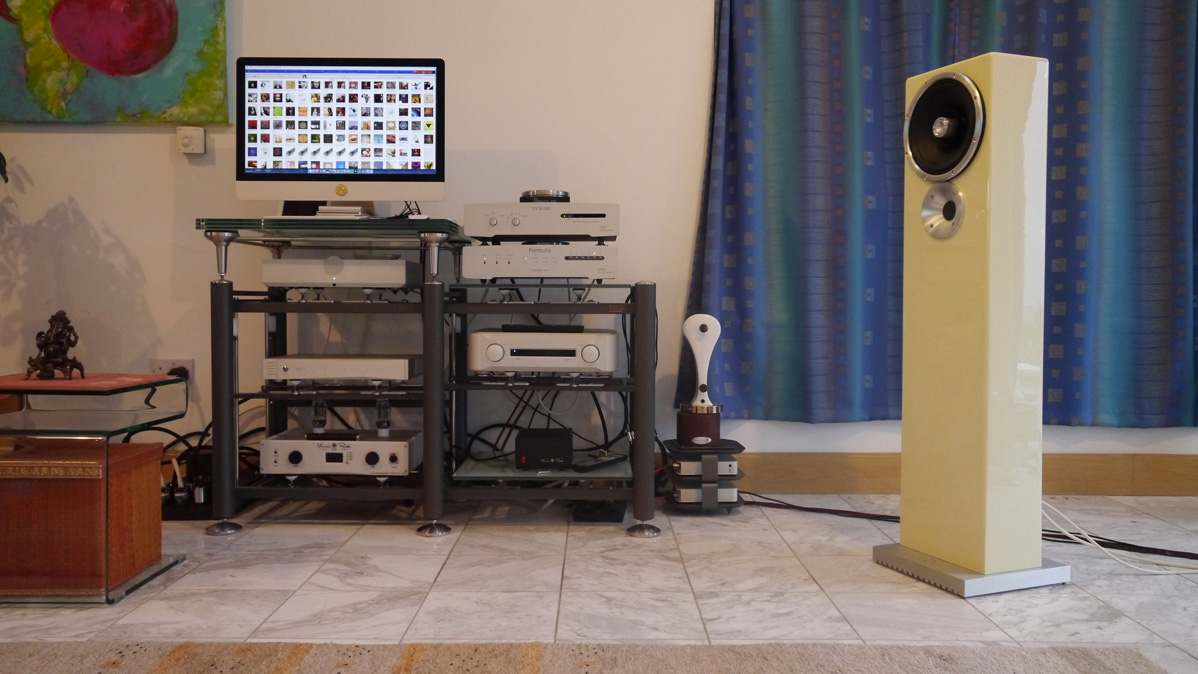 |
For today's purposes, I merely repeat that this ease of perception related to properly done R2R conversion —as though your ear/brain were a muscle that's usually contracted and suddenly relaxes—doesn't disable musical tension or weaken pace and rhythm. Those are still things. Perception is the process which notices them. An easier process has a distinct feel or mode about it. One can learn to recognize and appreciate it; or perhaps is naturally sensitive to the absence of subliminal effort to refuse listening to anything else. Again, that's not me. I don't refuse to listen to premium Delta-Sigma DACs; nor do I consider them poor by any stretch. Heck, I own three of them. They just don't do this thing. Hearing a top R2R like the Formula is like slipping into a well-worn perfectly upkept shoe. It's supremely comfortable. This segues neatly into the Taoist proverb of Chuang Tzu - that "when the shoe fits, the foot is forgotten".
|
 |
Power-of-two 64-bit NOS-style upsampling from 44.1kHz to 352.8kHz confirmed with the Formula's sample rate indicator.
|
Further on which, Cristian informed me that my loaner had the beta DSD firmware upgrade for DoP's 64/128DSD protocol. "For DSD, we can obtain the audio signal with a simple low-pass filter applied to DSD; or convert it to PCM followed by a DAC. We evaluated both options. From the design point of view, the low-pass is less demanding but in the end, we preferred conversion to PCM which takes advantage of the qualities of the R2R DAC; maintains our philosophy of no analog filtering at the audio output; and produced the best sonic results." In this, Cristian Anelli joins Bel Canto's John Stronczer who likewise prefers processing DSD as PCM. When a first comparison against our LaScala MkII didn't show an unequivocal lead on all fronts, I checked with Cristian on break-in and how many hours my loaner had. "Your unit has 4-6 hours on it. I think it needs 200." Given its parts density, that likely explained it. Shutting the main system down for 10 days of break-in simply was out of the question. So off into the guest room the virgin machine went for 24/7 2V coax signal from a Soundaware Esther M1 Pro. That was set to endless album repeat on an Android Belkin dock for never-ending charge. Without the connected integrated fired up, there was no noise pollution whilst the Formula stewed in its own juices. A week later, it was in proper fighting spirits back in the main system. Definitely don't judge it prematurely!
|
 |
 |
|

|

|
|
