 |
|
|
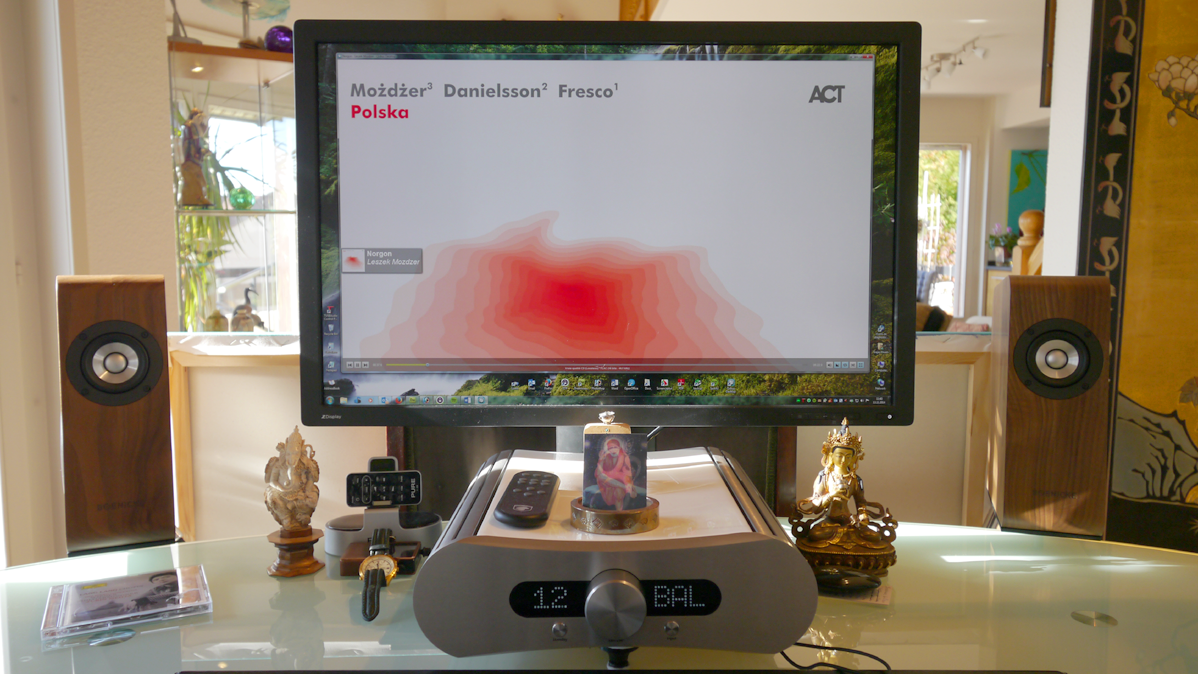
Ion+ vs. One18. Given sheer size or rather, lack thereof—the next photo serves as mere reminder—made relative bandwidth limits for the Ion+ obvious from the start. Knowing that required zero listening. No, the interesting thing would be resolution in the vital vocal band where a smaller driver can have the advantage. My question thus was whether the One18's bigger driver could offset or outplay that advantage with its excellent damping from the ABR.
|
 |
Using the Leszek Możdżer piano trio Polska [ACT] for wide bandwidth piano challenges, vocal stylings, upright bass sonority and percussive work high up into the cymbals, it became clear how on crystalline clarity, the Ion+ was closer to the One18 than the Helium 510 had been. Whilst handicapped in bass quality where its small port caused a bit of textural hollowness by contrast, the round-cornered Ion+ in its very impervious white paint—scuff marks polish right out—had equivalent insight and separation into layering. On scale based on profundity, the One18 had the unfair advantage. On perceived resolution, the Ion+ was unreasonably close and in certain respects, perhaps superior. The thing I quickly got hung up on during my A/Bs however was the particular port ringing triggered by the drum and lower piano registers; and a small midbass boost from it. This the bigger black box completely avoided by comparison. That behaviour of the Ion+ became like a pimple on your nose. You can't leave it alone once you know it's there. But really, it doesn't interfere with your vision at all.
|
 |
The practical takeaway from this otherwise silly juxtaposition was that indeed, the One18 very successfully exploits its ABR loading principle to bestow on its bigger mid/woofer the reflexes and separation magnification of a smaller driver which, by design, also plays it a bit leaner and lighter on body than the bigger diaphragm. In hindsight, no surprises there but still worthwhile confirmation to conduct in actuality rather than rely on theory or supposition alone. Returning from my excursion into the Cold White North of Finland to our mellower Swiss climes via my customary Boenicke W5se created more soundstage width—their mid/woofers fire sideways and in my setup, out—and clearly richer tone textures. Simultaneously the overall picture softened a bit and the treble grew less explicit.
|
 |
The Boenicke bridges the gap between the Harbeth/Spendor sound I had opportunity to refamiliarize myself with at the Warsaw audio show a few days prior; and the trained-for-exactitude Amphion aesthetic. What you prefer is entirely personal. Time to move the One18 into the big system and onto my set of British Track Audio stands. I merely had to swap their bigger top plates for the smaller pair and presto, the Amphions perched securely and at proper height.
|
|
|
|
|
|
As it happened, the One18 moved there just when the APL Hifi DSD-S arrived. That's a Bulgarian DAC which processes all PCM data up to 32/384 as 64 or 128 DSD. Quoting from its review—about conclusions I'd drawn after my Meitner and Nagra reports on such devices—"DSD seems to sound softer than PCM, with less treble tintinnabulation and a mellower grip on transient incisiveness. Depending on implementation, this innate mellowness could seem a mite sedate, plush, fuzzy, sweet or comfy. On the other hand, DSD can also exhibit more explicit spatial data to end up delivering more audible venue (real or faux is entirely irrelevant on that count). Though I'm a personal vinyl heathen not believer—purely due to my musical tastes and what format supports them—I have friends and colleagues deeply into needles and grooves. Without exception, if they're familiar with DSD as either SACD discs or DSD files, they report that the format and playback mode are closer to vinyl sound than 'regular' digital. Let's refrain from calling vinyl superior or closer to the source. Let's instead talk about that, disregarding differences between recordings and playback hardware, there seems to be a general recognizable flavour. Here DSD and PCM converted to DSD would seem to share more with vinyl's native flavour than Redbook does or hi-rez PCM."
|
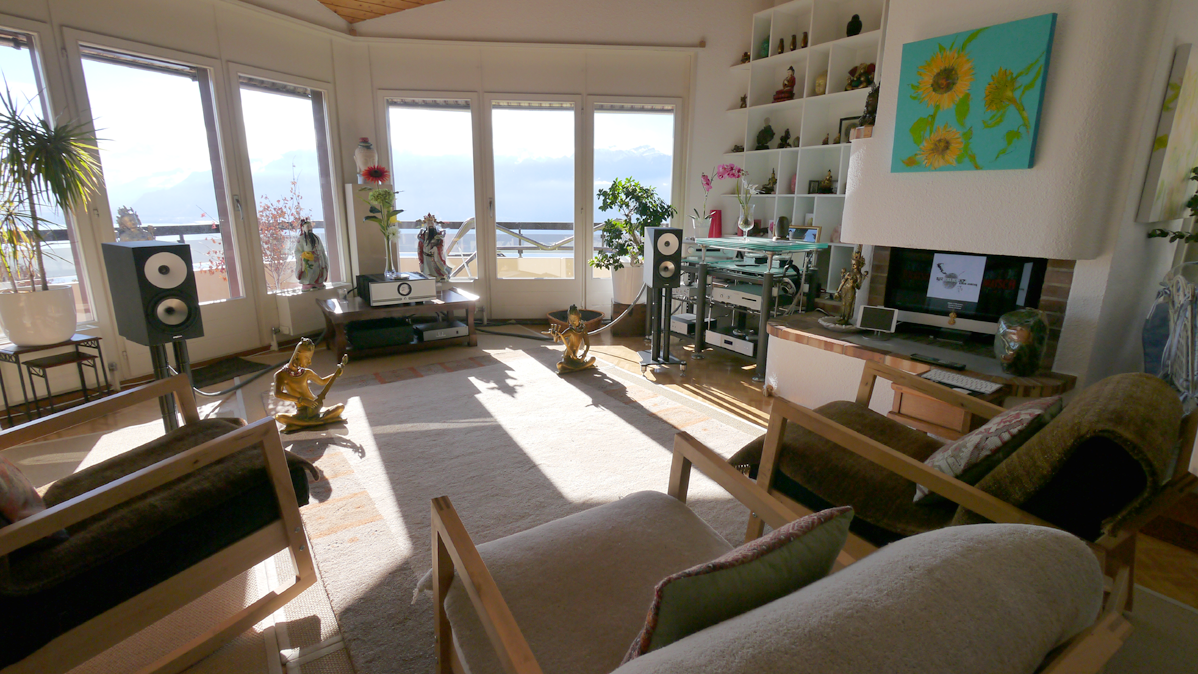 |
Still from the same review, "whilst the tube-hybrid 4 x PCM1704K Aqua Hifi La Scala II DAC is the antithesis of a hyped crispy critter, with this very precise cooler studio monitor, the DSD flavour asserted itself immediately. It made for an even better counterpoint to the attack sharpness and generally lit-up top end of the Finns. This being an instant first impression for the strongest possible contrast before the very adaptive ear/brain mechanism would kick in with its auto interpolation business, I had my 'three strikes and you're in' scenario for DSD. It really did have its own flavour exactly as described above." Because it was such a fortuitous good match, that's how I left things. My new Pass Labs XA30.8 handled amplification, my Esoteric C-03 preamp volume control and signal routing to the Zu Submission sub for some later fun. For yet more fortuitous timing, Hans-Jürgen Kaiser from Kaiser Acoustics Kawero! had just then announced personal delivery of the Chiara super monitor. It's conceptually quite similar to the One18, albeit at the truly bleeding edge of construction details, parts quality and expense. Given its far more modest sticker, how close might the Amphion come; and would it show recognizable performance traits one might trace back to the shared ABR bass loading?
First some general One18 midfield observations. In my setup—3-4 meter seat distance, about 100sqm of space—its LF were small speaker on bass articulation and speed yet on extension flatly equal to a standard 8-inch 2-way, i.e. a solid 45Hz. For such a space, some might prefer the Two18 for a bit more reach and air displacement. Even so, for piano trio fare with upright and bass drums, you'll not miss a subwoofer even with the One18. That only comes a'calling on synth-infested stuff (and if you know what should be there because you've already heard it with a sealed 12" or bigger subwoofer). The nearfield observations of very specific highly separated-out soundstage layering migrated fully. As is true for nearly all physically compact monitors, the apparent size of the stage was a complete contradiction to the boxes producing it. Obviously setup spacing and freedom from close wall proximity factor too but all that's still Hifi 101.
|
 |
With even my fullest densest PCM DAC—that's the Aqua Hifi La Scala II, followed by the AURALiC, then Metrum Hex for context—I found the presentation to major on exactitude and very keen timing like Gallo's Strada II with extra bass balls. It also was lit up, a tick too incisive and to my ears slightly generous on white and not enough black considering colour saturation. The move to the DSD DAC sweetened and softened this up. What then tied the package with a bow was shifting my Esoteric transistor preamp into 24dB of voltage gain. With selectable 0/12/24dB gain, its amplification factor progression as a form of quasi analog EQ moves from acting like a passive (super transparent, quick and lean) to more weight and bass mass and then even more. With these minor hardware adjustments to optimize the One18, bass impact and shove had frankly moved into eyebrow-raising turf. Here beefed-up Esoteric and full class A Pass amp with 20 Mosfets per side and serious reserves paid back big dividends. This move also injected the right amount of black into the palette to arrive at an ideal balance of precision and warmth.
|
True, one might criticize my funds allocation of €10'000 preamp + $6'500 amp = $3'000 pair of speakers. But putting some choice hardware ahead of the Finns certainly showed that they didn't embarrass themselves in such company. Whilst they do conform to the mastering monitor conception us civilians have (somewhat cool but ultra transparent, linear to a fault and rather explicit for cloudless visibility), some strategic reshuffling of ancillaries did easily move them into audiophile high-end turf. Now their asking price becomes embarrassing to those who preach that such performance must cost far more. Stick these drivers and crossovers into a solid Walnut box with Avalon facets à la Diapason and yes, you'd quickly get the sticker up into higher snob appeal. But to those who shop with their ears first and don't mind basic flat black paint, all that would be pure bling. Finding myself at this point seriously impressed, I flashed on Newton's cradle as an illustration of the ABR's effect on controlling the mid/woofer.
Bouncing the ball on one end into the second, the three central balls won't move. The motional force travels right through them to cause the fifth ball to move out. Upon its return, the same happens. The three balls in the middle remain still and only the first one moves again until the input energy has exhausted itself, click, clack. It seems to me that Amphion's main driver moving in does the same. It transfers its motional energy to the ABR which moves out and by doing so, stops the other driver in its tracks. It might be a somewhat crude and oversimplified illustration but it certainly sounds like it. And however it works, exactly, it most assuredly works to produce sealed bass on quality, ported bass on quantity. Add a big beefy amp to drive this system and find yourself surprised. And even better, no room-induced 'wet farts' intruding into your bass gymnastics. Everything stays dry and snappy for textural continuity.
|
|
|
|
 |
|
|

|
|


