 |
|
|
|
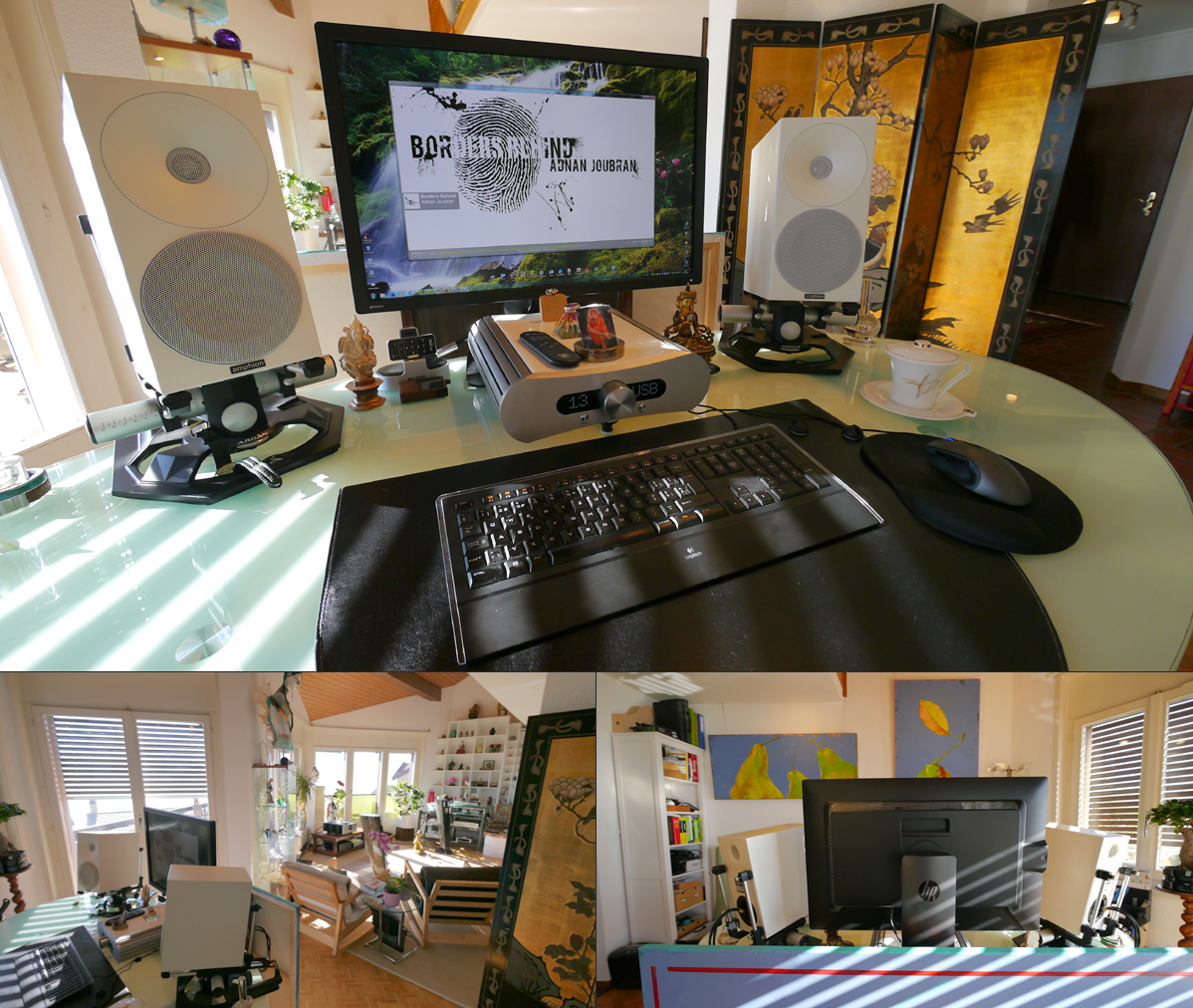
As the weeks passed by but no speakers materialized, I finally inquired. Now I learnt that Anssi had sold my review loaners. More than once in fact! Good for him. Not so for our readers. When I pointed out the glaringly obvious—that publications like ours are factories like his, creative factories where product equals content and lack of parts shuts down production—he promised quick relief. The amps would follow a week or so later, albeit with XLR inputs. No problem. I'd use Lindemann Audio's musicbook:15 as USB DAC, CD player and analog-volume preamp with balanced outputs. For speaker comparators, I raided my wife's paint studio for her white Ion+; and another ultra-compact bedroom system around Simon Lee's ingenious Aura Note Premier V2 for its white Helium 510. That would keep things in the Amphion family to get going. It should also reduce other variables to focus predominantly on the ported vs. ABR question and only secondarily on bandwidth differences. Seeing how vital proper tweeter-to-ear alignment and isolation are, all three Amphions would nestle in my Irish Ardán Audio fully adjustable desktop stands. Until Amphion's class D monos arrived, a 250wpc Gato Audio DIA-250 integrated with USB DAC was the designated alcohol-free driver. Source material would be home-burnt CD samplers in the musicbook's Teac slot-drive; and 16/44.1 streaming via Qobuz Desktop's hifi subscription; plus 320kbps Spotify+ for good half measure. |
|
|
|
 |
Helium 510 presetting the scene for an Amphion flavour fest test.
|
Having kicked out my usual Boenicke W5se in this system at least for the duration, the Helium 510 set up three days prior to the One.18's arrival. This made for a perfect reacquaintance op. The house sound or rather behaviour of Amphion speakers is all about accuracy. It's about maintaining high separation to never lose the plot. Whether you call them tonally lean or honest will depend on your upstream gear. With Gato's warmish class D amp, I call these pretty much dead-on neutral. With a rhythmically prickly recording like Le Trio Joubran gone solo Adnan Joubran's Borders Behind, accuracy telegraphs as wonderful articulation. That's very much like how a master mime articulates expressivity through motion since he can't rely on speech. It's related also to top-class enunciation whereby, unlike with so many actors, one makes out every single word of dialogue between news-cast anchors. Here this very articulate enunciated quality applies to the time domain whereby interlocking multi-tasking percussive events—which needn't be actual percussion but can be plucked strings or staccato woodwinds—remain very crisp and intelligible. Everything stays in its proper place sharply focused. Nothings wanders, blooms in size or gets fuzzy of contour. Very literally, speech intelligibility on video programming is demonstrably high to make the difference between following the full dialogue or only portions of it without needing to tweak up the volume. Set up properly in the nearfield with strict path-length equality between both channels, it's very much like an out-of-the-head headphone presentation.
Without any aggressivity, it's a very upfront clear-as-day unembellished sound just as one imagines should be vital for any recording studio. Except the Helium 510 targets consumers. Would the actual pro model be more accurate still? Here we play mindful of Anssi's view that this separation between pro and consumer is—should be?—purely arbitrary. |
|
|
|
|
But first, an organ-pipe family shot row to illustrate how the One18 compares physically to the Ion+ and Helium 510 models all around
|
|
Shot 1 & 3 show the height difference, shot 2 illustrates the depth offset with all boxes aligned in the back, 4 gives an idea as to foot prints. The crate is of the actual One18 shipment.
|
To avoid hifi absolutism which claims one solution superior to another or promotes it as the only proper one, let's invoke just two speaker brands which battle for supremacy in super speaker luxury branding: Wilson and Magico. Both have their followers and detractors. Yet one is ported, the other sealed. Regardless of white and really more grey papers, sales prove it. It's not the snazzier argument which wins. It's whatever folks like better. When enough folks prefer sufficiently different things, claims of better look a wee adolescent. That doesn't mean reviewers don't have preferences. It's simply best to not extrapolate anything more universal from it. With this bit of small print handled, did this reviewer have any clear-cut preference besides being able to lock to a definitive difference between passive radiators and ports? In fact, was there a demonstrable diff? It is after all the decisive design change between Amphion consumer and pro. It had to matter. Didn't it? I tend to prefer sealed over ported bass for its better timing and tautness and because ports always interact more with the room. In extreme cases, ports can sound like standing-wave riders which set off room modes. Except that if those effects vanish once you tightly plug the ports, the real message is clear. In my free-space desktop setup and given the size and tuning of Amphion's compact boxes, I wouldn't have those port issues at all. No effective wall for the ports to interfere with; no port tuning to 25Hz or some other boombastic figure. Hence my curiosity. How else would the ABR model express its mechanical difference?
|
 |
One18 and Two18 with Hegel H160 and H300 at the DigiExpo 2014.
|
 |
|
|

|
|


