|
|
|
Horse eats colour. The most significant advantage the Ensis had over Kroma Audio's Julieta was conceptual. Being a rear-firing twin-ported affair, Julieta's interaction with the room was far more severe. Even after I'd identified best positions for monitors and listening seat alike—during their visit, the Spaniards had arrived at virtually the same spots themselves—sitting outside her ideal window and closer to the side walls could get very boomy. Ensis' sealed MO meant that she sounded far more even in far more places. Recording studios might be festooned in sound-absorbent treatments. Living rooms very rarely are. Hence Æquo's decision against ubiquitous ports has made their design more practical. With it, it's more relevant to the lifestyle of fine hifi enjoyment. Whether you entertain multiple guests, move about or have more than one seated spot (our floor plan has the listening room triple-task as my studio and our kitchen/dining room), everyone's musical perspective will be less spotty and more even. Of course hairshirt extremists counter that the stereo illusion relies on one narrow listening zone to come off perfectly. Who should give a fig what it sounds like beyond it? Ha! That's exactly yesteryear's lone wolf idea of audiophilia: of the nutter in his basement man cave, head in a vise. If audiophilia is to become attractive to normal people, then particularly speakers can't be fussy divas. They must appeal not just visually. They must integrate into average room acoustics without causing major hot spots which beginners would think were fixed room modes when really, they are perfectly avoidable rear port effects. Plus, intensely loaded pressure zones of LF energies interfere with the reflections of far finer high frequencies. Any speaker which creates less of those zones—or lower amplitude in them—also suffers less treble interference. The Ensis is one of those.
|
 |
Once Æquo's own woofers had gone active, my original placement of woofers out and closer to the seat because the Zu sub handled LF no longer was right. Within less than 10 minutes, Ivo and Paul had moved the Ensis farther back and swapped woofer orientation, then made fine dial changes for the most even most extended response. Easy. Controlled directivity built into the design due to oval wave guide, mid/woofer Ø and baffle rake also meant less treble splash from our gabled ceiling; and fewer effects outside the speakers than the Kroma. That sounded spatially bigger, with more sound between side walls and boxes. With the Ensis, musical action focused between the speakers. Ideal toe-in for most setups will have the inner face (woofer or heat sink) parallel to the side walls. For my preferred listening distance, I wanted the treble to arrive just a tad later when critical vocals showcased just a bit of bite. Adding one washer to the original two under the front footers sorted it in two minutes. Again, the Ensis is a very clever design. Its team considered a lot of angles before they ever committed to first prototypes. Multi-disciplinary smarts!
|
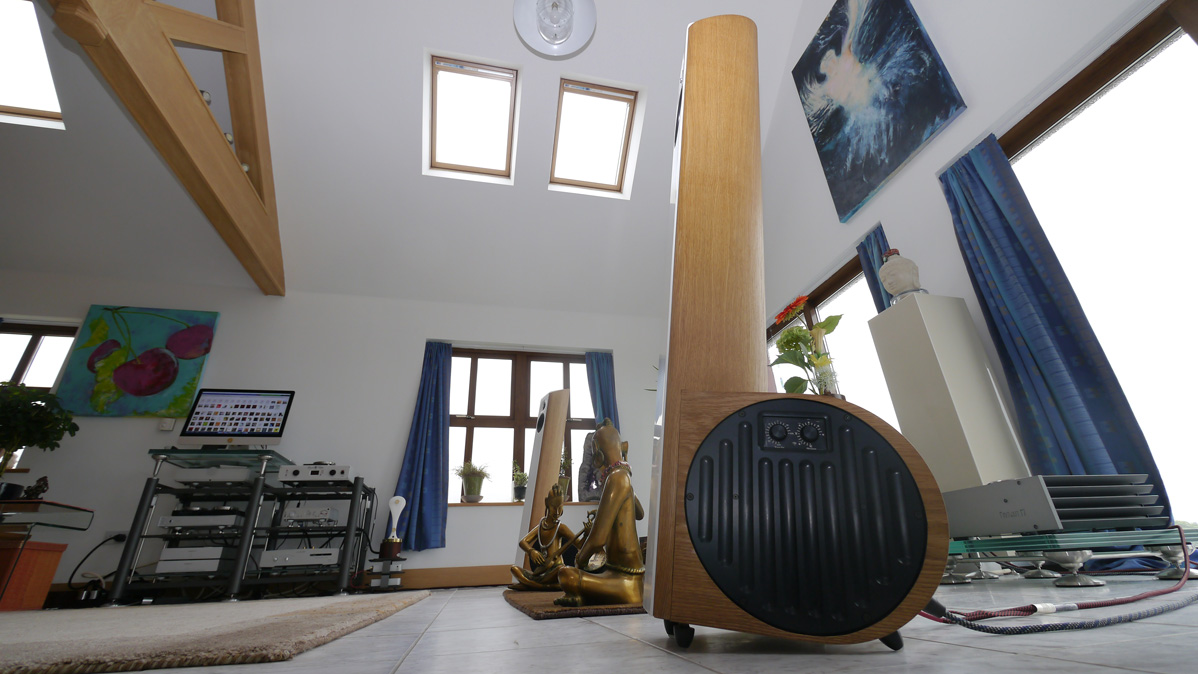 |
The choice of drivers—no metal* diaphragms above 100Hz—predicts and delivers a softer sound whilst the super-rigid cab and controlled dispersion ratchet up focus sharpness. Extricate the essence of softer membranes plus precision focus. That's the gestalt. It's crystal clear because the cabinet doesn't talk; and because your room won't talk back as it usually does with descending freqs. Just so, it's not the crystallized sharpness of transient prickliness which hard drivers can create. It's gentler. Throw in rapid dynamic reflexes of unexpected scaling not dumbed down by lossy cabinetry or inferior drivers. The only thing the Ensis didn't do in our capacious space was full power below 30Hz. For that you'd need bigger woofers and far greater cubic volumes like our Zu sub. Also, it had zero hum or noise from its active bass bins. But that you'd expect from a costly speaker (as you should from a costly SET but often won't get). Finally, the upper-bass handover of small midrange to sidefiring woofer had that region somewhat less dynamic than you'd get with a bigger front-firing midrange or mid/woofer. For top slam in the power zone, side- or downfiring drivers never seem as potent as more direct radiators which, facing the listener head on, produce the hardest shockwave. In audiophile terms, that struck me as the only small compromise of the Ensis concept. Anyone expecting 20Hz -0dB from this compact a speaker in a room our size would violate physics.
|
| ______________________________________________________________________________________________________________________________________________________ |
* Ivo: "To answer your question about why we use an aluminium instead of paper cone on the woofer,
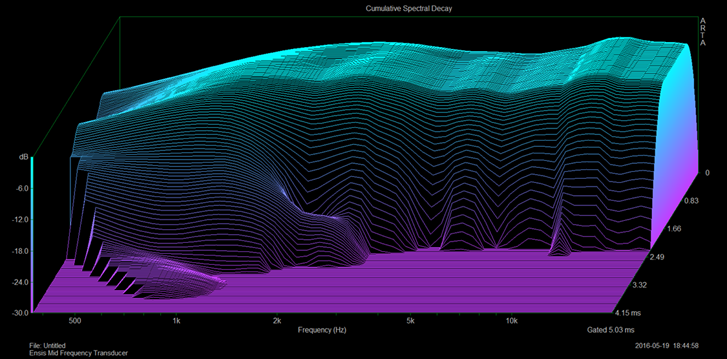
all rigid materials, including paper pulp materials, are prone to break-up resonance problems. This is why not only Accuton cut out these black round pieces but also ScanSpeak use spiral cuts in their Revelator cones filled with glue. Besides the slower signal response in the upper midrange frequencies and lower sensitivity compared to the Ensis midrange, the Revelator drivers are truly excellent and do not add the coloration which is a real and common problem with paper cones. The lower sensitivity of the Revelator is caused by the only downside of its special cone: its weight of paper, coatings and fillers. It is heavier than our special PP cone. This PP is not as rigid as paper or aluminium but has very good self damping as can be seen in the CSD diagram Paul will send you. It's ideal for the midrange if driven by the right motor.
For the woofer we have more focus on large forces and excursions. This is where more rigid materials like paper or aluminium come in. We actually started with a paper cone which had break-up issues around 1000Hz (not bad at all for a subwoofer). Changing to an aluminium cone and better spider, we now have a pretty comparable break-up resonance in intensity but pushed up to 3000Hz. That allows us to use a low-order low-pass on the woofer without any risk of audible side effects. Furthermore, distortion is lower especially at higher excursions.
Magnesium would be much more problematic since its break-up amplitude is far higher. Carbon also has break-up problems without special constructions and additions; and I find most sandwich (eg. Rohacell) or honeycomb solutions too heavy. Whilst we could have adjusted sensitivity on the active subwoofer to deal with the extra weight, it would still generate more work for the amplifier and more importantly, more heat in the motor inside our sealed enclosure. This brings me to another aspect of black-anodized aluminium being our material of choice. It has superb heat dissipation properties. It is the most used material for heat sinks. That includes the heat sink in the Ensis which opposes the woofer."
|
|
|
|
|
All of the above plus very potent yet unobtrusive low bass set the foundation for obsessing over soundstaging. Given locked focus and admirable reluctance to stir up the room's hornets nest, layering, image specificity & Co. played at a high level whilst first-octave support added tacit scale. As stated earlier, this low-to-the-ground bass had a different quality than Julieta's woofer high up off the floor regardless of reach or more even distribution. If you love big drums and synth trickery and how LF energies roll out into the room, the Ensis has your number. The number it doesn't ring is that of the audiophile rule book. Here integral subs are frowned upon. Class D is still ostracized, too. Such preconceptions abound. They're a hurdle Æquo will have to tackle. Ditto for being pretty and compact as though that had to conflict with full bandwidth and SPL stability by design. Before we segue into the conclusion, another description by contrast, against our Albedo Audio Aptica, a 1st-order pure two-way with Accuton ceramic transducers and downfiring transmission line bass loading.
|
 |
Despite their very clever loading, the Italians couldn't match the unfair low-down advantage of the nCore-powered 10" woofers but had more shove in the upper bass. Without directivity control, the Aptica staged wider, i.e. more outside the boxes. The quality of their inverted hard tweeters was more lit up to produce the higher gloss. Æquo's ring radiator didn't throw a sugar cube into the champagne glass for that extra fizz. For infrasonic badness, I had to harness the Zu subwoofer to the Italians to match the Dutch on extension if not room distribution. That added €5'000 to their tally and a third box which the decor has to accommodate. Whilst there were other small offsets, the primary one—subwoofer-style bass but in full stereo—underscored one of the main attractions of the Ensis. To get such even low bass from so compact a 'box' requires active drive and user adjustments. Purist will balk, realists applaud. Count me amongst the latter. Not only is the Ensis of high IQ on concept, it's the same on execution. Integration of passive and active sections is perfect and the critical handover/continuation of midband to bass seamless. Whatever adjustments the user makes to what happens below, it won't screw up that transition.
That's key. It's the big advantage over trying to match the midrange's roll-off with an outboard subwoofer's own filter network. And it nets stereo not mono bass. Finally, the sealed passive section without wicked impedance plot of ports is tailor made for experiments with low-powered amps of various persuasions. It's not only an invite at getting esoteric but a potential cost saver because costly muscle amps aren't required. The yeoman work of the bass is already handled by the most advanced class D currently to market.
Æquity. The Ensis is no hollow dry-by-night wonder but the result of a 5-year R&D cycle. The outcome reflects a younger team spirit and very modern head space. It's an effective rethink of how a speaker should interface with its environment cosmetically and acoustically. It incorporates advanced manufacturing skills, material sciences know-how and—surprising for a startup—in-house fabrication of the stem and bin shells under a 20-ton press in custom moulds. The complex form factor and material mix materialized in lovely finishing with quite the option menu on trim choices. "Nothing new under the audio sun" is a mostly true mantra but the Æquo Audio Ensis manages to escape its usual confines. For that and what should be the future for 21st-century speaker design (more uncompromised full-range performance in smaller more attractive packages), it deserves an enthusiastic award. Its caption points at the real accomplishment: marrying audiophile and lifestyle sensibilities. Going Dutch just acquired a whole new meaning...
|
 |
PS: For more tech, here's what Paul Rassin submitted prior to adding it to their own website: "We put enormous effort into our drivers. With earlier projects, we often used off-the-shelf units. Listening, acoustic measurements, measurement of parameters as well as taking them apart and reviewing all findings in advanced simulation software gave us insight into all the pros and cons of different motor designs, voice coil technologies, magnet systems, cone shapes, materials, spiders and surrounds. To take the Ensis to the next level, we combined forces with the best suppliers in the biz to develop three unique transducers for our low, mid and high frequencies. Bass reflex, closed box, ABR, transmission line and dipole dispersion all have their specific uses. For the Ensis, we chose a sealed 3-way system. Closed-box systems have the benefit of not adding the much larger group delay of the phase shift caused by the 4th-order roll-off typical for bass reflex and passive radiator enclosures. They are also more compact and free of port noise. Additionally, rear ports often result in limited placement options due to boominess when near walls or corners. The bass reflex system is also used for fake deep bass. If the tuning frequency is a bit higher (with a shorter or larger port) than normal, there will be a boost just above the roll-off.
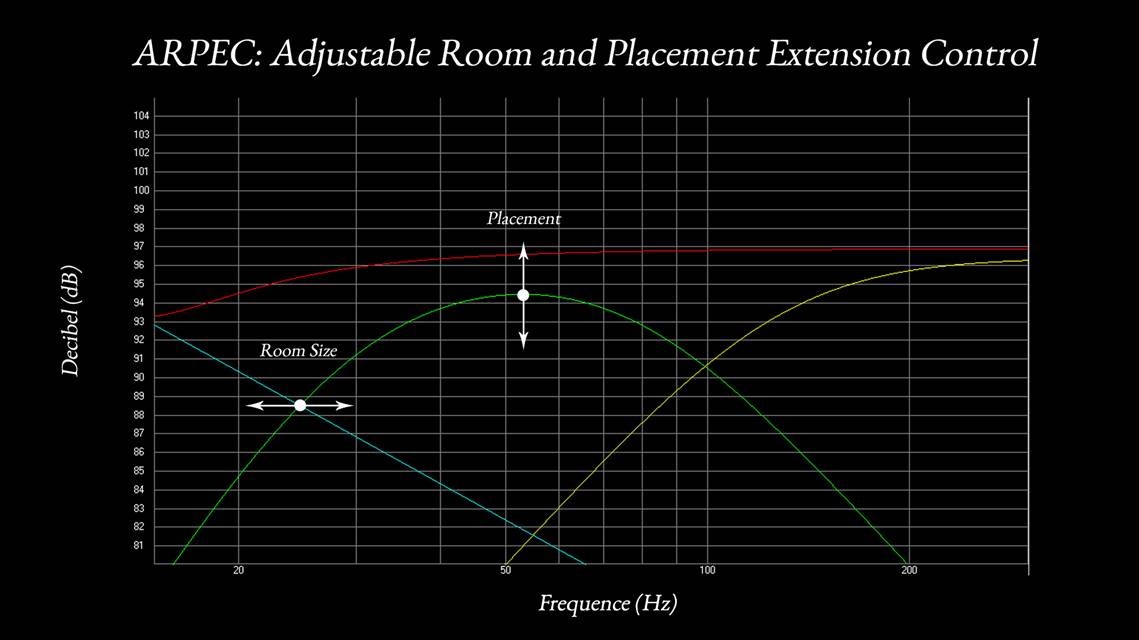
"Our Adjustable Room and Placement Extension Control is a fully analog system without DSP.
With universal DSP for LF extension and room adjustment, there is a big risk of pushing woofers or associated amplifiers beyond their limits. This results in very audible distortion at all listening levels, even permanent damage to either amplifier or woofer. These systems often rely on one or a small series of measurements from the listening position(s). Most self-measuring speakers will not even measure from such a position. Even with large suites of measurements, automated DSP correction can produce peaky EQ and phase by replacing one problem with another. They also introduce audible time domain issues with narrow-band group delays. Even professionally adjusted DSP by qualified sound engineers can sound slow, strange or plain dull and lifeless.
"In case of DSP purely for subwoofer use, it will always need computing time to process the adjustment, dithering and A/D and D/A conversions, causing a delay versus the rest of the system. Although phase corrections can partly solve this, the bass will always run wavelengths behind the rest as you cannot shift phase back in time. Increasingly popular hybrid active/passive speakers using integral DSP will have delay solely in the bass to not reach the uniformity one may and should expect in high-end audio. DSP platforms used for the active filtering of mid and high frequencies are virtually always limited in their use of combined ideal response curves and precise wideband phase alignment when compared to the best passive filters as used in the Ensis.
Also, the bit rate of the best and newest DSP A/D and D/A will always be behind the latest sound formats.
|
|
"This representation is very simplified to explain the adjustment system. As such, it isn't without flaws or fully representative of the actual process." - Ivo Sparidaens
|
"Although Æquo used DSP in the past and still sees a very specific role** for it in the future, the Ensis was equipped with one of the most bespoke new technologies developed by us: ARPEC™. We studied the effects of room size and speaker placement and implemented this knowledge in a piece of hi-tech yet fully analog hardware. It controls LF extension of the integrated active subwoofer to fit the 'room gain' of any room small to large. Then it properly adjusts bass levels to correspond with speaker placement in room corners as well as positioning near a wall or in the open field and everything in-between. ARPEC™ ensures deep natural roll-off into the lowest notes and does so with a fully analog signal path and phase alignment to the midrange driver. It avoids the unnatural notches usually made by DSP which are accompanied by slow or sterile sound, even if DSP processes multiple measurement positions. Just use our two easy step-less adjusters to find the perfect match without hassle. It's a real first and original analog room adjustment system that gets the job done.
|
| ______________________________________________________________________________________________________________________________________________________ |
** Ivo: "For horrendous rooms whose necessary fixes go beyond our Ensis adjustments to invite some universal DSP applications,
I would still suggest to move around the furniture and most importantly, the listening chair or sofa itself; and especially first the speakers. Even small movements together with the individual asymmetrical adjustments possible with the Ensis often bring very satisfying results already. I even feel that 9 out of 10 of such carefully achieved results would not benefit from adding DSP room correction at all."
|
"To handle the carefully thought-out adjustment range of ARPEC™ and deliver the best possible bass in general, our 10" subwoofer driver is equipped with exceptional qualities. The large heat-resistant 34mm long voice coil is placed into an 8mm gap in an overhung double magnet system with exceptionally large force field outside the gap to scale linear excursion to 5cm. Long voice coils can lead to slow signal response but not in the Ensis subwoofer. A clever symmetrical motor design with rings and pole extenders introduces very fast response comparable to most smaller drivers used above subwoofer frequencies. The mechanical design couples this high-precision motor to a very reliable Nomex spider and large yet flexible rubber surround. The end result was reviewed with the world's best driver measurement equipment from Klippel Germany to prove linear Xmax surpassing any other 10" subwoofer of equivalent speed. Ventilation under the dust cap and the low-loss suspension guarantee very low compression effects for high dynamics. The cone is made of lightweight very rigid aluminium and black anodized for optimal heat dissipation.
"The midrange
was born of a special cooperation with the Skaaning family business now led by Per Skaaning. Per's father Ejvind was the guiding force behind several Danish loudspeaker companies; among the most prominent ScanSpeak and Dynaudio, both founded by Mr. Skaaning. His best ideas and those by his former engineering teams at all these companies found their ways into all our drivers. The synergy between Æquo Audio's detailed specifications and Skaaning's superb materials and tech led to various prototype combinations of motor designs both underhung and overhung, with various suspensions and cone configurations. Our final version consists of a powerful symmetrical motor with very fast tweeter-like response as well as large dynamic capabilities. There is a hexagonally wound voice coil coupled to a Kapton/aluminium former. Unlike aluminium, Kapton is not influenced by eddy currents in the magnetic gap and therefore the material of choice for higher frequency resolution. Its downside is having no magnetic braking force at higher excursions. To improve reliability and push dynamic limits, we use a hybrid Kapton/aluminium former. The special-blend PP cone has very good self damping and no break-up problems as encountered by aluminium or even worse, magnesium midrange drivers. The cone coupled to the motor is very light and the absence of a phase plug in the dust cap area maximizes moving cone surface. This keeps the transducer in step with the high full-range 90dB+ sensitivity of the Ensis without needing a sub 8-ohm voice coil. This ensures ideal matching to any amplifier including low-power tube amps.
The combination of this motor and cone is unbelievably accurate, fast and very clean. Its well-mannered behaviour is shown by the CSD waterfall plot generated by an actual measurement of the assembled unfiltered driver. These highly desirable capabilities made it most suitable for our preferred low-order filter slopes. The Ensis therefore stays clear of the unwanted group delay that accompanies the high-order filters typical for metal or ceramic midrange cones. Æquo Audio's midrange maintains full control without the need for stiff suspensions, thick or unevenly shaped surrounds or the terrible choice of no surround at all.
|
|
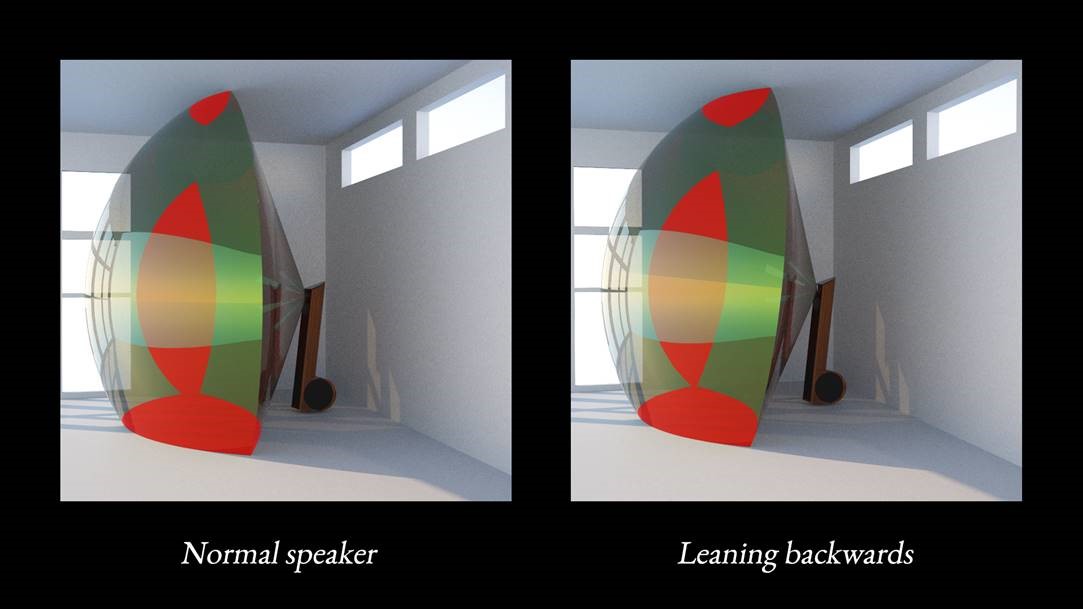
"EHDL™ technology. On the left below we show how a normal tweeter wave guide works in a normal vertical position, creating problematic floor and ceiling reflections. Especially the floor reflection is critical since it is much closer than the ceiling (even in low-ceiling'd rooms). On the right we get a better balance between ceiling and floor reflections due to the tilted-back position of the same tweeter.
|
|
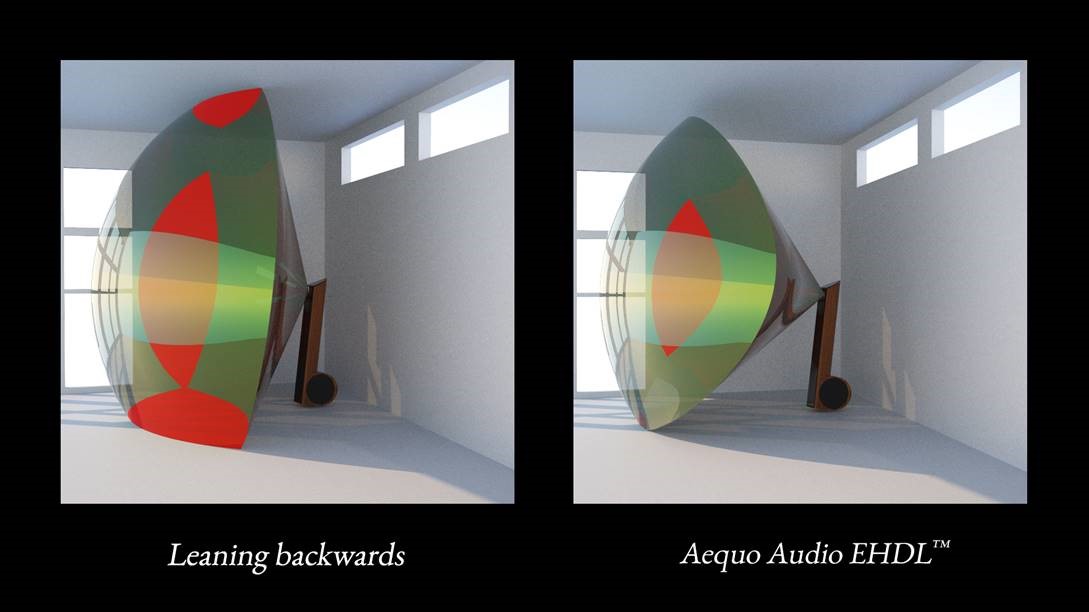
"On the lower left we repeat the back-leaning speaker. On the right you see that the special EHDL waveguide redistributes some of the vertical energy into horizontal energy, removing the problematic floor and ceiling reflections and providing a more realistic horizontal soundstage with increased depth and natural imaging.
|
|
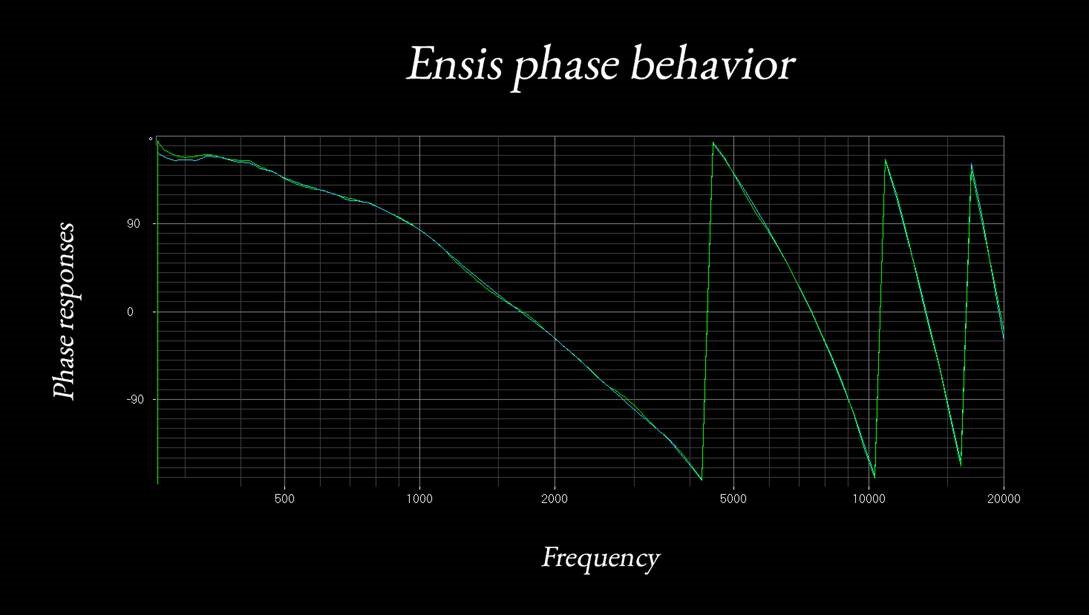
"Our low-order filter topology is fine-tuned for phase alignment of the already time-coherent physically aligned midrange and tweeter. Phase alignment is not limited to the crossover frequency area but valid across the entire bands of both drivers beyond 20kHz.
|
|
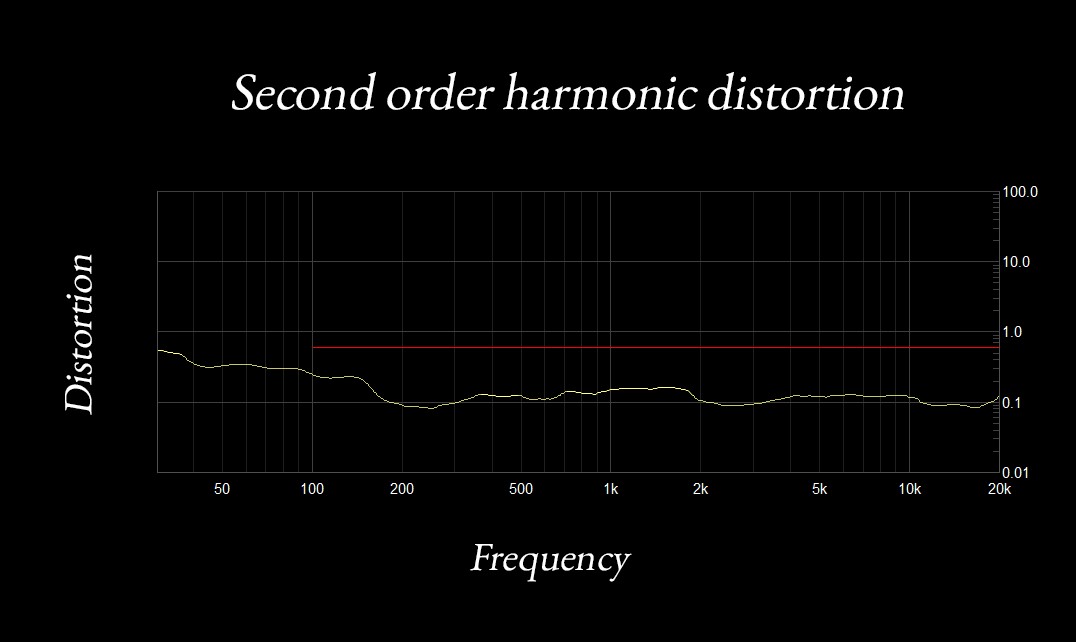
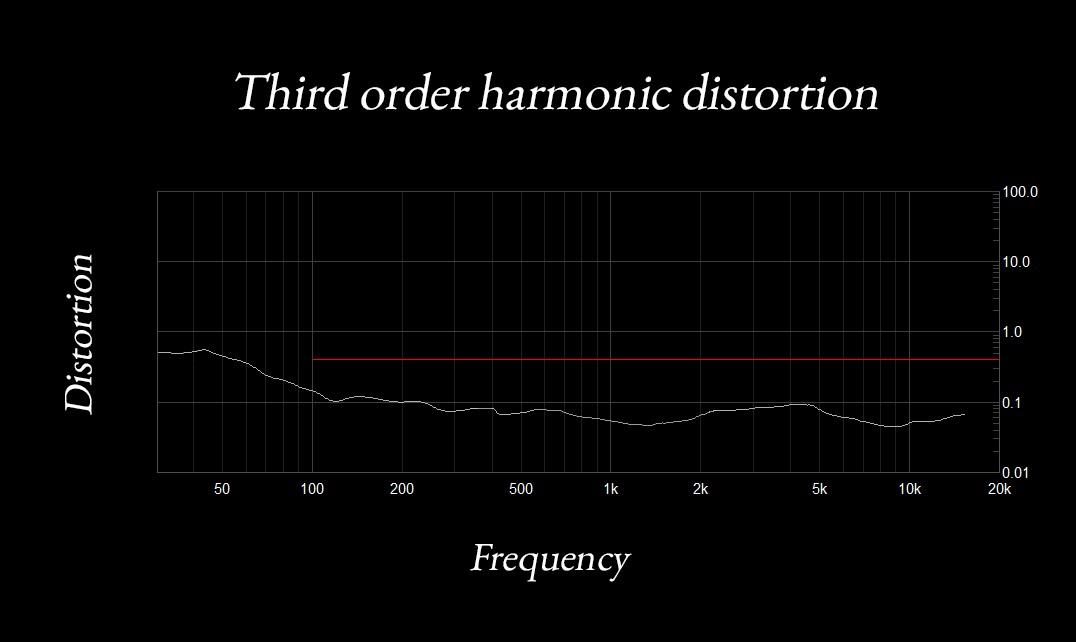
"Following are measurements of the review loaners'
second and third-order harmonic distortion between 30Hz-20kHz at 100dB(!) @ 1 metre. Often thresholds for midrange frequencies (where our ears are most sensitive) are chosen at 0.3% for 3rd order and 0.5% for the less harmful 2nd order harmonics. For some expensive speakers, these figures are still too hard to meet, resulting in specific sonic fingerprints. Ensis provides ultimate cleanliness by keeping 3rd order harmonics around and even below 0.1% above 100Hz to eliminate edginess leading to listener fatigue. The very low 2nd order distortion keeps unrealistic warmth and murkiness out of the sound. For some context on the Ensis sub's cleanliness compared to multi-paralleled 6.5" woofers in popular tower constructions, their horrible uneven harmonic distortion at 95dB listening levels would be a factor of about 4 to over 10 times higher and such figures are very audible."
|
|
|
|
We now come to Part II, the sonic commentary of Marja & Henk.
|
 |
|

|

|
|