This review page is supported in part by the sponsors whose ad banners are displayed below |
 |
The Ampeggio soundstaged very accurately and on a grand scale. So do numerous others. The sonic totality—wholosity as Harvey Rosenberg would have called it—was truly seamless and coherent. Here the Ampeggio moved into special though not exclusive terrain. While a superb five-driver 3-way like my Tango should be theoretically handicapped on coherence, it's not in practice save for a tiny thing in the bass. That becomes one of a few decisive considerations. The Tango runs 1-order minimum-phase filters. While bass extension and power-zone impact were superior to the Ampeggio, the latter's bass pulses did seem to occur atomically sooner. This was a very subtle matter but demonstrable.
Was it the small phase shift of the Tango's filter versus the amp-direct drive of the AC-3X? All I'm prepared to say is that on bass timing, the Ampeggio did have a very small but real edge. Most listeners would key in more on subjective bass power and low-down reach. Hence they'd call the Tango superior in a heartbeat. If you listened predominantly to very bass-heavy high-impact fare, you'd be right. To tease out Voxativ's advantage in the first place and call it preferable in the second means trading the obvious for something more subliminal. Who'd make such a choice? I cannot predict that. But make no mistake, it's a very real and sophisticated choice.
|
 |
A more overt distinction of the Voxativ was luminosity. Both the Tango and Reference 3.5 were robuster and earthier. While far from ethereal—it's too anchored in the bass for that—Ampeggio's very spacious, direct and translucent presentation introduced a type of Turner effect. JMW Turner [1775-1851] was an English romantic landscape and marine artist famous for the luminosity of his paintings. Depicting real objects in realistic settings, he managed to have celestial light break through such that the material plane seemed suffused, energized and spiritualized by this luminescence. With composers of the Romantic era, Anton Bruckner was arguably the closest equivalent in how his nine symphonies make the constant presence of the spirit world tangible. |
|
My Rethm Saadhana speaker had that very same quality. Its maker refers to it as breath of life. Poetic by default since we're attempting to describe gestalt rather than measurable quantities, that phrase fits. Modern synthesizers can clone instrumental timbres to near perfection. Yet a synthesized clarinet played by a keyboard or air-blown synthesizer never captures how human breath and tongue impact articulation, flow, microdynamics, pitch variation and timbre shifts from different fingerings for identical notes. While basic timbre can initially fool us, it takes a mere few notes to hear that the transitions from one to the next are artificial. It's in the transitions where we discern the synthesizer over a few short bars every time.
|
 |
To simplify, a synth might sound like the real thing but it never feels like it. Ultimately feel of course relates directly to sound but it certainly does transcend test-bench focus. In a similar vein, luminosity or breath of life have to do with feel. It's about an organic 'on the breath' vibe that's suffused by light. It doesn't make the sound less material per se. It does however make it less robust. Milan Kundera's book title The Unbearable Lightness of Being is fitting. It's not the heaviness or mass of being. It's not the impact or energy. It's the lightness of being. Referring again to the above painting should make the point. The boats on the water are real but overshadowed by a context of illumination that seems to break out from within the material world.
|
|
|
This luminosity is Ampeggio's core virtue. It becomes most compelling and relevant on voices, acoustic instruments and good recordings where superior phase accuracy depicts more audible space with its spider webs of subtle reflections, overtone sprays and presence halos around the performers. It's mostly wasted on HipHop, electronica and compressed studio crap. The gestalt difference between Voxativ and my Rethms was that the German's bass transients were continuous with the upper bands, their power and general amplitude superior. The Saadhana's bass—mine still runs dual isobaric woofers, the V2 iteration has three—was neither as potent nor as accurately timed. I could clearly hear and appreciate the top-to-bottom coherence of the AC-3X versus the (very cleverly but still) patched-together Lowther + woofers with dedicated bass amps. Quantitative distinctions between these speakers I already covered.
|
Terms like tacit, tactile, immediate and direct are reviewer jargon to point at the moon. As the proverb has it, don't fixate on the finger lest you miss the moon. In audio, the live vibe links directly to transient steepness; how far the initial cycle overshoots the next in amplitude; and whether all harmonic constituents of a tone rise as one. Or do they scatter over time due to phase delay between different drivers? Frequency linearity is far less important to musical realism than time-domain accuracy. The German Klangfluß company calls it the shock-wave precedent. Our factory tour makes worthwhile reading on that subject.
Dynamics in this sense aren't about the delta between quietest and loudest event spread out over a musical piece like between the barely audible double-bass tremolo of a Bruckner "Andante" opening and its climactic chorale with piercing piccolo flutes, thundering timpani rolls and blaring brasses. It's about the suddenness by which percussive events rise from zero to peak; and the size of those peaks. The Ampeggio won't ever compete with horns on ultimate peakiness. Other speakers will ultimately be more dynamic on a macro scale, especially once we move the system into more palatial spaces.
It will
be harder however to find a speaker that equals the Ampeggio on the microdynamic scale where top-to-bottom speed is king. Clearly its rise times are quite exceptional. That's what makes for all that finely filigreed accuracy. Rather than forcefully precise and mechanical, it's easefully delicate and flowing however. What exactly is responsible for this overriding luminosity and underlying breath of life? Harmonic fidelity. That's not about ultimate extension. There the Voxativ is shockingly good—considering—but surely not an ultimate reference. It's about timing. You'll only hear proper harmonics when they're aligned with and rightly assigned to their fundamentals. Even the slightest smearing in time undermines this luminous lucid quality.
|
|
|
While a diamond super tweeter for example might measure flat out to 60kHz, it's immaterial if overtones don't occur vertically on top of the matching fundamentals because those are being reproduced by another driver with a preceding phase-shifted crossover.
This mirrors the first watt credo. Why bother with hundreds of watts when the first one is crap? Why bother with breaking ultrasonic records when the time domain is scrambled? Instead of airy sweetness, super extension then only buys tizz, steel and hardness. Obviously luminosity has nothing to do with brightness.
|
|
|
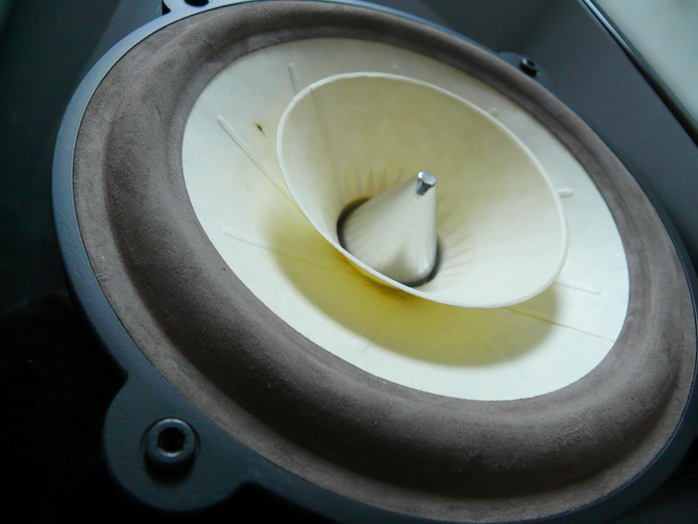
Personally, the overriding persuasiveness of the Voxativ was hearing my Rethm Saadhanas' luminosity in a full bandwidth version with more potent and better integrated bass; and without the occasional glinting in the presence region.
If you're sensitive to and attracted by this luminosity, I believe that in the dynamic realm, you can only get it from this type of light-coned highly efficient widebander run solo.
|
A full-range electrostat would be a valid counter option but sonically tends to be less dynamic. Practically it demands beefy amps with complex gain stages and load invariance. This very likely undermines the aspects of easeful speed and purity low-power two-stage circuits without feedback offer.
Most all other sonic qualities of the Voxativ can be found elsewhere too, often for considerably less and in matters of ultimate implementation routinely superior. On timing precision for example, Gallo's Reference 3.5 is very close. Its power region has higher impact, its output potential is superior as is its ability to separate out Mahler-type scenes of a hundred-plus extras. On spaciousness, it's mostly a draw. The vital distinguishing feature is luminosity. The Gallos' speed is married to a very robust fleshy character to make it a super-fit muscular performer. It's Shotokan Karate versus fluid T'ai Chi. Gallo's airier leaner $2.000/pr Strada moves closer yet to the Ampeggio but lacks the widebander's bass extension. Absolutely necessitating a subwoofer, the Strada then loses a bit in the cohesiveness stakes.
In short, to exactly end up with Ampeggio's "Turner effect", it's probably not possible via means other than those Inès Adler has incorporated to such a well-honed and balanced degree. I do wish her speaker was less costly though. I do wish the same for Nagra gear. In either case, the level of perfectionist finish and applied engineering combine to a level of luxury execution that makes such comments a reflection on personal means rather than rational criticism. When luxury delivers as it ought to and pricing retains a reasonable correlation between actual build cost and sell price, all is as it should be. I'm inclined to think it applies here.
|
|
|
|
 |
Conclusion: Inès Adler's Ampeggio appears to be a milestone in modern widebanders. That's true for her raw AC-3X drive unit and the expert marriage of transducer to enclosure. With solid bandwidth from 40Hz to 20kHz, it's presently one of the most compelling samples of the breed and surely the best I've encountered by not a small margin. The Ampeggio also is a musical instrument not merely on looks or because of who makes it. It's a musical instrument in how its superior time domain performance establishes proper harmonic fidelity in ways that read abstract or poetic but in the listening seat communicate themselves without any mouthfuls of fancy words. This somehow pierces right through the material and mechanical aspects of the playback process. One feels connected directly to the innate 'spirituality' of the wordless but universal art form of music. How much you'll appreciate this difference to want it for yourself and are willing to pay for... that primarily should be a function of exposure and expectation.
The most likely prospects to seek out the Voxativ Ampeggio might be so those who, having previously heard a Lowther, got it and felt the siren call but couldn't commit due to obvious flaws. An uncompromised high-performance widebander run solo remains quite the rare critter. Most precedents are imbalanced. This usually kills interest in those who wrote off the theoretically promising concept after experiencing flawed examples. If you've read various anti propaganda that flat-out asserts that present technologies don't allow for full bandwidth performance from one driver... well, you probably won't stand in line to hear an Ampeggio. Be assured though that the Voxativ goes places no Lowther I've ever heard has before (which doesn't mean such designs don't exist, just that I haven't heard them). In my book then, this is a breakthrough.
|
 |
It's very much a sparkling new boutique wine in a musty old bottle. It reinvigorates this most vintage of audio concepts to perhaps insure its ongoing relevance. For concept and execution, Ampeggio gets a standing ovation that begs for many enthusiastic encores. While Anthony Gallo's Reference 3.5 at $5.995/pr is the Ampeggio's equal in many important performance parameters and superior in some, the solo widebander retaliates with the "Turner effect". If that's what you're after—it's very compelling—you have to pony up. Should luxury realizations have you freeze up despite personal desire, you might find relief considering that even Voxativ's current AC-X top field-coil driver at €5.500 prior to VAT (at least on price - the jury on performance remains out) is completely overshadowed by Feastrex's D9e-II 9" field coil driver. That exotic beast rose from last year's already steep $27.000/pr to a whopping $42.000 just for the drivers, cabinet to be supplied elsewhere. As uncle Albert put it so famously, it's all relative.
|
Given the Feastrex precedent and hifi's law of relativity, Inès recognizes that certain customers wanting the very best are quite prepared to pay for it. In collaboration with top German magnetics and metallurgy firms like Vaccumschmelze, she is presently working on a no-holds-barred 100% cobalt-iron motor version of the AC-X. This AC-Xp—'p' for permendur'— will be an option for the forthcoming Wall Horn speaker model.
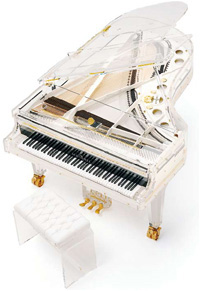
It and the Ampeggio will also be available in special-edition acrylic variants. This takes advantage of Schimmel's already established expertise with custom pianos in acrylic bodies. The acrylic Ampeggio and Wall Horn models will cosmetically benefit from gold-plated magnet casings and special wire-routing channels. This should take the concept of fine audio furniture over the top and into the world of the most exclusive mansions.
|
|
|
| What Voxativ contributes to the genre with their Ampeggio model now is a perfectionist turnkey driver/enclosure solution that was conceived and realized as an inseparable whole, then built to musical instrument standards. In this exact combination of attributes and performance, it strikes me as unique. I also find it promising for the single-driver sub genre of exotic loudspeakers which I'd personally nearly written off as not being completely viable. I was wrong. The Voxativ Ampeggio proves otherwise. The future for such speakers looks bright again! |
|
Quality of packing: Presumably first rate and built by Schimmel Pianos as an expert in shipping luxury goods worldwide but my delivery came by car tucked in bubble wrap.
Reusability of packing: Unknown.
Ease of unpacking/repacking: Unknown.
Condition of component received: Minimal finish wear as a well-traveled dealer demonstrator. Otherwise clearly top-end stuff. White piano lacquer wears a lot better than black and doesn't mirror its surroundings. White would be my vote by a landslide.
Completeness of delivery: Perfect.
Human interactions: Candid answers to all questions.
Pricing: Unapologetically high.
Final comments & suggestions: None on performance. A poor man's finish option of basic veneer that shaves off 5G might be very welcome. Transistor amps may apply but must be as refined as a FirstWatt J2, M2 or equivalent. Traditional direct-heated triodes might appear ideal candidates but the coagulation effects of heavy THD do compromise some of this speaker's phenomenal speed and lucidity. Ideal candidates might be advanced mid-power push/pull valve amps of superior bandwidth, high rise times and deliberately minimized 2-order distortion. |
 |
|
 |