This review page is supported in part by the sponsors whose ad banners are displayed below |
 |
 |
|
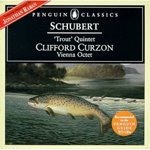 |
Ocellia could be described as sitting somewhere between. Even so their Calliope .21 possess more of the others' combined strengths without their associated weaknesses. This Calliope version provides greater truthfulness and balance of tone, as much upper-mid resolution as the Rethm and far more microdynamic resolution than my Zu. Above all the Calliopes are transparent to the signal. They sound lean on older CDs, lifelike on the best LPs, cavernous on Bela Fleck, nimble on Renaud Garcia-Fons, jumpy for attention in Marc Minkowski’s new release of Schubert’s Symphonies and putting me to sleep when Curzon and members of the Vienna Octet played Schubert’s Trout Quintet 'old style'.
|
|
|
|
|
Although it will sound like a strange comparison, the Calliopes actually remind me of the best demos I've heard of Quad ESL 2905 - the same freedom from box colorations, the same resolution of microdynamics, the same uncanny holographic imaging from a point-source phase-coherent speaker and the same emotional intensity; albeit with a richer tonal palette, more bass weight and definitely greater macrodynamics. No wonder that this here Quad fan took to these Frenchies so quickly. Although exploiting radically different technical solutions, the result is actually quite close. Ocellia has the edge for their unique ability to reproduce acoustic instrumental tone so realistically.
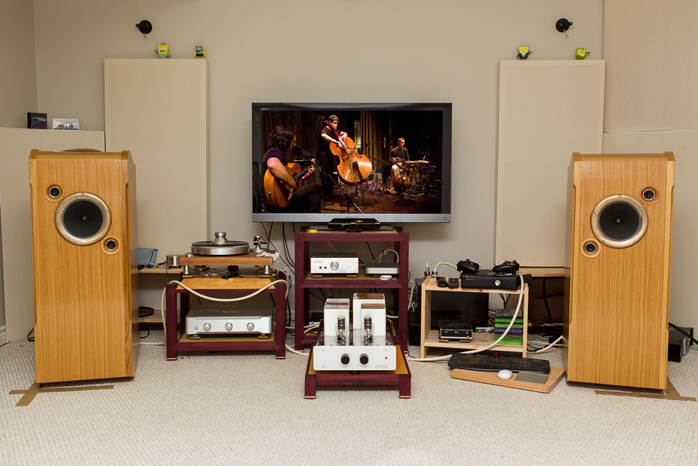
Up to this point everything reads as though Ocellia's system couldn't be faulted. On acoustic ensembles it was true for the most part. Yet what emerged when moving away from the music Samuel Furon favors was that bass depth and control with his full system could be less than ideal and upper bass impact lacked significantly. My music system in Canada serves double duty for home theater. The Avengers seriously wanted for grunt and punch as did my kids' Cars 2 movie.
|
|
|
|
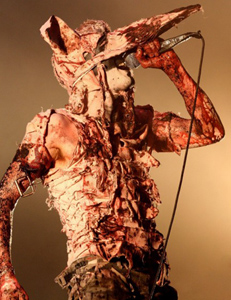 |
My wife wasn't too happy either with her Skinny Puppy and Beasty Boys discs sounding far too civilized and bland compared to the Zu Essence. I can’t listen to this type of music long but even to me it was obvious how its primal energy was somehow awol. Bottom line? Although I was in heaven, the Beudot clan as a whole was less convinced. Once made aware of one possible area of weakness, I too started discovering things I missed on discs I knew well, be it Mahler's Fifth, Saint-Saëns' Fourth or Beethoven's Third. I missed the ability to discern instruments within large orchestral masses. It was not unlike sitting in the last rows of an older opera house. The orchestra often sounds like one singular mass rather than multi-colored composite. The Ocellia system systematically gave me this type of presentation whenever I asked it to reproduce heavy complex fare or challenging bass material from Bela Fleck, the Gorillaz or Renaud Garcia Fons. Now I reread Srajan's review of the Ocellia .16 to realize that he too had the same challenge in making his loaners perform over a wider range of music when paired with any of his SETs. Alas low-power transistor amps had been a perfect fix to his issue. Hmm. |
|
Despite my initial intention to assess the Calliopes within a full Ocellia system only, a month into the review I pressed my FirstWatt F5 into service and have listened to the Calliope .21 that way since. Although it was no radical transformation, it was sufficient to have me prefer the F5.
Switching from a 300B SET to the FirstWatt did lose a little of that tonal truthfulness and flow which incandescent bottles excel at but in truth the step taken back was smaller than anticipated. Srajan has been saying it for a while now and with a speaker as transparent as the Calliopes it was obvious: the FirstWatt amps, though not as good as great triodes on tone and flow, come pretty darn close. I would love to hear Nelson's SIT1 monos in this system to appreciate just how great they must be.
|
|
|
|
To my ears what I gained with the F5 far outweighed what I lost. Improvements in depth, control and bass impact all contributed to prove that the Calliopes after all were quite endowed and that the SET had been the limiting factor. The greatest benefit was to now clearly differentiate instruments in a big orchestral mass, something the triodes were masking when the Calliopes were capable of incredible resolution and differentiation even here.
It almost seemed sacrilege not to be using tubes but I actually liked these better with the low-power FirstWatt. I have also seen glowing reports on using Bakoon's 15wpc integrated. If you insist on valves I'd stick with push/pull triodes to limit some of the unavoidable dynamic compression from a SET - unless you listen primarily to smaller ensembles. Then a SET will deliver all the goodness you'll ever want.
One day Samuel Furon came over to hear his speakers with the F5. Although he immediately latched on to the slightly less lively midrange, slightly reduced sense of flow and somewhat reduced tonal richness so obvious on horns for example, he admitted that the shift was small and that he could easily live with the system as it stood. He and I love the same music but we obviously listen slightly differently and enjoy a slightly different balance of qualities.
The one thing to remember is that the Calliope .21 had no issue adapting to our varying expectations depending on amplifier used. Driven from the F5 even my Punk Rock-loving wife found them to be quite engaging, never mind the kids who hid under blankets whilst watching the latest Scooby Doo movie. Give these speakers the right engine and they will turn into serious little devils.
|
|
|
I firmly believe that speakers in general are the most limiting factor of any hifi system. When one pushes their limits as far down as Samuel Furon has done with the Calliopes, what remains is finding the most synergistic blend of electronics that will deliver the balance of character one wants. The Calliopes are so transparent to what’s ahead of them that fine-tuning this balance proved quite easy.
It's important to understand though that even with the F5 the Calliopes did have limitations in bass output which the F5 simply delayed. The best way to describe this is by illustrating what the speaker could and couldn't do in the nether regions. What it could do was reproduce the lower reach of an acoustic upright. Even on Garcia-Fons’ lowest notes I never felt that their output was rolled off when powered by the F5 yet below that range response fell off extremely rapidly. The lowest pedals of an organ were barely audible and the deepest synthesizers were severely reduced in scale. If you are heavily into disco bass the Ocellias will frustrate. For the vast majority of acoustic bass they will surprise on both quantity and quality as defined by speed and resolution as well as output.
|
|
|
The only risk you'll take with them may be having to upgrade your electronics sooner than planned. They easily reveal all bottlenecks preceding them. I've been a strong proponent of Burson’s HA160D as an underestimated integrated source/preamp. As Srajan clearly reported, their new Conductor operates at significantly elevated levels. Bringing that into the system for a followup review felt like lifting a veil. It unleashed further microdynamic abilities from the speakers. Similarly when the Metrum Hex DAC arrived shortly thereafter for another followup. Naturalness of tone and dynamics took another step forward, enough to have me wonder just how good the Calliopes really are. I did hear them with a phenomenal vinyl front end at Samuel Furon’s Atelier Audio. Even so I can’t say for sure that I have pushed them fully yet to demonstrate just how much further their disappearing act might go within my own four walls.
In the end these speakers were designed to provide the most lifelike rendition of acoustic music possible. At that objective they succeed fully. In the process Samuel Furon has created an amazing chameleon which properly matched will connect you more deeply with the music—any music really—than most. When listening through the Calliopes with a triode or high-quality low-power transistor amp, you won't escape the feeling that the music is happening in your room. Feed them with the highest-quality vinyl or digital source you can afford and the concert will move into your home. Time to scalp those tickets.
|
 |
The Ocellias aren't cheap but neither is their concept or laborious manufacturing process. The resultant sound is something you'll struggle to obtain from any other speaker in their price range or significantly beyond. I obviously can't know whether these are the best widebander speakers made today (I've already been told that the equivalent model with the 30cm PHY goes even further). I can say that they easily trounced the models from Rethm, Zu and Audio Note I know, let alone those built around various Fostex, Feastrex and Lowthers drivers I've heard which couldn’t dream of the ultra-low coloration achieved by the PHY in this sophisticated an enclosure. I have also heard many horn-loaded speakers. With the notable exception of the very best Avantgarde, their midrange colorations made most of them sound like broken tin boxes by comparison.
The Calliope .21 Twin Signature now belongs at the very top of my personal pedestal of speakers I could live with permanently and without any regret. They're right up there with the Quad 2905 and the Avantgarde Trio & Basshorn... and in many ways ahead of either!... |
|
 |
 |
|
 |