This review page is supported in part by the sponsors whose ad banners are displayed below |
 |
 |
|
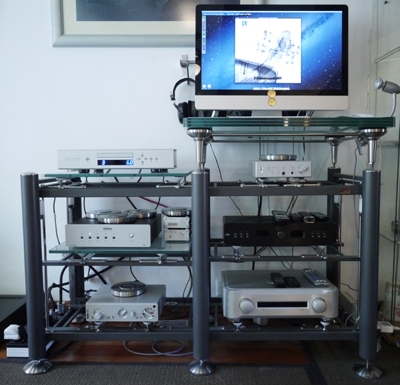 |
For Revo reverie I set up my Nagra Jazz/Job 225 team. After I'd ascertained that the DS-1's USB input handled all rates as advertised—with Norma's upsampler defeated I quickly toggled PureMusic 1.89g through all available sample rates which the Italian's big blue display confirmed accordingly—I defaulted to my two-box battery-powered SOtM USB bridge connected AES/EBU. This avoided having to relaunch the iTunes-embedded PureMusic software player for each DAC change. I simply swapped the 110-ohm Van den Hul Pro cable between Revo and my reference Hex DAC.
For 44.1kHz fare PureMusic was set to 176.4kHz NOS-style upsampling. Audirvana did its equivalent during an alternate session. Hi-rez files like the 24/96 Ricercar album of Tomasio Antonio & Giovanni Battista Vitali Ciaconna under Stéphanie de Failly [left] played back at their native resolution. These kinds of on-the-fly resolution changes produced no hiccups or misfires. |
|
On tonality with its concomitant fix on the attack/bloom/decay meter, the Revo DS-1 was very similar to the Resolution Audio Cantata, perhaps not surprising given that both focus on the BB1704K chip. This setting favors body and density over velocity and space. The Metrum converter added more cayenne to transients. Whilst tonally a bit leaner it felt both quicker on the uptake and more languorous on trailing edges.
|
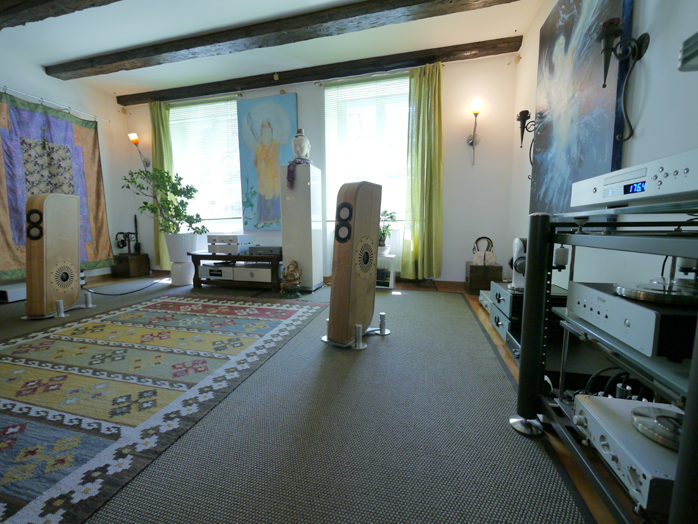 |
Boenicke Audio B-10 driven from Job 225 amplifier, Revo, Hex and Jazz in foreground
|
Massed strings with octave-doubled flageolet as in Claude Chalhoub's brilliant Diwan album to which I return often had more scintillating separation and fire. Particularly in the depth domain where the narrow Boenickes with their hidden arsenal of 'voodoo' tweaks rule as a quasi Gallo 3.5 (those Tangband tweeters have astonishing off-axis response to echo Anthony's CDT), the Hex managed deeper hexing. This returned with Fado queen Mariza when her already nicely layered ensemble suddenly adds subdued string orchestra which appears as though from another room far in the distance. With a very different speaker of the sort my current arsenal was without—perhaps metal drivers tweaked for transients over follow-up mass—this balance of attributes should have registered quite differently to plainly favor the Norma. With my tonally heavier speakers which perhaps make up for my abandoning valve amplifiers, the pace-setting vigor of the exacting Metrum DAC produced the most impressive results.
|
|
|
By inevitable necessity the combination of Revo DS-1 and IPA-140—stable mates and soul mates though the amp moves deeper into the darker weightier milieu—thus veered further adrift in my context of hardware and listener bias. Given how beautifully styled, built and featurized this gear is, I was somewhat upset to think that I wasn't meeting it at the top of its game. A French Triangle Electroacoustique speaker, German Burmester or perhaps electrostat of most any persuasion could have been the ideal ticket. It simply wasn't to be.
|
 |
Our narrative now closes the circle which was opened by the intro. Exploded bandwidths. Turbo-charged slew rates. Remember how Norma's US importer Tim Ricketts utilized those specs to suggest inherent circuit superiority? My time with the Norma gear reiterated what I've felt certain of for years. In hifi and at the end implementation trumps concept. There are mediocre and stellar examples of all conceivable circuit permutations. By themselves particular ingredients or topologies guarantee nothing more than being part of the final recipe. It's the cook who remains king, not the bookish recipe. Things would be far simpler and more predictable if that weren't the case. Yet there seems no escaping the rule: there ain't one recipe to fit one and all.
|
|
|
Conclusion. As one expects with hifi kit that's from a house with a history in measurement gear and thus unlike nearly all loudspeakers, these Norma components didn't showcase any arbitrary or artistic deviations from basic response neutrality. But that didn't mean they lacked individuality. What they shared with their domestic mates at Sonus faber during Franco Serblin's reign was a focus on chewy tone density. With that came a preference for a moist, slightly dark, thick and gutsy presentation. Here particularly the amp exhibited more wall-of-amplified-sound elements than what one gets from unassisted acoustic instruments close up. Those are lither, harmonically more energetic and quicker if less weighty and more compact.
The IPA-140
thus reminded me of vintage Jeff Rowland or a mid-hall seat in a reverberant-rich venue - exactly where one might favor sitting when following operatic voices which happen to be confessed favorites of designer Enrico Rossi. The IPA-140's specs also predict brilliant current delivery into challenging speakers of the sort I don't possess on principle but which under the populist power-is-cheap mentality become more common. Here one is usually predestined to muscle amps or better yet monaural versions. The potent Norma combines two of the latter with an active preamp stock and even throws an optional USB DAC in to get heavy on practicality but light on box clutter. Those who from certain specs predicted a Bakoon or Goldmund-type sound must simply reset their expectations.
|
 |
With highly configurable socketry for the amp, embedded menu options and one convertible i/o port for the player, understatedly elegant cosmetics from the pen of Livio Cucuzza, black or silver finishes with blue or red lights, materially dense topologies and a combined remote, the perhaps greatest surprise once we backtrack to what it buys with Italian labor and a dealer network is the European pricing. Whilst despite clear longevity Norma still isn't as well known as brands with more and far louder advertising, the material evidence of these components speaks persuasively to top-shelf manufacturing and clear design maturity. Distributors keen on discovering worthwhile brands not yet promoted in their markets might want to take a really close look at Enrico Rossi and his Norma catalogue. So should shoppers who favor meat over sinew, mass over adrenaline, relaxation over energy and advanced treble refinement over maximal illumination and separation. |
|
 |
 |
|
 |