This review page is supported in part by the sponsors whose ad banners are displayed below |
 |
 |
The remote's twin volume controls and various mode buttons already suggest a multi-layered user interface. As one learns, its options are more extensive than apparent. This makes things far from intuitive. It's the price to pay for pristine fascias with minimal button cluttony. With the Revo DS-1 CD/DAC one must learn double/triple functions for specific front-panel buttons and precise sequences whereby to get at various things whose display confirmation once again is far from self-explanatory. Welcome to alphabet soup à la FSrC, CLSr, drdn, Fdig, dEEn, dEFA which, respectively, stand for upsampler, clock source, direct down, digital filter, de-emphasis control and default parameters. Without the extensive owner's manual and warnings like "when you change the selected input with one that has no active function of oversampling, the volume is immediately reset to the maximum value (0dB)" you'd be quite lost. This is a definitive read first case including learning how to convert certain inputs into outputs via internal jumpers (with the DS-1 the coax socket can be i/o, with the IPA-140 input 2 can convert into an output for a subwoofer for example whilst input 3 can be set to bypass the preamp stage and input 1 is either line or phono).
|
 |
As Enrico explained, his circuitry isn't simple by design. Unlike the half empty boxes one routinely finds with competitors, his are quite packed. Here's the entirety of the digital deck with the optional M2Tech hiFace 1 OEM module. That's based on the Cypress Semiconductor chip like Antelope Audio's Zodiac converters use it. The popular XMOS chip only showed up with the next-gen hiFace OEM board. In this preference for the original, Norma mirrors Metrum Acoustics and what's in my reference Hex converter.
|
 |
Here is a closeup of the digital board followed by...
|
 |
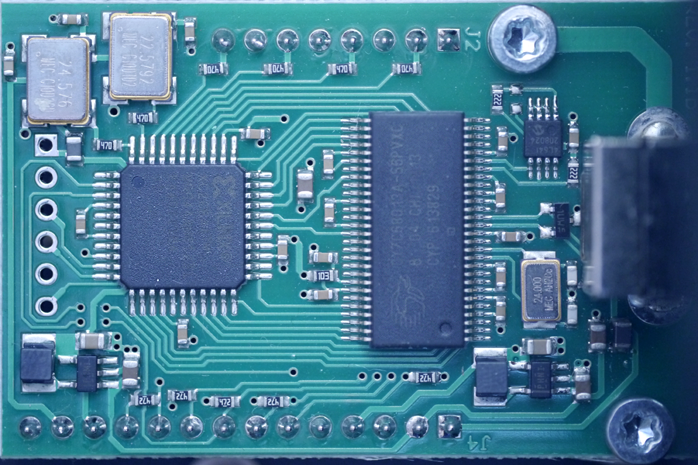
... the outsourced USB transceiver board with its twin clocks and custom-coded Xilinx FPGA.
|
 |
|
|
|
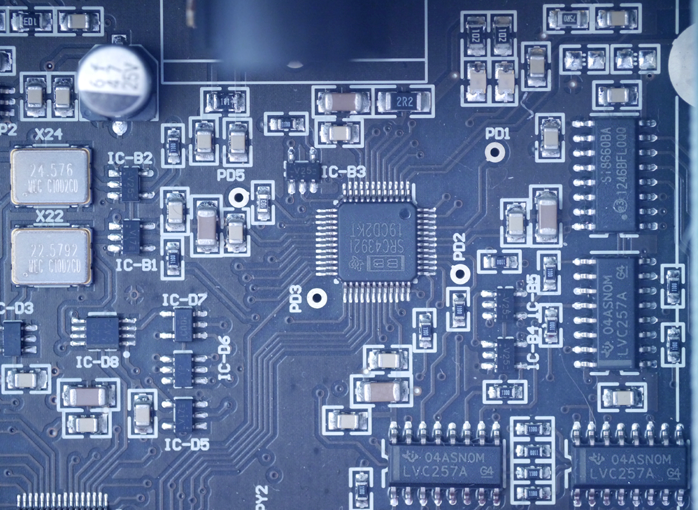
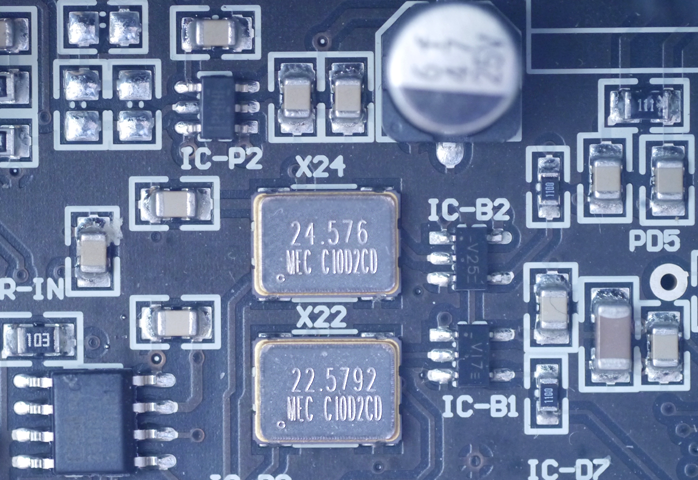
Here we see the two precision clocks for the 44.1kHz audio and 48kHz video families of sampling frequencies on the main digital board and a Burr Brown SCR43921 sample rate converter ...
|
 |
|
 |
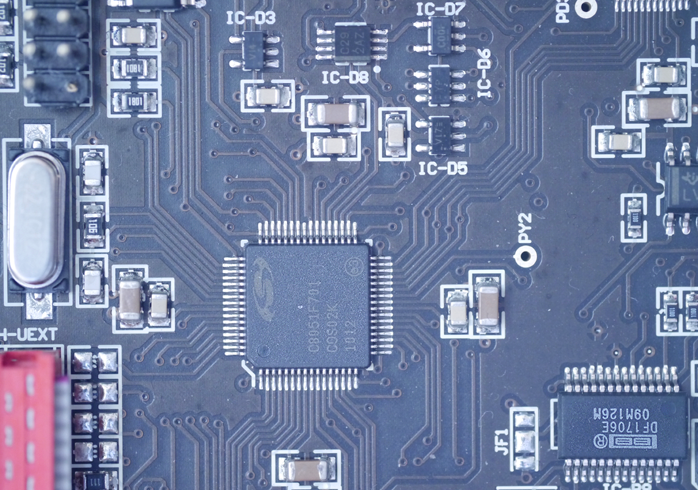
... followed by a reference oscillator, Silicon Laboratories MCU chip, Burr Brown DF1706E digital filter...
|
 |
... and the analog output section of the bigger yellow circuit board.
|
 |
|
|
|
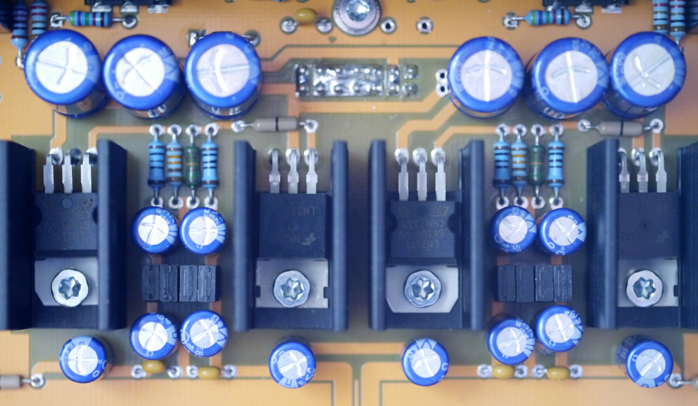
Here is a closeup of that output stage followed by...
|
 |
... the same board's lower half with its channel-specific NOS R2R multi-bit Burr Brown PCM1704 chips in best 'K' quality as recently encountered also in Resolution Audio's Cantata Music Center.
|
 |
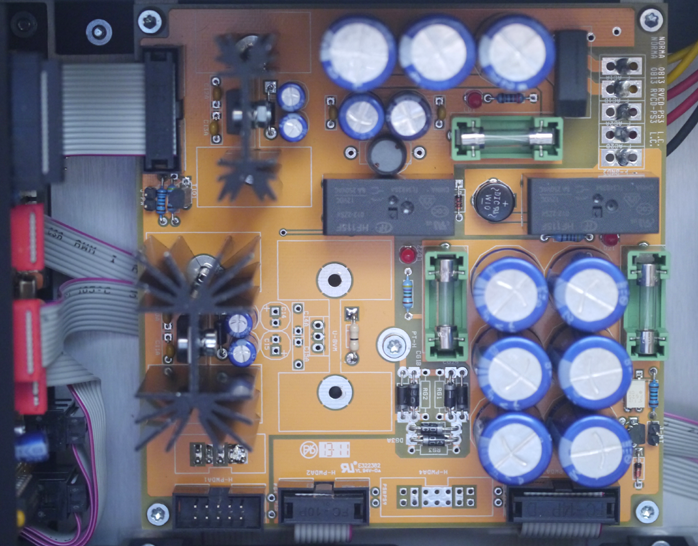
To round out the guts of the player/converter here's a closeup of the power supply board.
|
 |
|
 |
  |
 |