This review page is supported in part by the sponsors whose ad banners are displayed below |
 |
 |
The Naim system—that’s exactly how the two reviewed components need to be treated—is relatively inexpensive. With its beautiful tone colors, meatiness and resolution, its sound however isn't. Add great functionality and you have this system’s most important characteristics. What’s also important is that the brand has its own group of faithful intelligent followers. Becoming part of a 'club' especially as elite as this could be an added attraction.
|
 |
Review methodology. The system was reviewed in an A/B with both A and B known. Music samples were 2 minutes long. The source was an Ancient Audio Lector Air V for its transport section of Philips CD-Pro2 and my HP Pavilion dv7 laptop with 128GB SSD, 320GB HDD and Foobar2000+JPlay connected with Acoustic Revive USB-1.0SPS cable. The system sat on the stock rack placed on the floor. The speakers were connected via Acoustic Revive SPC-PA cables. I had three pairs of speakers at my disposal: the Harbeth M40.1, Raidho D-1 and Castle Richmond Anniversary Limited Edition.
|
|
|
|
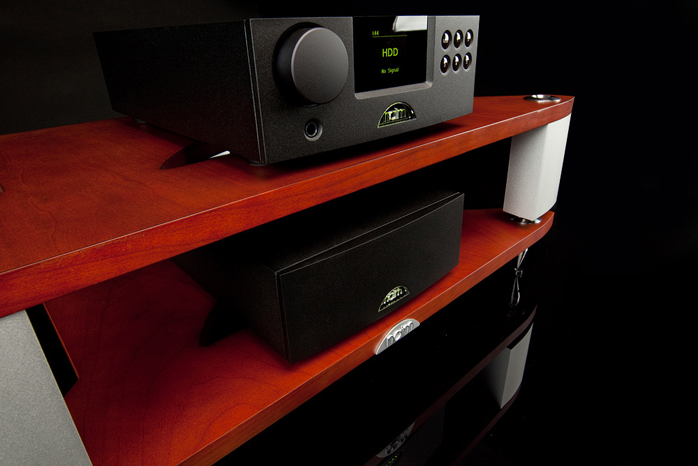
Design. I've already given the basic information earlier. Both machines are of modest size with 207mm wide cast aluminium fascias. The remainder of their chassis is more aluminium. The DAC-V1 features a nice green OLED display for basic information on volume and selected input. The volume shows in large digits and the display dims after a user-defined period. The input selectors and logo remain lit. The latter may also indicate mute mode. On the left side are a large volume knob and the headphone socket.
|
 |
The rear panel shows the unit’s true purpose. It’s a D/A converter with built-in preamp section. We only get digital inputs however: USB, BNC, two coax, two optical. All handle 32/192 except for the asynchronous USB which extends to 384kHz but limits word length to 24 bits and no DSD. Next to the inputs are RCA and DIN outputs, the latter in the less typical 4-pin configuration. There is also a small ground lift switch. The picture is completed by a mains socket and mechanical switch. There is no standby switch which suggests that the unit should remain on all the time.
|
 |
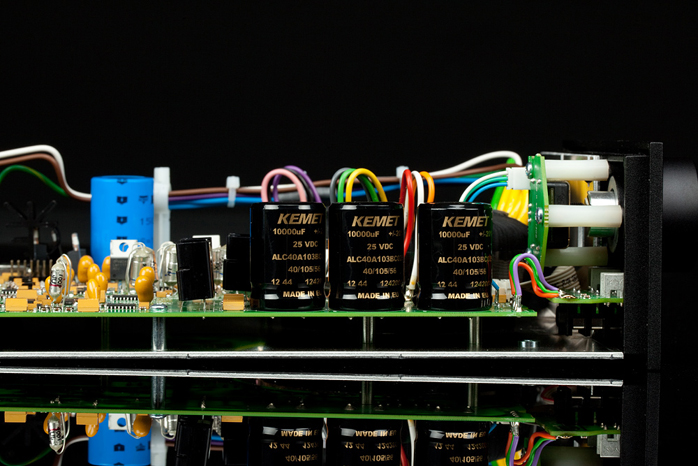
The electronic circuit mounts on one PCB with a hole for the transformer. The latter is a 210W Talema toroid potted in epoxy and mounted to a thick rubber mat. It sports three secondaries for the inputs and digital filters, DAC and analog section. Next to the USB input we see an Atmel DSP chip which works as USB transceiver. All other inputs are isolated with impedance-matching transformers. From the selected input the signal moves to an Analog Devices SHARC ADSP2148 DSP chip with Naim’s custom software for their 16 x oversampling digital filters and jitter reducing circuit. Next the signal hits a single stereo Burr-Brown PMC1791 converter. chip Next to it are two quality clocks for the 44.1kHz and 48kHz families of audio/video sampling frequencies. The analog section mounts on the same board but is separated from the digital section by distance and opto electronic components to isolate high-frequency noise. This layout also gives each section its own ground reference. I/V conversion is performed by Burr-Brown OPA604 operational amplifiers. The volume control uses an IC-based resistor ladder. Control is digital but attenuation happens in the analog domain. The output stage employs transistors mounted on small heat sinks that work in single-ended class A mode. The headphone output is driven from the same circuit. To provide enough current,plugging in headphones raises gain by times 5. The outputs are switched by reed relays and the complex power supply looks impressive. The plastic remote is rather small and can additionally control the basic functions of a computer software player.
|
|
|
The amplifier is housed in a similar enclosure except that its front panel only sports the logo and the rear an IEC mains socket with mechanical switch, silver-plated output sockets and RCA and DIN inputs which are paralleled to be active at the same time. The NAP100 employs full dual-mono topology starting with two separate secondary windings of a large Noratel toroidal power transformer. Power filtration is via four 47.000μF capacitors. The gain stage is built upon discrete transistors. The push-pull class AB output stage is based on 2SA1386+2SC3519 transistor pairs bolted to the bottom strengthened by a thick aluminum plate. This turns the entire enclosure into a heat sink. Assembly mixes SMD and THT parts.
|
 |
Specifications according to the manufacturer:
DAC-V1
Type: D/A converter/preamplifier
Inputs: 5 x S/PDIF (1 x BNC, 2 x RCA, 2 x TOSLINK) 32–192 kHz, 32-bit + USB (asynchronous) 44.1kHz–384 kHz, 24-bit
Frequency response: 10Hz – 20kHz (+0.1dB/-0.5dB)
THD: <0.002%
Input voltage: 2.1Vrms
Power consumption (max): <17W
Dimensions: 87 x 207 x 314 mm (H x W x D)
Weight: 4.3 kg
NAP100
Input impedance: 18kΩ
Output power: 50W/8Ω, 75W/4Ω
Gain: 29dB
Frequency response: 3.5 Hz–69kHz (-3 dB)
Power consumption: 15W (standby), 260W (maximum)
Dimensions: 87 x 207 x 314 mm (HxWxD)
Weight: 5.1kg |
|
opinia @ highfidelity.pl
|
 |
 |
|
 |
