This review page is supported in part by the sponsors whose ad banners are displayed below |
 |
 |
Summary: On the previous page, I listed only some of the recordings I used during the Klimax’s stay. I also tried HDCDs —the RipNAS converted 20-bit HDCD signal to 24-bit files—and many CDs. It took time but I finally was able to formulate certain conclusions that are vital to my own education and development. The Klimax DS is one of the best players I have ever heard (yes, players and not servers as its design might suggest). As a player the Klimax DS offers amazingly refined, precise, high-resolution sound. When comparing CD-resolution material, it easily competed with top-class CD players. Of course I could add that the Jadis, Reimyo and my Lektor decks offer a somewhat richer midrange and an attractive sound attractive at already low output levels. But what you get with the Klimax at regular levels is another vision of highest-quality sound.
|
 |
Raw resolution and the ability to differentiate between recordings are simply superb. The soundstage is large, precise and well integrated. With hi-rez files the sound becomes richer and a bit softer in a more natural way. The differences are perhaps not overwhelming but if you pick well-prepared hi-rez material, you will realize the limitations of the CD format very clearly. I am pretty sure that Mr. Waszczyszyn from Ancient Audio and other digital visionaries haven't yet had their last word on CD players. But what they may still achieve can only be small improvements now, not quantum leaps forward. The Klimax DS’s progress in this area is really fast but you won't have to change the player to keep up. Simply upgrade its software when it becomes available.
|
 |
Once my wife realized that all my CDs could be ripped and stored in the small black RipNAS box, she wanted me to buy it immediately. She hates the hundreds of CD jewel cases all over the house. She feels the same about books. It makes her a potential early adopter of Apple's iPad that will allow reading e-books, net surfing and more. She simply can't stand the overwhelming clutter of all this at home. I can sympathize. Still, I’ll have a hard time abandoning the physical media of CDs, LPs and books. A file is very anonymous. You don't know who prepared it (maybe the Japanese will specialize in reissues as well?). Even a good meta data description does not accommodate all the information we get in a CD booklet; and reading a paper version is easier. That’s why I recently invested in an expensive new CD player. On the other hand, the vision of me not chasing a particular recording over the shelves or all through the house and still getting the highest quality sound is very tempting. I think that those who plan on buying a Linn Klimax DS will have to first change their habits and way of thinking. The sound itself won’t be an issue as they will get a top-performance machine.
|
 |
|
|
|
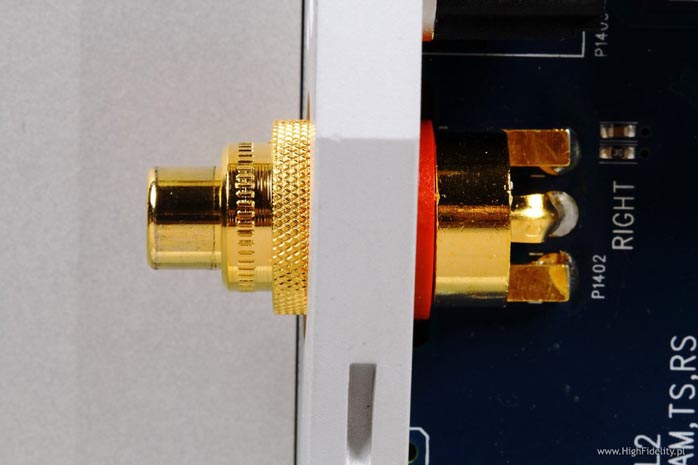
Description: As mentioned earlier, the complete Klimax DS consists of three elements – a player, the file storage and the user interface. You’ll need to buy your mass storage separately. For this review, Linn delivered a RipNAS with two built-in HDDs, one for file storage, the other as backup. The Klimax is made of a massive and heavy aluminum block that’s been very nice proportioned. The narrow front panel houses only a small half-round window with an acrylic cover and a blue alphanumeric dot-matrix display for file data. The top panel protrudes over the back panel so you can push the Klimax all the way up against a wall and have enough space for all the cable connections of Ethernet link, power cord with the mechanical mains switch and RCA and XLR outputs. The IEC placement precludes aftermarket audio cords. You’ll have to use a computer version which Linn claims to work best. I’d love to disagree but couldn't even try to prove the point.
|
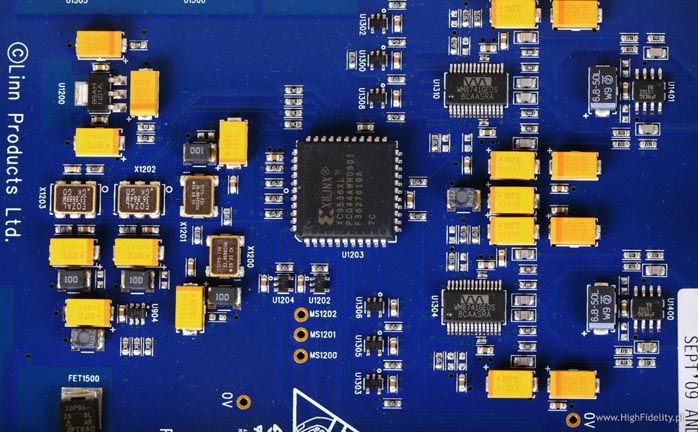 |
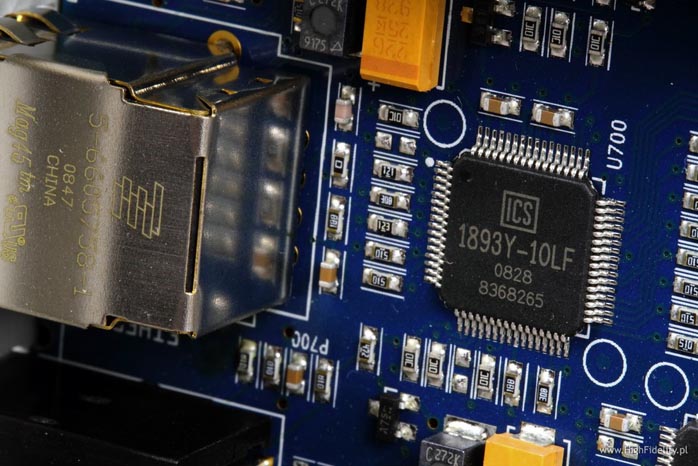
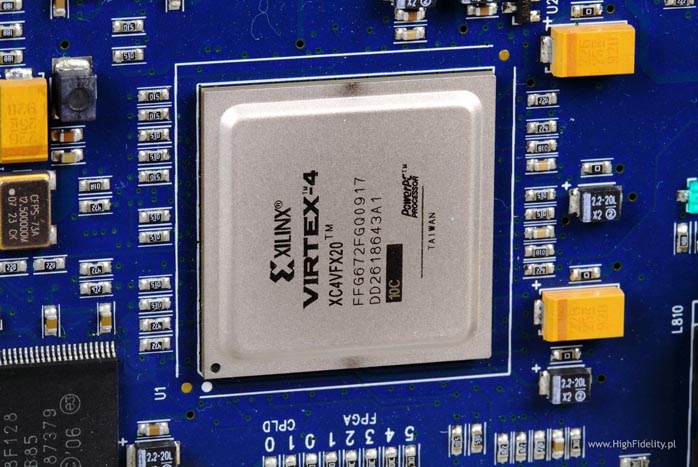
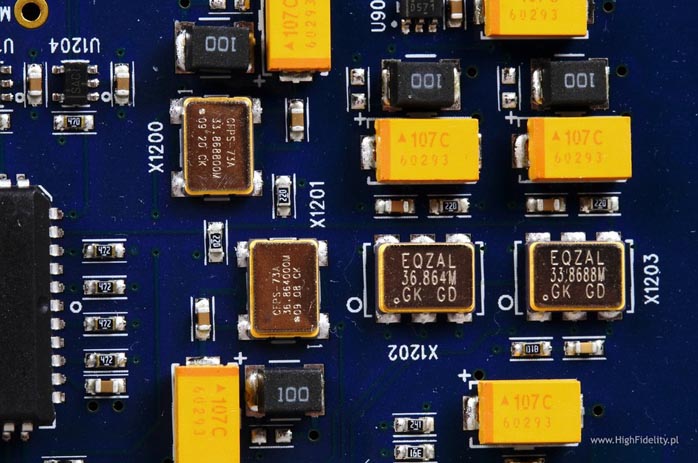
A look inside shows a complex and technically advanced device with rather small outputs circuits. The heart of the device is a XilinxVirtex-4 Power PC microprocessor and a precise clock right adjacent to it. There are many other chips including one for Ethernet transfer and others for memory. But the most important is the output section. For each input sampling frequency starting from 32kHz up to 192kHz, there are separate clocks with independent power supplies. This avoids the need for PLL loop generators to create a particular frequency which introduces much jitter. As its top-of-the-line player, Linn maxed out D/A conversion with two Wolfson Microelectronics WM8741GEDS chips per channel. Wolfson is a unique Scottish company based out of Edinburgh. They're big enough to introduce advanced applications yet small enough to cooperate with other companies to create custom apps. Rega already exploited this and Linn followed suit. The WM8741GEDS is a stereo 24/192 D/A converter with advanced ultra high performance multi-bit Sigma-Delta architecture and DSD bit-stream support. Its advantages include very low noise, high dynamics and advanced digital filtering.
|
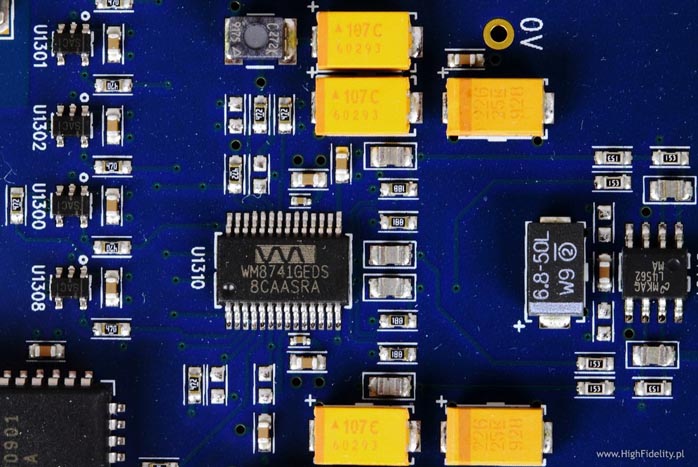 |
The Klimax DS is equipped with a dither interpolation system which changes all incoming signal to 24/192 before being converted. L4562 chips from National Semiconductor deal with the I/V conversion. All components are surface mount except for the Lundahl output transformers which were originally intended for matching microphones inputs as the best there are. Another important information regarding Linn designs is that they use impulse power supplies. This technology has been almost totally abandoned by audiophiles (mostly for good reasons) but perfected by Ivor. Already the CD12 used an SMPS. The Klimax version I reviewed was equipped with the new Dynamik version.
|
|
|
Klimax control is by included remote, iPod Touch/iPhone or computer monitor. For the latter there’s special software called KinskyDesktop. Regardless of how convenient this was, my old habits missed the usual knobs and buttons on the front panel.
|
 |
|
opinia @ highfidelity.pl |
 |
|
 |
