This review page is supported in part by the sponsors whose ad banners are displayed below |
 |
 |
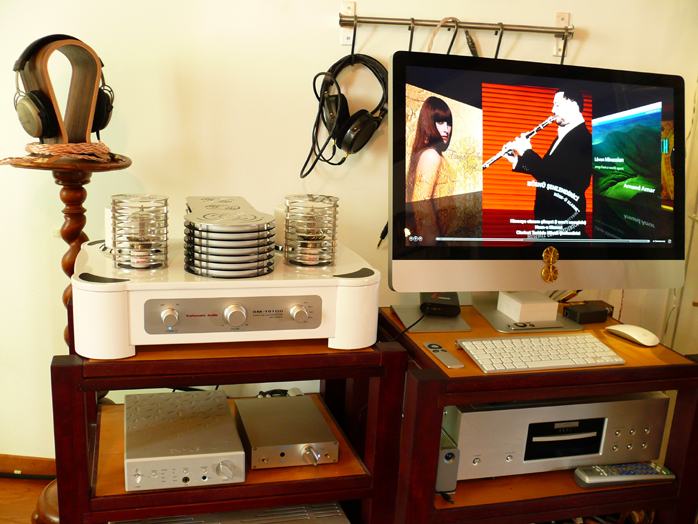
Hybrid conclusion. Back in Villeneuve with Sasa's SM-101Dn replacing my customary ModWright LS100, I experienced my—predicted, hoped for—second coming within the very first bar. Our little theory was reinforced. Score 2:0. And by contrast with my own very familiar system, it now was very easy to better verbalize the womanly touch. What the single-stage pure DHT ahead of the SIT1 did was inject elasticity and fluidity into the gestalt; greater microdynamic waves; air and billowing into the soundstage. The latter increased the subjective scale of space and hence the sensation of another acoustic superimposed on my own. This shift in gestalt could be called the Chopin effect. Elegance in motion. The sense of ebb and flow, of tension and release riding on a breath not just with wind instruments and vocals had become more palpable. Everything sounded bigger. And the SIT's operating point feature once again had the more pronounced obvious effect than with my usual linestages.
|
 |
|
 |
As it had at Dan's, this sound was the finally perfected blend of transistors and tubes. The Vfets contributed 80%. They performed the hard work of speaker drive with nonchalance and extreme purity. Liberated from any grunt work, the valves then injected a very fine aroma. Because this collaboration involved only two zero-feedback ultra-simple amplification stages in toto, the 101D aroma of the preamp could express itself easefully without any dominatrix conniptions through the following amp. That made for the kind of sound which SET aficionados aspire to but only very rarely achieve. Where 10 watts are sufficient—and where a single-stage DHT preamp is available—I'd now really call it game over for such valve amps. Period. My remaining ones are thus for sale. Chapter closed. Whilst sophisticated OTLs would perhaps compete, I find the massive forest of tubes required to drive down output impedance without a transformer conceptually unattractive. Even if simpler weren't better but just as good, it's still simpler. And in my book that already makes it better.
|
|
|
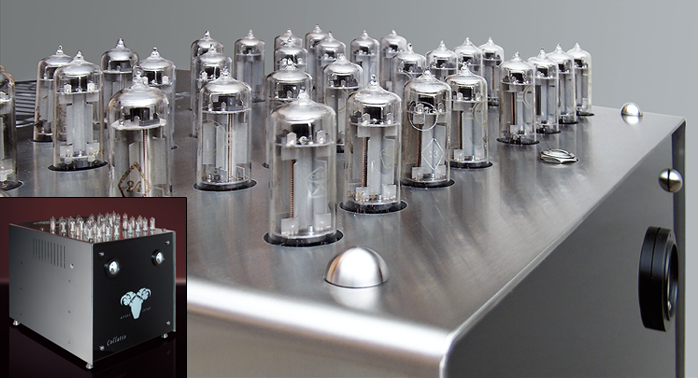 |
110kg Aries Cerat Collatio single-ended stereo OTL with 32 x 6C19P
|
Incidentally, trading out my Aries Cerat Gladius for the Voxativ Ampeggio speakers, I noticed how the latter parlayed the bias adjustments to a slightly higher extent. Did one have to extend the theme of signal-path simplicity already explored with the DHT preamps to the transducers for maximum effect? That seemed like a reasonable supposition. With no crossover and just one twin-cone driver, the German widebander certainly embodied that notion to a higher degree than the massive outboard three-way filter of the Cypriots.
|
 |
| |
|
|
Catalogue shuffling. Having played with one-up custom preamps for results readers couldn't easily replicate*1, my final experiments deliberately reverted to DAC-direct drive for snap shots on how the SIT differs from its stable mates F5, M2 and J2 without any valves in the signal path. All three stereo amps were first warmed up for 30 minutes to thermally stabilize before being connected to signal. The SITs were biased dead center.
|
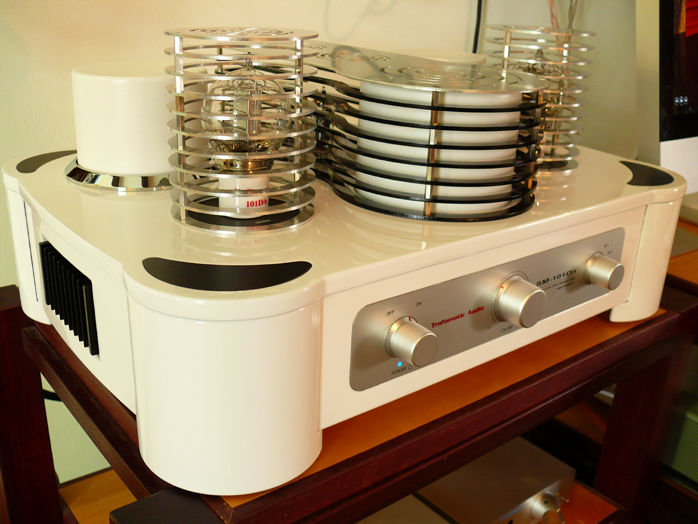 |
*1 Because Sasa Cokic was equally smitten with the DHT/SIT results, it looks likely that a regular such preamp with a current-production direct-heated triode will be added to the Trafomatic lineup this year or next.
|
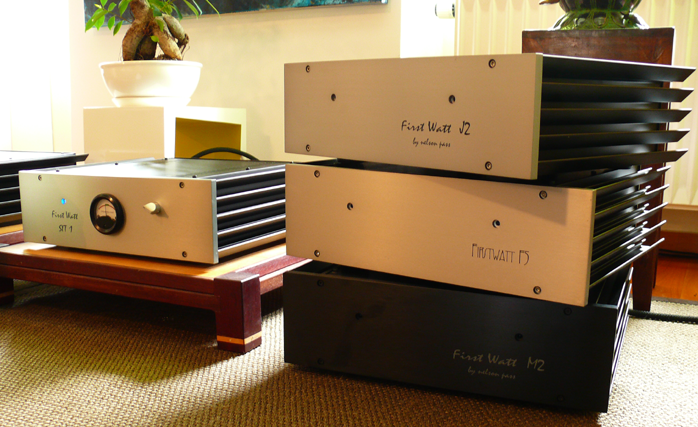 |
F5. The SIT1's primary advantage manifested threefold. One was greater textural suavity. Two was higher contrast ratio for greater image lock. Lastly expressivity—that peculiar fluidity of gestalt—was higher. Grouped together the sense of presence was more acute and soundstaging was even more specific than the F5. These distinctions grew larger with the SM-101Dn as though to confirm again the additive benefits between two single-stage components.
|
 |
CDs used during the auditions and recommended: Dorantes Sin Muros; Steve Shehan/Natil Othmani Awalin;
Benoit Dimmer-Valet Passeggiata; Avishai Cohen/Nitai Hershkovits Duende
|
M2. Here the SIT's primary advantage manifested as higher resolving power. Listener ability to 'drill down' to a more molecular level was greater, leaving the passive voltage-gain amp slightly veiled by comparison. Relatedly the M2 felt softer overall, gently shaded and not as preternaturally defined.
|
 |
Falete Sin Censura; Rahat Fateh Ali Khan/Michael Brook Kinna Sohna; FisFüz Ashuré; Anna Maria Jopek Polanna
|
J2. This made for the closest match on overall gestalt but the J2 wasn't as finely boned. Its demeanor was a bit heavier and thicker. As a result tone textures felt slightly coarser.
|
 |
As is always the case, the higher the resolution of all ancillaries, the more one hears. This enlarges differences which in a less advanced context would be far closer or overlay altogether. Whilst the SIT1 is the best amplifier yet from this Nelson Pass stable, how much better will depend on first-rate playmates. For the SIT the mantra of 'the best preamp is no preamp' rings categorically hollow. On this amp the performance delta between DAC direct—which clearly benefited the Colotube monos—and inserting a DHT preamp was significantly greater than between the FW amps. The ultimate preamp thus becomes a quest. As suggested by our fortuitous appearances of two extremely rare single-stage valve preamps with power triodes, the mythical missing link seems to be just such a beast. Dan and I mused how Nelson doesn't yet know just how fiendishly good his SIT1 is... until he hears it with such a 10Y, 101D, 73A, 205D-type preamp. If the moons align perhaps something can be arranged. For now our six moons align another happy way.
|
|
|
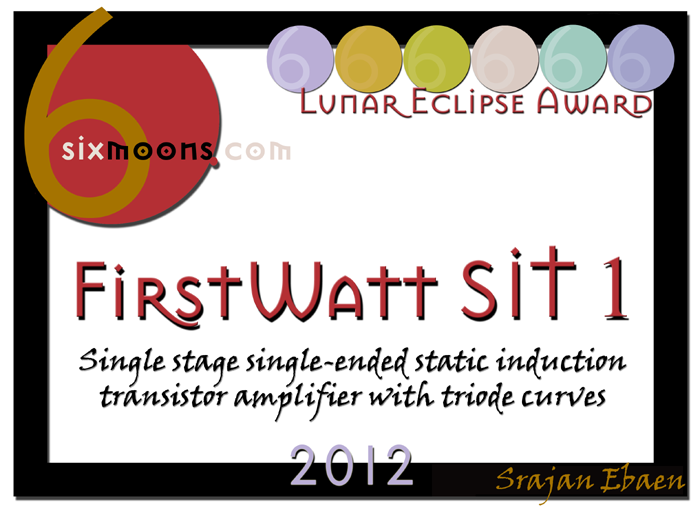
Nothing new under the hifi sun. It's an oft-uttered opinion particularly about traditional amplifiers. The SIT1 demonstrates that advances aren't over. Exotic 40-year old technology mated to cutting-edge modern manufacturing and radar R&D has netted a superior new audio transistor one expects will show up also in future Pass Labs products for high-power applications. For now the only ones to sample it are those smart enough to own loudspeakers of sufficiently high sensitivity. As such the SIT1 is a bravura proof of concept and first look into the future. It breaks new ground. In the present circuit it's arguably the closest a transistor has ever come to a direct-heated triode. The inside joke is that in so doing it's actually come closer to the ideal device than real valves at least in power amplifiers. For pushing the envelope; for concept, execution and performance... only our extremely rare Lunar Eclipse Award does proper justice to this launch! |
 |
Postscript. When news hit the Internet that SemiSouth had closed its doors for good, Nelson had this to say on October 10, 2012: "Too bad considering that they were nice people with a great product, in
Mississippi no less.
Fortunately I bought large quantities, enough to last me 5 years or so even
with
an allowance for repair parts.
I also bought a large quantity of a part that I haven't even got around to
designing
with yet...". Hence nobody need to worry about the ongoing viability of the SIT1/SIT2 platform or its availability.
|
 |
 |
|
 |