This review page is supported in part by the sponsors whose ad banners are displayed below |
 |
 |
 |
What about voices? Once more I had to admit how particularly convincing the Cha’am acquitted itself. Listening to the young Renee Olstead [Reprise Records], there was no excess in the singer’s voice but instead simply a charming presence in the listening room without exaggeration (compared with what my full transistor system delivers) which is usually one feature of overly colored valve amplifiers. The Cha’am preserved the freshness of the various takes from the great American songbook while delivering a very accurate reproduction of orchestral swings and piano. This isn’t the most natural recording but I highly enjoyed listening to such a sophisticated David Foster production over my Korean loaner. The Cha’am demonstrated great rhythmic abilities and the perfection of timing is really essential to completely enjoying this old-fashioned genre of music. In the pocket!
|
|
Listening to Händel’s Italian Baroque cantatas featuring soprano Natalie Dessay and Concert d’Astrée’s conductor Emmanuelle Haïm [Delirio, Virgin Classics], the result seemed close to perfection. There was a seamless fluidity to the voice of the French soprano that lacked all harshness or electronic glaze in the peaks. This kind of work is particularly helpful to check how audio gear handles the midrange and treble. The Cha’am gave me a very joyful contrast of colors with a profusion of harmonics. Once again the timing was absolutely catchy.
|
|
|
 |
Again and again the Cha’am proved it tremendous rhythmic skills of being fast, dynamic and detailed. On Al di Meola’s Winter Nights [Telarc], these dynamics however never played against fine detail or quality of tone. In fact this recording reveals exceptional qualities when the playback system is good enough to maintain the relaxed climate of Christmas songs while delivering great acceleration, huge impact and diversified timbres (even if the multi-string harp or bandura should prove less familiar). Overtones sparkled and lingered. It is always a bit confusing to explore Al di Meola’s studio recordings when the system has great resolution powers because the profusion of detail seems unending. The Cha’am performed this without mistaking the artificial scale of the various musical pictures.
|
|
|
|
That sense of scale and three-dimensional soundstage was also evident in Ahmad Jamal’s Live in Paris 1996 [Dreyfus Jazz], with the charged atmosphere of the Pleyel concert hall clearly perceptible. The soundstage had exceptional depth and layers of hall information resolved properly so that each instrument was reproduced with full energy. In fact image outlines were not only precisely located but also fleshed out with palpable focus. The Cha’am had great authority with strong and tight bass, solid percussive impacts and of course explosive attacks by the man with two right hands. Nevertheless the good abilities of the Emillé to reproduce dynamic lively music never played against its musically natural smoothness and liquid nature. This combination of qualities resulted in a highly pleasing level of realism.
|
|
|
Conclusion: For more than a month it was a great pleasure to play with the Cha’am in my system. This machine answered all demands I would have from a high-end amplifier particularly in terms of tone, dynamics, transients and three-dimensional soundstaging. At first I was not completely convinced by the price demanded for two channels of just 70-watt integrated power. And of course it remains expensive. I would not gloss over this at the end of my audition.
|
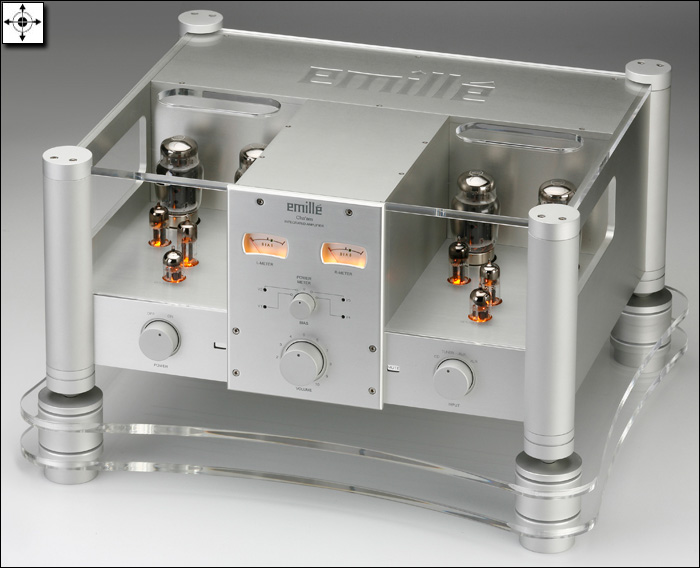 |
If we consider my reference amplification (Orpheus Labs 3M monos & Wyred4Sound STP-SE preamp), we occupy more or less the same neighborhood of expense. These two amplification systems had their own personalities. The separates offered a bit more linearity and sweetness in the upper midrange while the Cha’am brought further degrees of transparency and fluidity. The differences nevertheless weren’t that pronounced and each system does require careful setup to deliver the best results. If you pay attention here, you perhaps will encounter even fewer differences between both systems although for my tastes the Cha'am performed slightly better. The only reason for not buying the Cha’am as far as I am concerned is the space necessary to host/hoist it into a traditional hifi rack and the perhaps reduced freedom of an integrated solution versus separate components. Obviously the Cha’am requires space and isn’t exactly as light as a feather.
Returning to its sticker, I concluded firmly that the Cha’am is worth its price of admission. It is quite difficult to find true competitors in this arena and the sonic results are completely different from what you can find in the $5-7K range of integrated tube amps. To get this level of performance traditionally meant separates - or exceptional products such as a VAC integrated. Otherwise you’d point at fine transistor amps to become serious alternatives to the Cha’am. At this juncture, I considered the Cha’am to be quite affordable still relative to performance.
|
|
|
It is a very commendable solution for those looking for a highly transparent tube amp that can offer convincing bass punch and pitch definition. I do not like making modifications to loaned equipment and did not try tube rolling but the very favorable impressions I garnered would seem to have real potential for further advances with more ambitious 1st-stage tubes.
|
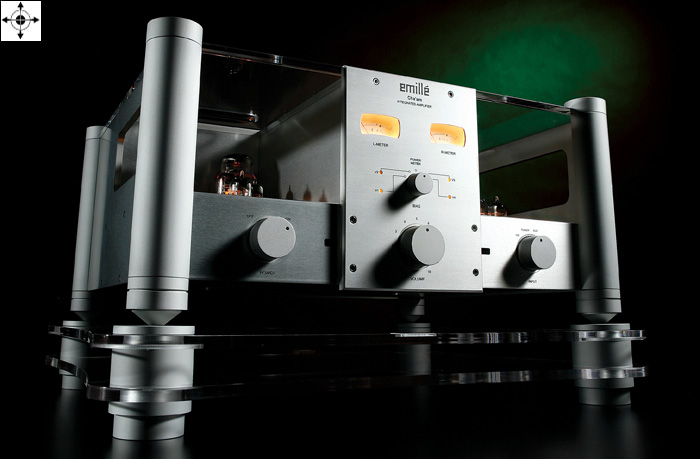 |
Like all the best audio components, the Emillé seduced me with its easeful lively spirit. This is not the kind of equipment that becomes boring over the long haul. It has sufficient transparency, neutrality and equilibrium to remain a solid partner through any substantial system transformations while remaining fully versatile to excel on any musical genre. Transient speed was absolutely amazing for a valve integrated amplifier. In fact, the Emillé Cha’am was my kind of perfect weapon against boredom.
|
 |
Congratulations to the company’s staff for releasing such a unique high-performance product. I have perhaps bestowed too many awards this year and felt quite reluctant to reinforce my image of serial awarder but it would be disingenuous not to reach once more for a Blue Moon award seal in this case.
|
|
 |
 |
 |
|
 |