This review page is supported in part by the sponsors whose ad banners are displayed below |
 |
 |
Amongst the things changed in the 5.3 soft/firmware update was an enhancement of the power supply. Prior power delivery had been somewhat conservative. With the new version a more generous supply improved LF response. The slightly bright top was subtly rounder to eliminate the edge. Imagine telling your partner, "hey luv, I’m going to upgrade the software in my power supply, wanna watch?”. Not long ago the guys in the white coats would have been ready to pick you up. Welcome to the 21st century.
After the Rotterdam show not only the Pnoe returned to our place but also a Devialet D-Premier. That still ran V5.1 so we sent an email to Paris asking for version 5.3. We also asked for configuration settings for our Zu/Denon DL-103 Grade II cartridge. We promptly received the software plus custom phono settings. Just as it had been in Rotterdam, the upgrade was a snap. Afterwards we used a spare SD card to load the phono configuration file.
|
 |
Devialet at that moment was working on adding a website feature to enable registered users to obtain custom configuration settings themselves. A menu will lead through specific questions to generate the correct file. Until that website feature is live, an email request will do.
|
 |
As we had during the first encounter, we once again set up the D-Premier with our Avantgarde Duo Omega speakers but now added Dr. Feickert’s Blackbird turntable. Instead of our usual Japanese Tri Audio phono stage the output from the turntable now connected directed to the custom-configured phono inputs of the Devialet.
|
|
|
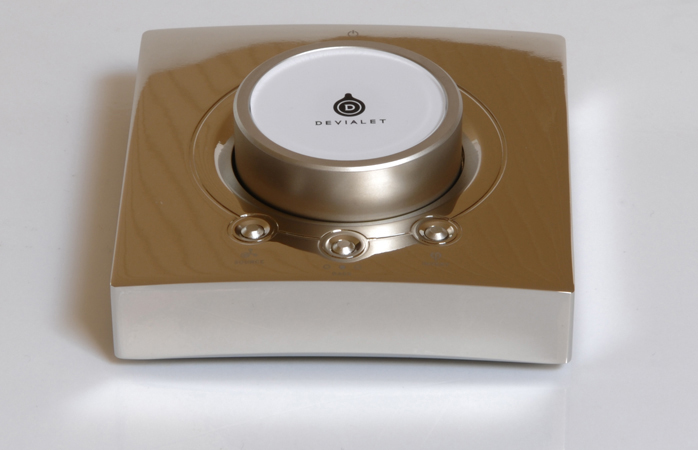
With the remote—we absolutely loved this thing and don’t understand why except for Steinway/Lyngdorf others still cling like dinosaurs to infrared—selecting phono only requires being close enough to the D-Premier to read its LCD. It is however possible to configure only one or two inputs so you don’t have to read the display. Pressing the bass button while in phono mode selects the RIAA curve. Currently available are 1953 and 1976. Custom settings can be ordered. With everything connected we repeated the noise test. Imagine a phono setup that is dead quiet and then even more dead. Eerie! Back at a safe volume setting the needle then hit the groove.
|
 |
Ulla Meinecke may not have been the most original choice but Wenn schon nicht für immer dann wenigstens für ewig remains a great album. The sound was so clean, so effortlessly natural and so devoid of any artificial noise and distractions—the album had been cleaned extensively to be almost without ticks—it was hard to believe we were listening to vinyl. Was it a master tape or a real singer? That was the precise frame of mind we were in. There was no grain, no hiss, no spurious noise but only blackness, albeit not the digital on/off type of blackness but a pregnant silence. There’s power in such nothingness, anticipation for the next note. Then there's music!
|
 |
Version 5.3 also was kind to plain CDs. With this medium there was the same restfulness, the same ease without stress, jitteriness or noise. It was perhaps a bit painful to realize that the difference between hi res files and good ol' 16-bit 44.1kHz as processed by the D-Premier had shrunk. Yes there still was a notion of additional space in decaying notes but no longer sufficiently so to warrant discarding Redbook in favor of hi res. Ha.
Next to sonic enhancement V5.3 arrived with other improvements as well. One of these is multi-room functionality where one D-Premier acts as master, the other(s) as slave/s. For bi-amping the master D-Premier is in charge of volume and only one RF remote is active. Units are daisy-chained between S/PDIF i/o ports. Tri- or nth-degree amping are all possible. An upcoming version will add active crossover settings in DSP. For 12-cylinder power users 5.3 already offers true bridged mono operation for 400 watts per amp to take care of many so-called tough speaker loads.
|
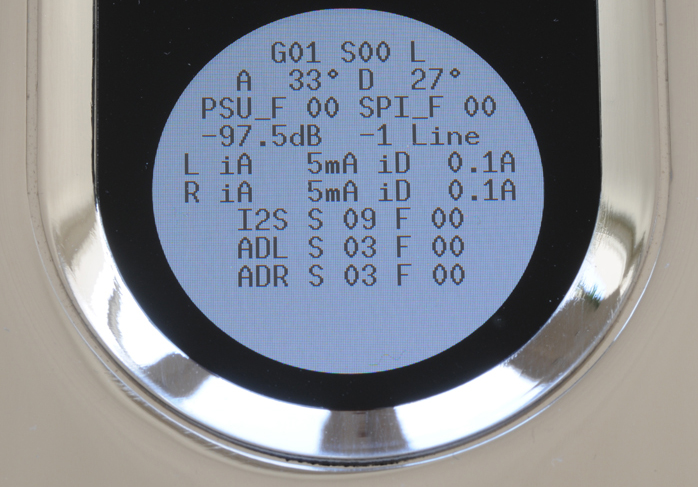 |
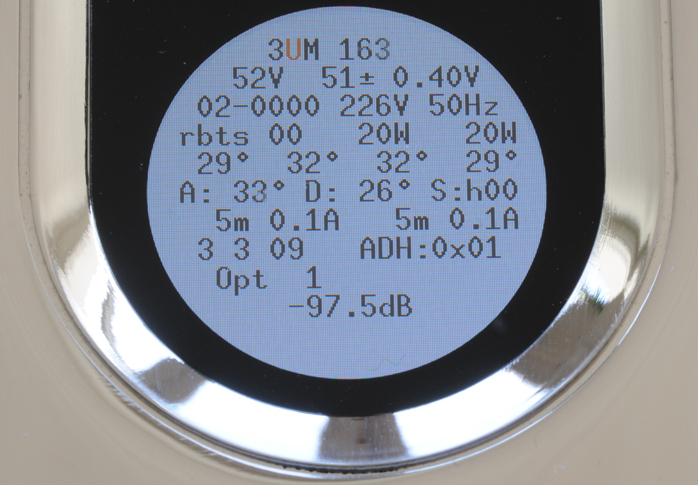
For a more intimate look at what’s happening inside the D-Premier, version 5.3 offers info screens. Just press the invert button for a little over a second and enter the world of software status indication. Pressing the invert button again one now walks through several screens. Serial number, creation date, soft- and firmware version and remote address can be shown this way. Incidentally each D-Premier and RF remote are paired so two sets in proximity won’t interfere. When needed an RF remote can be re-paired with a different amp than the original.
Pressing the source button on the remote displays the sample frequency in use. More information is available by pressing all 3 buttons simultaneously, starting with the bass button. This sort of alt-ctrl-del sequence known from Windows enters a loop of displays revealing info about the system’s voltage settings, internal temperature at various circuit junctures, input settings and electrical specifications. In case of a problem, technical support can ask for these figures to evaluate the necessary steps to fix things.
|
 |
There were a few items we did not or could not assess during the review. The HDMI features that can make the D-Premier part of an A/V system where a BluRay player’s HDMI output connects to the D-Premier’s HDMI input and its HDMI output to a video display is subject to an upcoming software update planned for the end of this year. Another feature we did not check out was the subwoofer output.
One item announced and prepared in 5.3 is streaming audio. The D-Premier comes standard with a WiFi antenna and by around the High End 2011 show in Munich a plug-in module should be available to accommodate streaming input from iTunes via WiFi. The hardware module will be free for all registered users owning systems without the module. From a certain production data forward the module will be standard issue.
|
|
|
In toto the Devialet D-Premier is a unique and truly wonderful machine. A combination of phono stage, preamp, DAC, ADC, audio streamer and class A amplifier with lots of power has as yet no generic category designator. For now it’s simply called D-Premier. It is truly a first and with RF remote and green energy-conscious operation even firster.
Sonically the D-Premier is exceptional. Its extremely low internal noise levels translate to a completely new perception of reproduced music in the home. It is a rare event to encounter a really new way of handling recordings from whatever source is available yet deliver a consistently high-quality signal at the speaker terminals. At the current price of €12.000 including VAT the D-Premier offers at least four outstanding separates in one handsome enclosure which separately would surely set one back 10 to 12G already. Add the savings of three obsolete AC power cords, two or three obsolete interconnects and a redundant power filter. Add superbly elegant cosmetics and unique ways for mounting/displaying the piece. Finally take into consideration the expected life span of the concept. With the many configuration options available already and more in the pipeline, the D-Premier is extremely future proof.
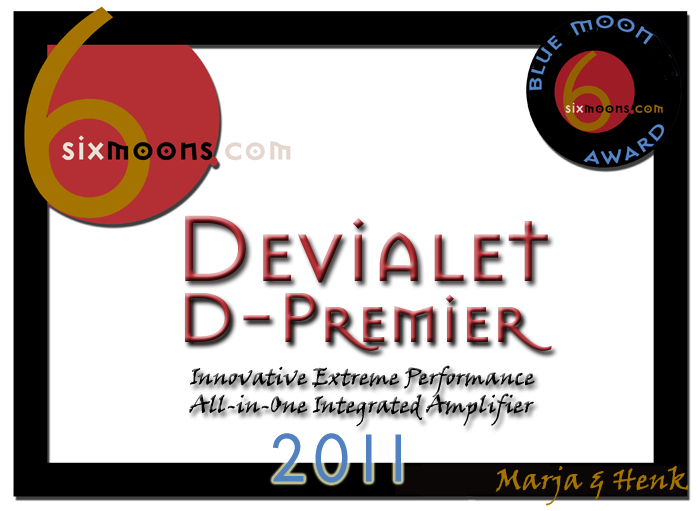
A Blue Moon award is in order. A conclusive caption for it might be innovative extreme performance all-in-one integrated but as you'll agree, to make full sense of just what that entails requires (if one came upon that award in isolation) that one have read all of the above first. Bravo!
|
|
 |
Quality of packing: Triple boxed with ample snug fitting padding in the innermost one.
Ease of unpacking/repacking: Easy as pie.
Condition of component received: Perfect.
Completeness of delivery: Ready to roll, even batteries come pre-installed in the remote.
Quality of owner's manual: Well though out for any level of user.
Website comments: Informative and well put together.
Pricing: Aggressive even though no competition exists..
Human interactions: Heartwarming and very responsive.
Suggestions: Bring out the champagne and pop a few corks.
|
 |
 |
|
 |
