This review page is supported in part by the sponsors whose ad banners are displayed below |
 |
 |
|
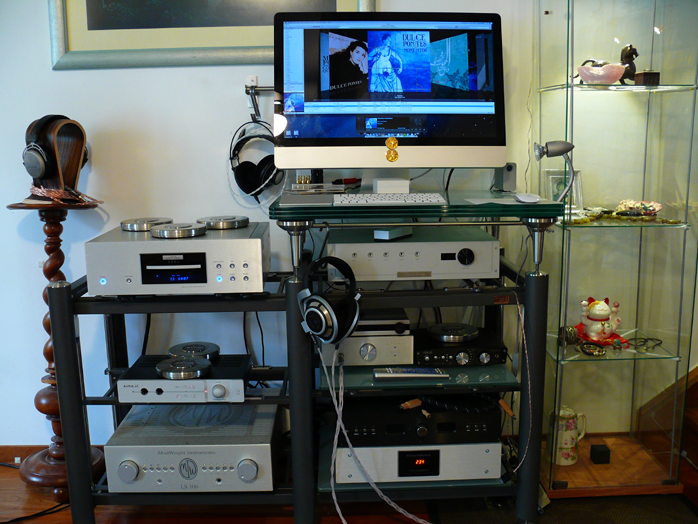
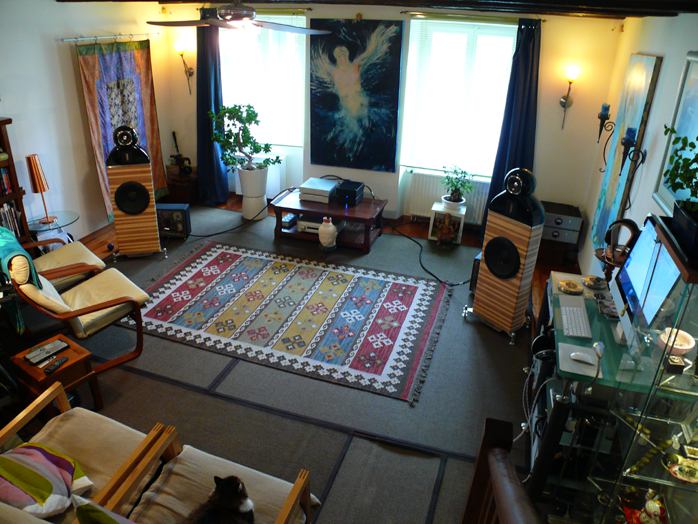
Modified linear-powered UcD vs. SMPS-powered Ncore. At this juncture of the assignment, the Lithuanian loaners had already made onward tracks to Germany. Hence it was back to my sealed smaller internal volume Gladius speakers with their innately quicker leaner tonal balance. Here the best ancillaries were my NWO-M DAC with AURALiC's fully balanced Taurus preamp (none of my other XLR-fitted preamplifiers sport true balanced outputs to make the Taurus best). Regardless of component matching including three valve preamps, on these amps and speakers none produced the same tone density or color saturation as had the previous Eximus/Atsah/Rhapsody chain. For a bit more of that flavor on my own speakers, you'd want the Stello Ai700. It's probably no coincidence that the latter's US premiere at RMAF 2012 showed with Mårten Design speakers. Simon Lee's ICEpower voicing does mirror paper drivers to mellow out the usual 'ceramic sound'.
|
|
|
|
 |
|
 |
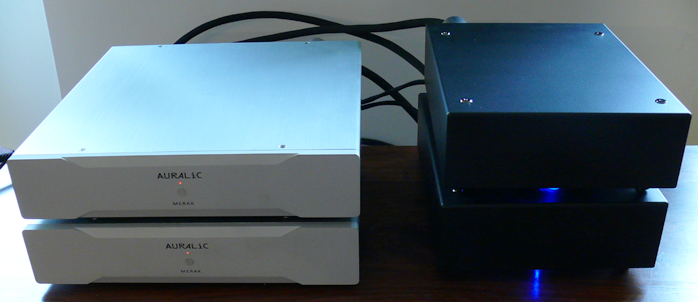
This UcD/NCore juxtaposition had the even higher contrast ratio, the more quicksilvery presence and what in this overall review context was clearly the utmost translucence for the Atsah monos. The effect was what one would expect from an even lower noise floor. The AURALiC Merak monos with their Lundahl input transformers and 500-watt linear supplies were warmer, texturally softer and energetically a bit more set back or distanced. They weren't as cozy as the Stello had been and quicker on the uptake but in this comparison cozier than the Atsah. The latter really were "lit up all over" as I had put things in the review of Nelson Pass' SIT1 monos. This doesn't refer to a lit-up treble but a sense of overall illumination which banishes all shadows from the virtual stage for complete and utter unconcealedness.
|
|
|
 |
|
I'll now quote from my review of April Music's Stello Ai700: "...latest-gen ICEpower modules—I've experienced them in Wyred4Sound, Peachtree Audio and two April Music implementations—are warmer, darker, softer and more organic than the diehard street rep knows is possible for the breed. While they retain that character vis-à-vis Ncore which is more transparent and sorted, what all of these current proponents of switching output stages (modified uCd included) share is dense detail and detail density. Their soundstage is chock-a-block with musical detail. Unlike before though, this detail isn't edge-rimmed, bright or hyper focused. It's undeniably there and is so en masse. It now simply coexists with material gravitas. Call it the heaviness of substance. It's no longer a sharp-toothed piranha swarm in a feeding frenzy. It's a benign school of bigger fish passing by stately.
|
|
|
|
 |
|
 |
"As playback levels increase, this heaviness increases in lockstep. And because detail capture is immense, high volumes create a particular intensity that gets nearly oppressive by how much virtual space it occupies. This is different from my low-power class A FirstWatt amps.
Those are still more illuminated from within but also more aerated and thus translucent. They have the more effervescent top end. They are lithe-ankled ballerinas, not stout farm girls. Their damping factors are lower too. Perhaps as we ascend in frequency, less damping means more elasticity and liberty to ring out. Where an SMPS done right seems to enjoy an unfair advantage is noise. The absence of bulky power transformers can generate S/N ratios of >120dB. For muscle amps!"
|
|
|
|
|
|
"Let that sink in. That's on par with or better than top-resolution DACs. Now compare premium valve preamps. They might be proud to hit 94dB. Forget tube power amps which barely stretch to 85dB. Remove those bottlenecks and you finally hear what our supposedly low-rent 16bit/44.1kHz digital really packs. Ear on tweeter, the 500wpc Ai700—just as true of the Atsah—might as well be DOA. There's not even the faintest breathing. Dead as a rusty door nail. If you hear anything, it'll be down to your converter or player. Whatever creaky ailments of noise they suffer simply gets amplified. That certainly wouldn't fault the amp." As you'll appreciate now, quoting myself for this many paragraphs really was suitable as it all applied verbatim to the Atsah monos.
|
|
|
Because of its infinitesimal noise floor, the Atsah is a very bipolar chameleon. Any upstream changes have this chameleon undergo larger-than-usual mood swings. Such magnified responsiveness to ancillary flavors and interactions means two things. Actually it's one and the same. It simply has two practical consequences. One, it's easier than ever to over/undershoot a personally ideal balance of tone/texture and attack/sustain which could be quite frustrating as it's so obvious. Two, the same mechanism makes for more precise fine-tuning. Adding a 6SN7 rather than 12AU7 or 6H30 valve pre for example makes very obvious differences. Losses become as obvious as gains or mere differences. This requires decisive prioritizing. Are you willing to trade some speed and presence for greater color saturation? If so, how much? A bit of two steps forward, half a one back is nearly unavoidable in this dance. Altered preamp gain with a flexible circuit like Esoteric's C-03 shifts sonics more greatly than it does with normally responsive amps. DACs one might have lumped into one pile now are more different than expected. And so forth. The Ncore magic is the antithesis of being uncertain. It goes without saying that inherently lean bright and forward systems won't be best served by such candor.
|
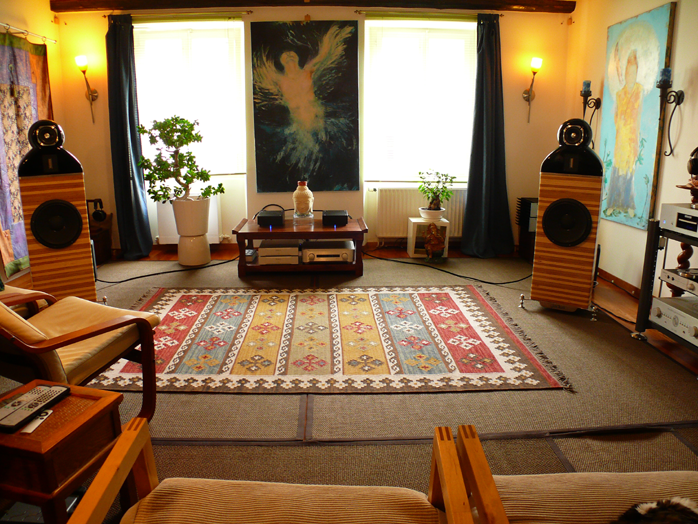 |
The high damping factor can work wonders as it did for the deliberately low Qms tuning of the Rhapsody 200's ported bass. On a rarer sealed and already well-damped alignment like the Gladius, the same ultra-low output impedance ended up with a bit less bass amplitude to be missed.
The final upshot of the Ncore 1200 performance is really supremely basic. The more neutral an amp, the more music gets through unfiltered. True, sub-par or simply ill-matched ancillaries and poor recording quality will be raw and their failings twice exposed. Yet the same transparency also makes for rather more spectacular results when the system works as it should—as a proper system—and when the music played is quality worthy stuff.
|
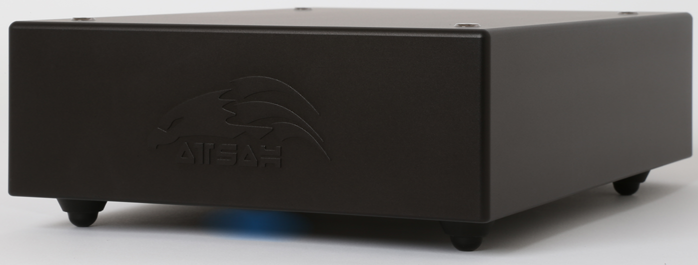 |
Resolution from vanishingly low self noise implies that any upstream bottle neck qualifies and limits what the Atsah can ultimately do. To recognize their true potential requires components of equal resolution. Here less should be more. This returns us to DAC-direct balanced drive which ought to guarantee matching S/N figures. Anything more complex is likely to step down lucidity and suchness. Whether you prefer that isn't the point. The point is that you should first hear the Atsah unvarnished to have that decision. If you conclude that less is indeed more, the hunt could be on for a superior fully balanced DAC with analog-domain remote volume. Due to the amps' high gain and power, chances are you'll be listening deep inside source attenuation. That makes digital volume undesirable.
|
|
|
Wrap. Can class D really compete directly against class A now? "Minus the last degrees of treble sophistication" is my affirmative but incomplete answer. Other areas like watts-per-coin ratio, noise floor and raw resolution would seem to exceed what class A can deliver in combination. The one area where some class A might still hold the trump card would then rather pale against the other areas where it doesn't. No matter where in this equation you come down, as a matter of competition—running the same race—the only possible answer is a loud firm yes it can. For now the Ncore 1200 solution with matching SMPS isn't simply best of breed I've heard. It's the only truly high-power amp of any persuasion I'd personally aspire to. That's because nothing not class D can possibly offer this combination of qualities. And in class D Ncore is the best I've yet heard.
|

|
Since a personal pair of white AudioSolutions Rhapsody 200 speakers is already ordered as my Xmas gift this year—with the Atsah those simply made stupid good sound—a pair of Ncore monos will likely have to be in my future. After all, nothing else I own or had on loan worked quite the same magic on those speakers. But I hate black hifi. Seeing that Bruno's own Mola-Mola version comes in my preferred silver, I'll probably have to go Dutch all the way. That website's ongoing limbo condition simply has me wonder whether those amps are actually available yet.
|
|
Final thoughts. Let's not mince words. Going this route is costly. At nearly half the price AURALiC's Merak monos are close and far better value. It's when close gets you no cigar that the Atsah monos press your hand with the strongest sweatiest conviction. The future will tell in how many guises and micro flavors the Ncore circuitry might become available. If you have no issue with Acoustic Imagery sticking another man's circuit and power supply as is in a fancy and expensive casing—sonically you really shouldn't—the Atsah twins get my very highest recommendation. If you now wonder why no award, it's because I'd really like to reserve that for the man who actually designed and built this circuit with its matching PSU. Call it old-fashioned but a bit of engineering contribution other than a pretty packaging job would seem an essential prerequisite for an award particularly with amps as expensive as these ... |
|
 |
 |
|
 |